
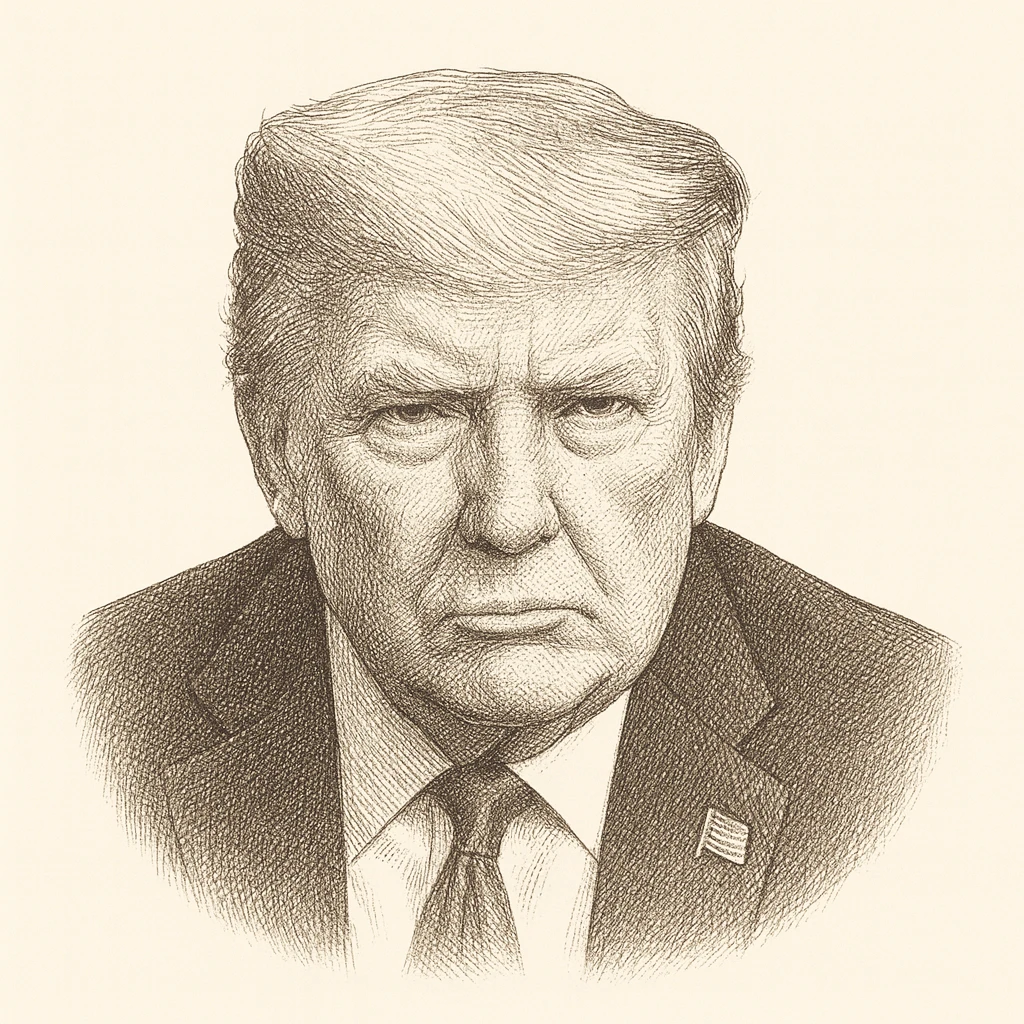
Donald Trump is an American businessman and reality-television personality who entered electoral politics as an outsider and won the presidency in 2016, lost it in 2020, and returned to win in 2024. His political significance lies less in a formal ideology than in the durable movement he crystallized around the slogan "America First": a fusion of economic nationalism, restrictionist immigration policy, skepticism of multilateral trade and alliances, and a combative posture toward established elites, media, and administrative institutions he framed as a corrupt "deep state" or swamp.
Trump's political thought draws on longstanding but previously marginal currents in American life—protectionism, non-interventionist "America First" foreign policy, and a nationalism that defines the political community in terms of the ordinary, often working-class citizen against cosmopolitan and bureaucratic elites. He argued that trade agreements and open borders had hollowed out domestic industry and betrayed American workers, and he made tariffs, immigration enforcement, and renegotiated deals signature causes. Rhetorically, he governs through direct, unmediated appeal to a mass base, treating loyalty and grievance as organizing principles and casting himself as the singular champion of a forgotten majority.
His influence has been to realign the Republican Party away from its post–Cold War fusion of free trade, interventionism, and market orthodoxy toward a more nationalist, populist, and protectionist stance, while inspiring kindred movements across Europe and beyond. Ideas once confined to the political fringe—economic patriotism, hostility to globalization, and distrust of expert-led governance—moved to the center of one of America's two major parties.
Trump's record is deeply and seriously contested, though its core facts are a matter of documented record. He lost the 2020 election to Joe Biden and refused to concede, promoting false claims of fraud; on January 6, 2021, his supporters attacked the U.S. Capitol in an effort to stop certification of the result. He was twice impeached, and in May 2024 a New York jury convicted him on 34 felony counts of falsifying business records—the first U.S. president convicted of a felony (he was sentenced to an unconditional discharge in January 2025). What remains contested is the verdict on that record: critics across the political spectrum argue that it, together with his attacks on courts, the press, and civil servants, represents a threat to democratic norms and constitutional order, while supporters counter that he exposed a genuinely unresponsive establishment and gave voice to voters it had ignored. Whatever the verdict, he stands as the defining national-populist figure of his era.
Donald Trump is associated with National Populist. See the archetype