
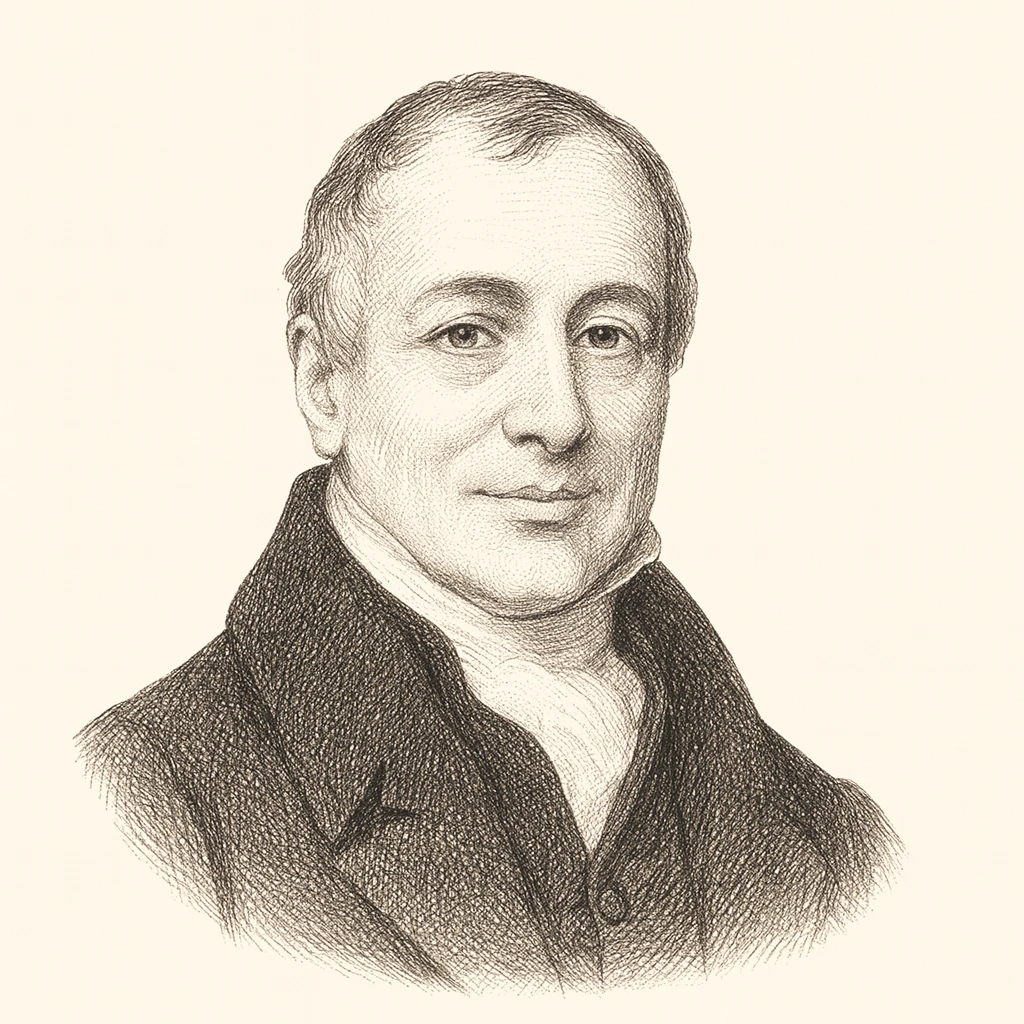
David Ricardo was one of the founding figures of classical political economy, ranking alongside Adam Smith as a shaper of how liberal societies think about markets, trade, and the distribution of wealth. A successful stockbroker who amassed a fortune before turning to economic theory, Ricardo brought an unusually rigorous, deductive method to the field, building abstract models from stated premises. His major work, On the Principles of Political Economy and Taxation, set out a systematic account of value, rent, wages, and profits that dominated economic argument for much of the nineteenth century.
His most enduring contribution to political thought is the theory of comparative advantage, which holds that nations gain from specializing in what they produce relatively most efficiently and trading for the rest, even when one country is more productive at everything. This argument provided the decisive intellectual case for free trade and against protectionism, and it fed directly into the campaign against Britain's Corn Laws, the tariffs protecting domestic grain producers. For classical liberals, Ricardo supplied the analytical proof that open markets could enrich all parties, transforming free trade from a policy preference into a demonstrable principle.
Ricardo also advanced influential and contested ideas beyond trade. His theory of rent, his "iron" tendency of wages toward subsistence, and his analysis of the conflicting interests of landlords, capitalists, and workers gave later thinkers—both liberal and socialist—tools they would use in very different directions. His labor theory of value, in particular, was later taken up and reworked by Karl Marx, so that Ricardo stands at a genuine fork in the road of political economy. He served briefly in the House of Commons, where he argued for free trade, sound money, and reform, applying his theories to practical questions of the day.
Though his abstract, model-driven approach drew criticism for detachment from real conditions, Ricardo's method and conclusions defined economic orthodoxy for generations. The disciplined case for trade, the insistence on mutual gains from exchange, and the analysis of how income is distributed among social classes all trace back to his work, making him a central pillar of the classical-liberal economic tradition.
David Ricardo is associated with Classical Liberal. See the archetype