
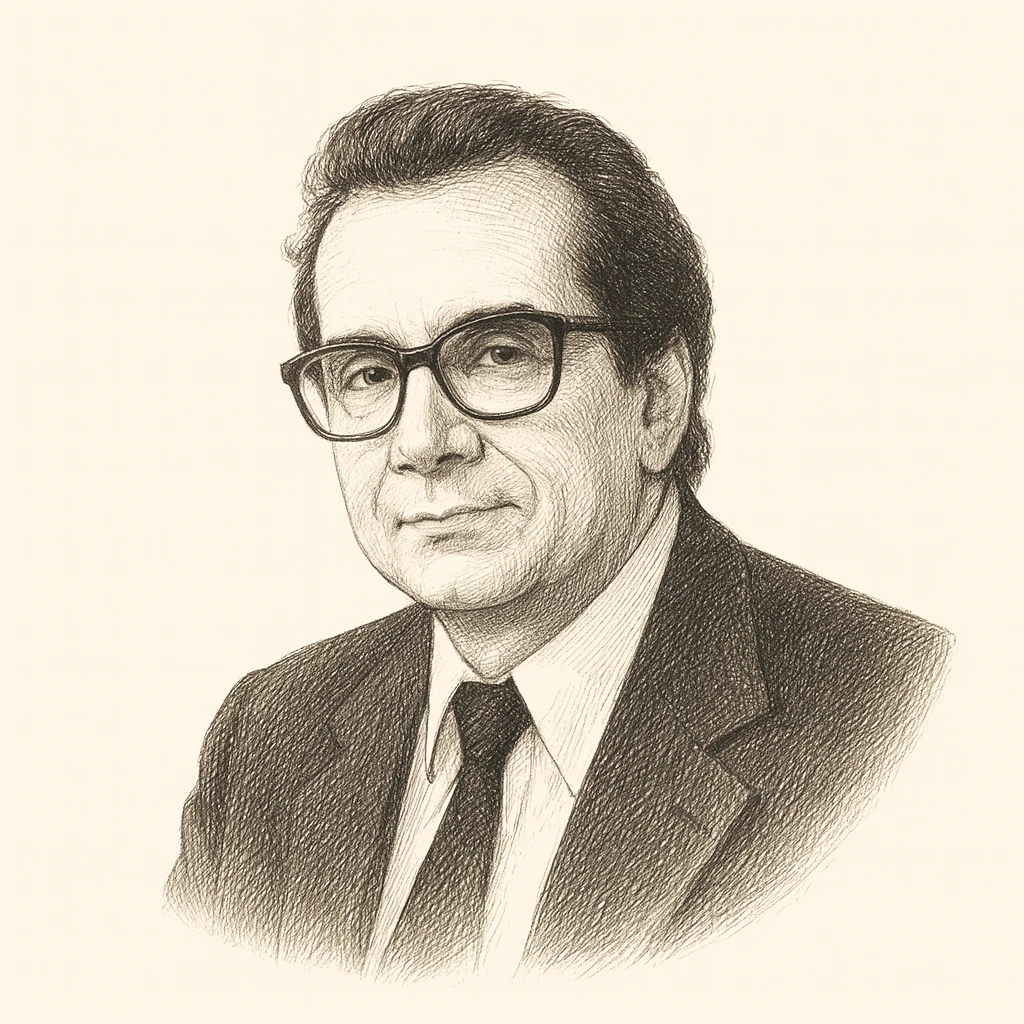
Charles Krauthammer (1950–2018) was an American columnist, commentator, and essayist who became one of the most influential conservative voices in the United States over roughly three decades. Trained as a physician and psychiatrist, he entered public life first through speechwriting and journalism, initially associated with liberal and Democratic circles before moving rightward over the 1980s. He won the Pulitzer Prize for Commentary, and his syndicated column, widely carried in major newspapers, alongside his regular television appearances, made him a fixture of mainstream political debate. A diving accident during his medical training left him paralyzed, and he wrote and worked from a wheelchair for the rest of his life.
Krauthammer is most closely identified with the intellectual current of neoconservatism, particularly its foreign-policy dimension. He argued that after the Cold War the United States occupied a position of singular preeminence, and he was an early and forceful proponent of the idea that America should use that power assertively rather than retreat into restraint or multilateral constraint. He is commonly credited with popularizing the notion of a post–Cold War "unipolar moment," contending that American strength was both a fact and a responsibility. This outlook made him a prominent public defender of a muscular, values-laden American internationalism, and a supporter of interventionist policies in the Middle East.
His political thought combined a hawkish view of national security with a broadly conservative stance on domestic questions, though he was known for independence from partisan orthodoxy and for changing his mind on specific issues over time. He wrote often about the relationship between morality and power, the burdens of leadership, and what he saw as the dangers of decline and self-doubt in American foreign policy. His style—analytical, argumentative, and drawing on his background in medicine and philosophy—was influential in shaping how a generation of conservatives articulated arguments about statecraft.
A collection of his essays and columns, published near the end of his life, became a bestseller and consolidated his reputation as a synthesizer of conservative ideas for a broad audience. Beyond specific policy positions, his lasting influence lies in helping frame debates about America's role in the world after 1991, and in modeling a form of intellectually serious opinion journalism that treated political commentary as a vehicle for sustained argument.
Charles Krauthammer is associated with Moderate Conservative. See the archetype