
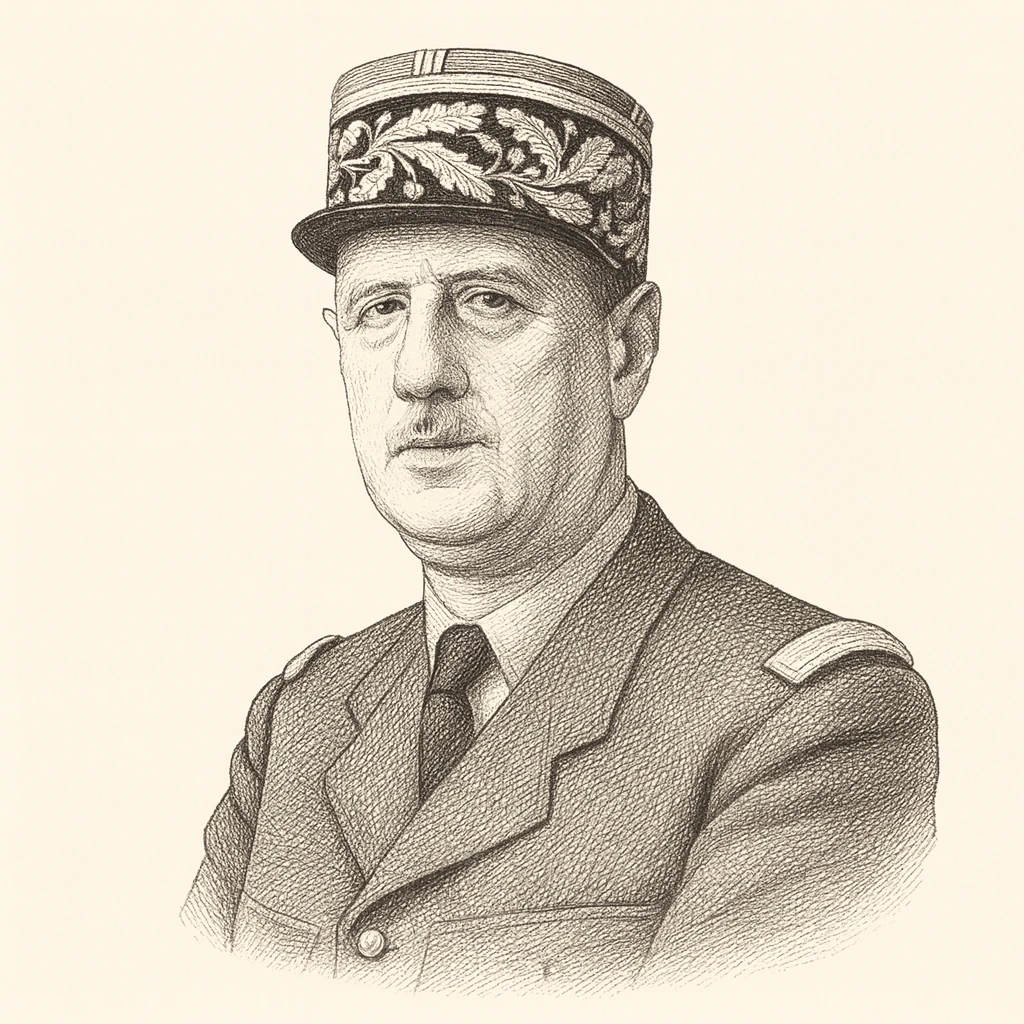
Charles de Gaulle led the Free French in World War II, founded the Fifth Republic, and made French grandeur the organizing theme of his politics. A professional soldier who rejected France's 1940 surrender, de Gaulle broadcast from London on 18 June 1940 calling on the French to continue the fight; the poster that followed declared, 'France has lost a battle, but France has not lost the war.' From exile he built a movement claiming to embody the legitimate France against the Vichy regime, insisting that national sovereignty could not be surrendered even in defeat.
De Gaulle led Free France throughout the war and headed the provisional government after liberation. Disgusted by Fourth Republic instability, which he blamed on a fragmented parliamentary system that produced weak, short-lived governments, he returned to power in 1958 during the Algerian crisis, creating the Fifth Republic with its strong presidency. His constitutional vision placed executive authority above the shifting coalitions of the National Assembly, and in 1962 he secured direct popular election of the president, tying legitimacy to the nation rather than to parties. He granted Algeria independence, developed French nuclear weapons, and withdrew from NATO's military command to assert French independence.
De Gaulle's nationalism was neither left nor right—he combined dirigiste economics with conservative social values, independence from Washington with anticommunism. He championed an active state directing industrial modernization and national planning while resisting both Marxist collectivism and unfettered liberalism. He wrote that 'France cannot be France without grandeur.' His foreign policy sought an independent France standing apart from the American-led Western bloc without joining the Soviet one, with an autonomous nuclear deterrent as the guarantee of sovereignty.
His vision of Europe was a Europe of nations, not supranational integration; he resisted ceding sovereignty to European Community institutions and twice blocked British entry into the Common Market. His use of referendums and his personal authority over government drew organized opposition: François Mitterrand's 1964 polemic Le Coup d'État permanent attacked the Fifth Republic's presidency as a concentration of power in one man. After the student protests, general strike, and economic disruption of May 1968, he resigned in 1969 when voters rejected a referendum he had staked his office upon.
Every president of the Fifth Republic since has governed within the institutions he designed, and his influence is visible in each of them. Gaullism outlived him as a strand of French politics, uniting a strong state, national independence, and a rejection of ideological blocs.
Charles de Gaulle is associated with National Conservative. See the archetype