
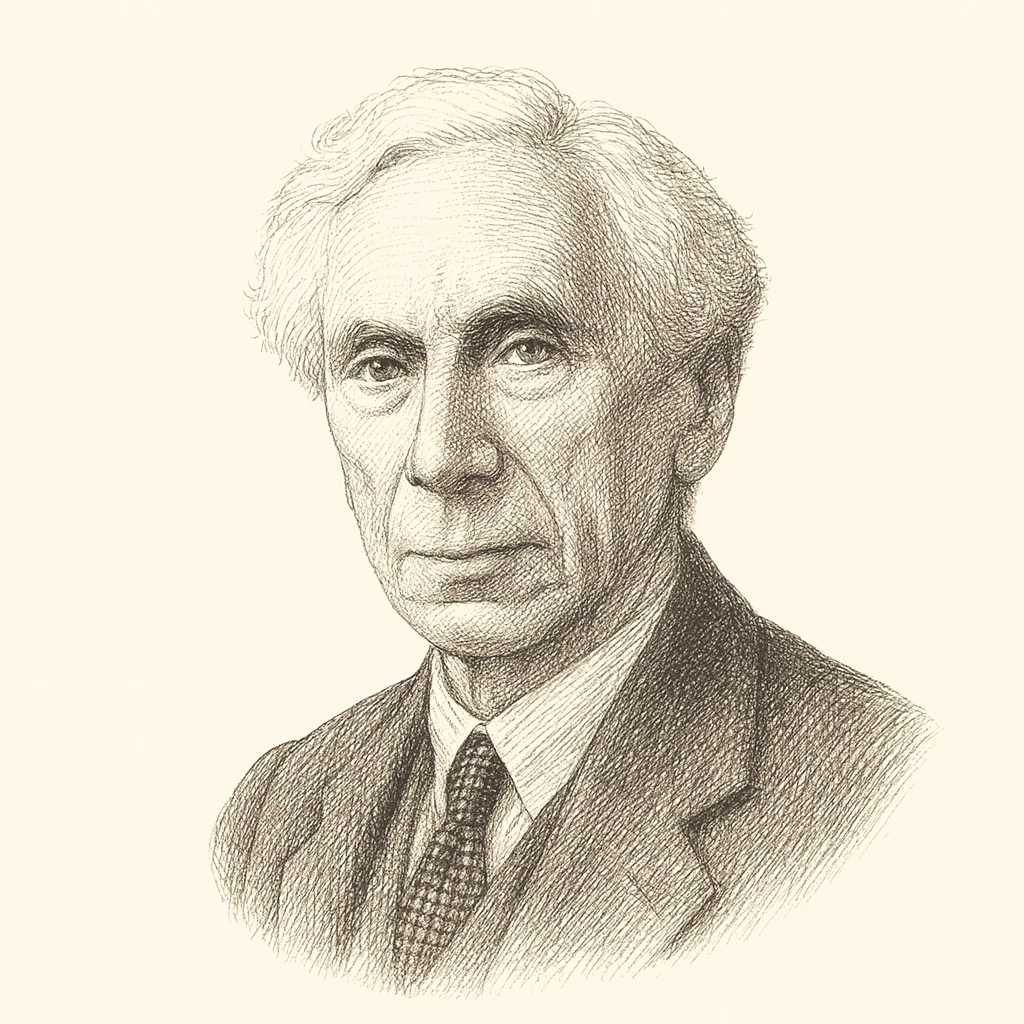
Bertrand Arthur William Russell was born in 1872 in Trellech, Monmouthshire, the grandson of Lord John Russell, twice Prime Minister of Britain during the mid-Victorian period, and the son of Viscount and Viscountess Amberley — freethinking liberals who numbered John Stuart Mill among their close friends and who appointed Mill as Russell's godfather. Both his parents died when he was very young: his mother and his sister when he was two, his father when he was three, and he was raised by his grandparents at Pembroke Lodge in Richmond Park. His grandmother, the Countess Russell, was a woman of strong Scottish Presbyterian character who shaped his moral seriousness even as he eventually rejected her theology. He grew up largely alone, reading everything in the family library, without playmates his own age, in circumstances that gave him a remarkable self-sufficiency and a slightly alien quality in social settings that persisted throughout his life.
He entered Trinity College, Cambridge, in 1890, studying mathematics and then philosophy, and encountered the circle of intellectuals that would remain the most important of his life: Alfred North Whitehead, who would become his collaborator; G.E. Moore, whose philosophical method shaped his own; and, a decade later, the young Ludwig Wittgenstein, whose arrival in Cambridge in 1911 was the most consequential intellectual encounter of Russell's career, and whose subsequent development took philosophy in directions that Russell found mostly incomprehensible. His fellowship dissertation on the foundations of geometry was accepted in 1895, he was elected a Fellow of Trinity, and he began the work that would produce Principia Mathematica.
The Principles of Mathematics (1903) and then Principia Mathematica (1910-13), co-authored with Whitehead over ten years of extraordinarily demanding collaboration, were the attempt to derive all of mathematics from purely logical foundations — to show that mathematical truth was a form of logical truth and that the apparent autonomy of mathematical axioms was an illusion. The project was only partially successful even on its own terms — Gödel's incompleteness theorems of 1931 demonstrated that no formal system powerful enough to derive arithmetic could be both consistent and complete — but as an intellectual achievement it was extraordinary, and it established Russell's reputation as one of the leading minds of the century.
His political life began seriously during the First World War. He opposed the war from the beginning, published anti-war pamphlets, and was imprisoned in 1918 for six months for a newspaper article judged to impede recruitment. He spent the prison months writing Introduction to Mathematical Philosophy and reading widely in non-academic subjects, emerging with a book and a deepened political commitment. His visit to Soviet Russia in 1920 produced The Practice and Theory of Bolshevism — one of the earliest and most prescient critiques of the Soviet system, written after direct observation, arguing that the Bolsheviks were building not a workers' state but a new form of authoritarian power that would be worse than what it replaced. This was not a comfortable position in 1920, and he maintained it without apology.
The middle decades of his life were marked by the prolific output of a public intellectual at full power: Education and the Good Life (1926), Marriage and Morals (1929), The Conquest of Happiness (1930), Freedom and Organization (1934), Power (1938) — a stream of books that engaged education, sex, politics, economics, and the social conditions of human flourishing with the combination of philosophical rigor and accessible style that was his distinctive gift. He was appointed to a lectureship at City College of New York in 1940 and immediately had the appointment revoked by a New York court ruling that found his views on sex and marriage unfit for a public institution — a ruling that provoked a famous defense of academic freedom and that he took with remarkable equanimity, having been accused of worse things by more formidable opponents.
A History of Western Philosophy (1945) was his most commercially successful book, a narrative history of philosophy from the pre-Socratics to the logical positivists that combined genuine philosophical analysis with narrative skill and occasional devastating wit. It generated enough royalties to secure his financial independence and is still in print, which says something both about its accessibility and about the peculiar cultural endurance of books that explain everything.
The nuclear age transformed his political priorities. He had opposed the First World War, reluctantly supported the Second as a lesser evil against fascism, and then watched the dropping of the atomic bombs on Hiroshima and Nagasaki with a horror that organized the rest of his life. He co-authored the Russell-Einstein Manifesto in 1955, calling on scientists to assemble to discuss the threat posed by weapons of mass destruction, which led to the Pugwash Conferences on Science and World Affairs. He founded the Bertrand Russell Peace Foundation, organized sit-down demonstrations in Whitehall, was arrested again at ninety years of age, and conducted a vigorous correspondence with both Kennedy and Khrushchev during the Cuban Missile Crisis — convinced that his personal intervention might help prevent nuclear catastrophe and not entirely wrong about this. He died in 1970 at ninety-seven, still writing, still arguing, still organizing against the weapons that he regarded as the supreme threat to human survival.
Bertrand Russell is associated with Civil Libertarian. See the archetype