
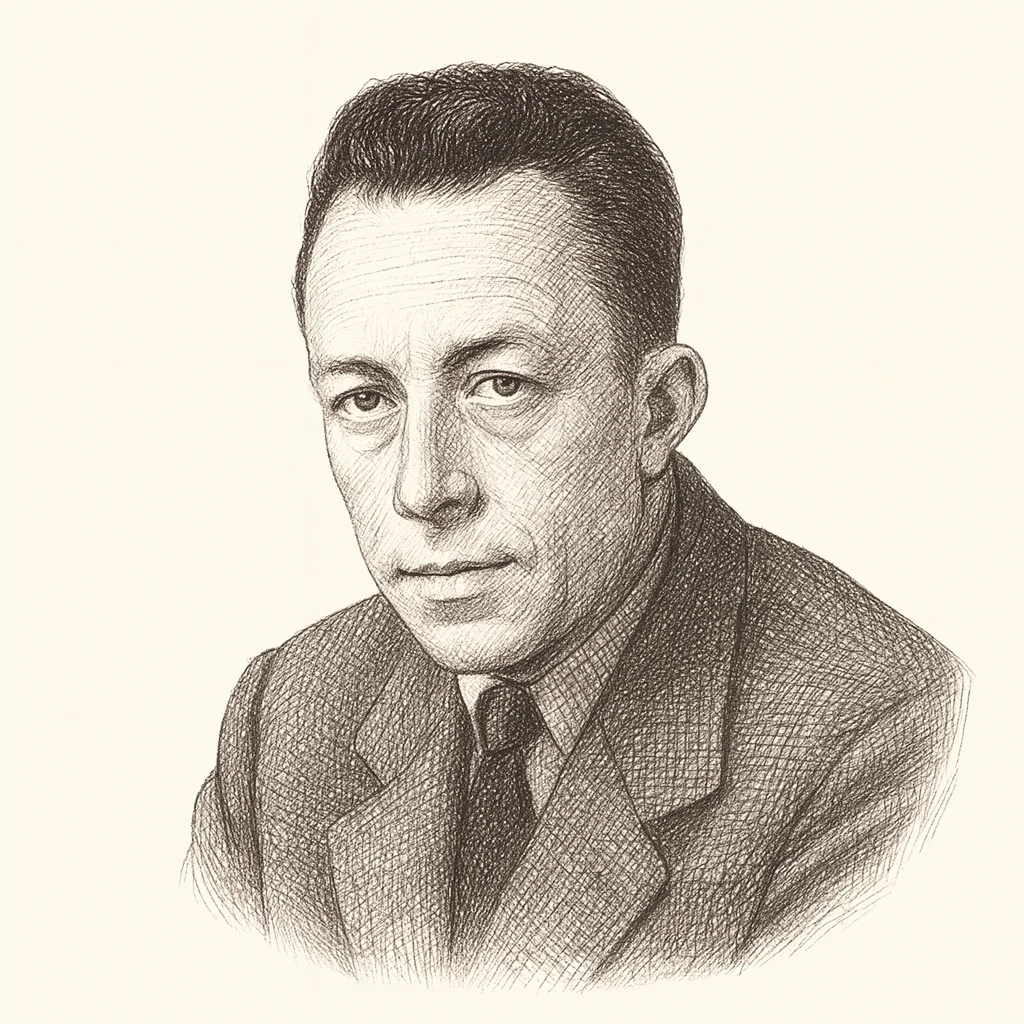
Albert Camus was born in 1913 in Mondovi, a small farming village in eastern Algeria, the second son of a farm laborer who was killed at the Battle of the Marne before Camus had reached his first birthday. His mother Catherine, who was partially deaf and nearly illiterate, moved the family to the working-class neighborhood of Belcourt in Algiers, where she worked as a cleaning woman and they lived in a two-room apartment without electricity or running water. Camus grew up in conditions of genuine poverty in a city that was simultaneously French and Algerian, European and North African — a layered colonial world that gave him an understanding of cultural mixture and political complexity that the metropolitan French intellectuals he would later engage never quite grasped. He later said that his mother taught him, without words, everything he knew about the world: her silence, her stoicism, her absolute lack of self-pity in the face of difficulty gave him the standards against which he measured everything he subsequently read and thought.
He attended the primary school in Belcourt where he was identified as exceptional by his teacher Louis Germain, who tutored him outside school hours and argued successfully for a scholarship that allowed him to continue his education at the Lycée d'Alger. Germain's intervention was decisive — without it, Camus would almost certainly have left school at the end of primary education and entered the working-class labor market. Camus dedicated the Nobel Prize speech of 1957 to Germain, and the letter he wrote him on receiving the prize is one of the most moving documents in his published correspondence. At the lycée he was an outstanding student in philosophy and literature, played goalkeeper for the Racing Universitaire d'Alger football club with genuine skill, and was diagnosed with tuberculosis at seventeen — a disease that would recur throughout his life, that disqualified him from military service, and that gave him a persistent visceral awareness of physical fragility and the proximity of death that marked his writing.
He studied philosophy at the University of Algiers, wrote his thesis on the relationship between Hellenism and Christianity in Plotinus and Augustine, and then spent years working as a journalist, theater director, and essayist while writing the early fiction and philosophical essays that would eventually make him famous. The Algiers years were years of genuine intellectual formation: he read voraciously, worked with the Théâtre de l'Équipe producing experimental theater for working-class audiences, and developed through practice the conviction that literature and political engagement were not separate vocations but expressions of the same fundamental commitment to honesty about the human condition. He joined the Communist Party briefly in the mid-1930s and left it after two years, too independent and too skeptical of party discipline to maintain the kind of doctrinal loyalty the Party required.
The German occupation of France, which began in June 1940, was the experience that completed his political formation. He had moved to metropolitan France in 1940, working for Paris-Soir, and found himself in an occupied city where the choices available to ordinary people were collaboration, resistance, or the gray zone of accommodation. He joined the Resistance in 1943, writing for and eventually editing the underground newspaper Combat — clandestine journalism that was, in the most literal sense, life-threatening work. The discipline of writing for Combat under occupation conditions — the obligation to produce accurate, clear, morally serious journalism under conditions of extreme danger and without the safety net of unverifiable claims — shaped his prose style and deepened his conviction that language was a moral instrument, that its corruption was not merely aesthetic but ethical.
The Myth of Sisyphus (1942) and The Stranger (1942) appeared during the occupation and were received as the founding texts of a new philosophical and literary sensibility. The Myth of Sisyphus was his philosophical statement of the absurdist position: the fundamental tension between the human demand for meaning and the universe's absolute silence in response. His conclusion was not despair but what he called revolt — the Sisyphean insistence on living fully in the face of meaninglessness, "one must imagine Sisyphus happy." The Plague (1947), his most widely read novel, was read immediately as an allegory of the occupation — the city of Oran besieged by epidemic as France had been besieged by the Germans — but was also a meditation on solidarity, endurance, and the refusal to abandon the immediate human obligations that catastrophe tends to overwhelm.
The Rebel (1951) was the book that destroyed his friendship with Sartre and changed his relationship to the Parisian left permanently. Its argument was that modern revolutionary violence was not an unfortunate excess but a logical consequence of the metaphysical rebellion that had run through Western thought since the Enlightenment — the refusal of any limits on human self-determination, including the limit represented by the lives of other people. Every ideology that justified present murder in the name of future liberation was committing the same logical error: sacrificing actual human beings to an abstract principle. The only honest political position was one that acknowledged moral limits — a politics of reform rather than revolution, of the achievable relative good rather than the absolute good that licensed any means.
Sartre's response, delivered through Les Temps Modernes, was that Camus was prioritizing his own moral comfort over the actual political needs of the Algerian and Third World poor who needed revolution rather than liberal scruples. The exchange crystallized something real about the difference between them: Camus had spent his childhood poor in Algeria and understood the human cost of political violence at the visceral level that childhood poverty and wartime resistance provide; Sartre had not, and his willingness to endorse political violence in the abstract reflected a comfort with the abstract that his Paris intellectual formation had enabled.
The last decade of Camus's life was marked by increasing isolation from the Parisian intellectual mainstream. The Nobel Prize in 1957 — awarded when he was forty-four, among the youngest recipients in the award's history — both honored him and confirmed his marginality from the ideological commitments that the French left regarded as obligatory. The Algerian war was the wound he could not address publicly without losing everyone: he was too attached to the French Algeria of his childhood to endorse independence simply, and too honest about colonial injustice to defend the status quo. He died in a car accident in January 1960, at forty-six, en route to Paris from his home in Lourmarin. Albert Camus — the writer, his wife, his publisher Michel Gallimard — were killed when the car driven by Gallimard hit a tree on a straight, dry road at high speed for no explicable reason. In Camus's coat pocket was an unused train ticket. He had changed his plans at the last moment.
Albert Camus is associated with Independent Localist. See the archetype