
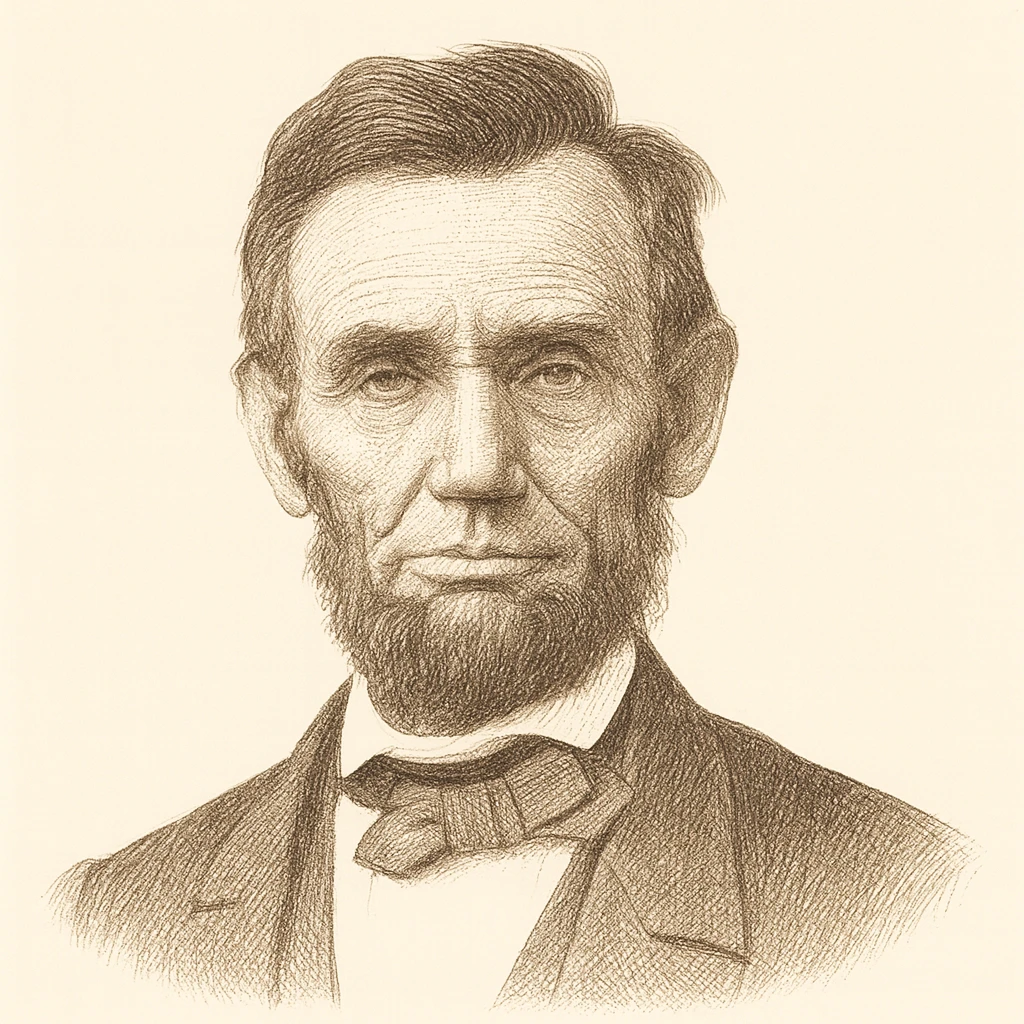
Abraham Lincoln was born in 1809 in a log cabin in Hardin County, Kentucky, the son of Thomas Lincoln, an illiterate subsistence farmer who moved the family to Indiana when Abraham was seven, and Nancy Hanks Lincoln, who died of milk sickness when he was nine. He grew up in the hardscrabble poverty of the frontier, doing farm labor, absorbing what education he could from borrowed books, and developing the habits of self-teaching that would make him one of the most consequential intellectual figures in American history. His formal schooling amounted to less than a year in total; everything else he knew — law, rhetoric, history, Euclid, the King James Bible — he taught himself.
The self-education was serious in ways that distinguish it from mere self-improvement. He read Euclid's Elements in his thirties, reportedly until he could prove every proposition, not because he needed geometry for anything practical but because he wanted to understand what genuine demonstration meant — what it took to prove something rather than merely assert it. This epistemological seriousness pervaded everything he subsequently argued about politics: his speeches were built on distinctions, on definitions, on the patient tracing of implications from premises. He was not an orator in the style of Daniel Webster or Stephen Douglas, who impressed audiences with their vocal magnificence. He was a logician in political clothing, and his arguments were designed to convince rather than to inspire, though at their best they did both.
He studied law on his own, was admitted to the Illinois bar in 1836, and established a successful practice in Springfield, developing the combination of genuine legal intelligence with the capacity to explain complex matters to ordinary juries that made him one of the most effective trial lawyers in Illinois. He entered politics through the Whig Party, served four terms in the Illinois legislature, and served a single term in Congress (1847-49) before returning to private practice. His opposition to the Mexican War — he challenged Polk's account of where the first blood had been shed with the "spot resolutions" — prefigured both the moral seriousness and the political risk-taking of his subsequent career.
The Kansas-Nebraska Act of 1854, which overturned the Missouri Compromise and reopened the question of slavery's extension, brought him back to active politics and produced the arguments that made him a national figure. His Peoria speech of October 1854 was the first extended statement of the constitutional and moral philosophy that organized his subsequent career, and it remains one of the most searching analyses of the relationship between the founding principles of the republic and the institution of slavery ever produced. The argument was not primarily that slavery was wrong in some general humanitarian sense — though he thought it was — but that it violated the specific principles on which American self-government rested. The Declaration of Independence had asserted that all men were created equal and that government derived its just powers from the consent of the governed. A slave had not consented to be governed; slavery therefore contradicted the premise on which the entire American constitutional project depended, and its extension was not a neutral question about popular sovereignty but a moral and constitutional crisis.
The Lincoln-Douglas debates of 1858 were the fullest public working-out of these arguments, and they remain the most intellectually serious public debates in American political history. Douglas's popular sovereignty position — that the people of each territory should decide the question of slavery for themselves — seemed democratic on its face, and Lincoln had to argue that there were questions on which popular sovereignty was not the appropriate decision procedure: that a majority could not vote to deprive a minority of natural rights without destroying the premise that made majority rule legitimate in the first place. You could not invoke consent as the basis of self-government while denying it to an entire class of people. The attempt to do so produced not stable popular sovereignty but the slow corruption of the democratic principle itself.
The Second Inaugural Address (1865), delivered with the war nearly won and the assassination weeks away, is the most philosophically profound speech in the American political tradition. Its argument about the meaning of the war — that God had given "to both North and South this terrible war, as the woe due to those by whom the offense came" — was not the triumphalism of a victorious general but the theological realism of someone who had watched 620,000 people die and had thought hard about what that death meant. Both sides had prayed to the same God; both sides' prayers had not been answered. Divine providence was not the instrument of either side's project. The nation that had sustained slavery for two and a half centuries was paying a price that its own best founding principles had required, and the appropriate response was not victory celebration but "malice toward none, charity for all." It was a speech that asked the victorious side to understand themselves as implicated in the crime they had just spent four years fighting.
He was assassinated at Ford's Theatre on April 14, 1865, shot by John Wilkes Booth five days after Lee's surrender at Appomattox. He was fifty-six. The Reconstruction that followed was conducted without him, and its failures confirmed the scale of what had been lost.
Abraham Lincoln is associated with Rooted Progressive. See the archetype