
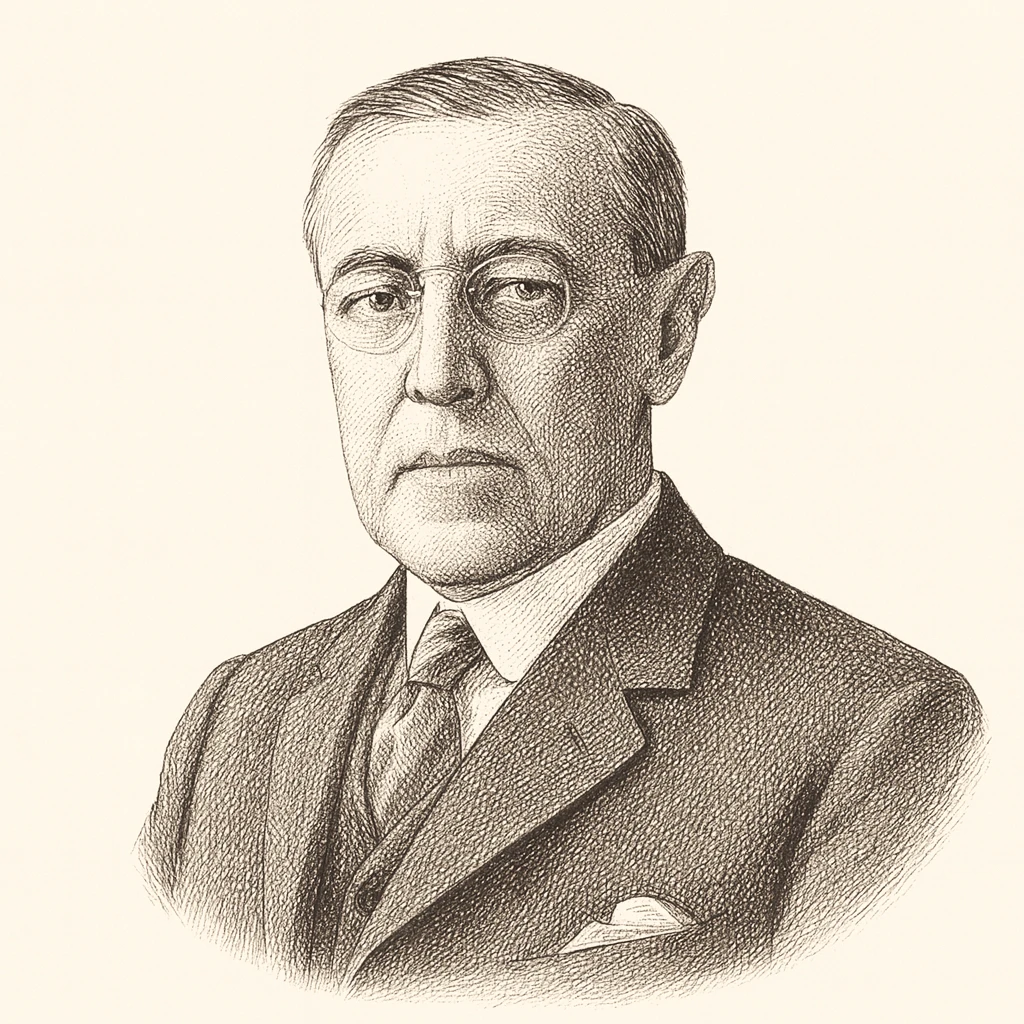
Woodrow Wilson was the 28th President, a progressive reformer at home and idealistic internationalist abroad whose vision of a new world order shaped the 20th century. A political science professor and Princeton president before entering politics, and the only president to hold a doctorate, Wilson came to the presidency with a scholar's theory of government. As a scholar he had argued that the American constitutional separation of powers produced weak, fragmented government, admiring the accountability of parliamentary systems, and he helped establish the study of public administration as a distinct field—holding that a professional, expert bureaucracy could execute policy efficiently and above partisan politics. As president he acted on these convictions, treating the office as a national leader who could speak directly to the people and drive a legislative program.
Wilson's domestic progressivism, campaigned for as the 'New Freedom,' created the Federal Reserve and the Federal Trade Commission and, after the Sixteenth Amendment's ratification in 1913, a graduated federal income tax, while establishing the eight-hour workday for railroad workers—a program aimed less at accommodating big business than at restoring competition and curbing concentrated economic power. His administration also extended racial segregation across federal departments, and when the Black editor William Monroe Trotter protested it at the White House in 1914, Wilson defended the policy.
He was reelected in 1916 on the slogan 'He Kept Us Out of War,' then led America into World War I, telling Congress that 'the world must be made safe for democracy.' Wartime mobilization brought sweeping restrictions on dissent through the Espionage and Sedition Acts, under which critics of the war were prosecuted; the Socialist leader Eugene V. Debs was sentenced to ten years in prison.
Wilson's Fourteen Points proposed a new international order based on self-determination, open diplomacy, and collective security through the League of Nations—a repudiation of the secret treaties and balance-of-power diplomacy he blamed for the war. Yet the Senate, where Republicans led by Henry Cabot Lodge objected to surrendering sovereignty to collective commitments, rejected the League, his health collapsed from a stroke, and his vision of international cooperation remained unrealized until after World War II. Wilson's internationalism and its defeat set the poles of American foreign policy debate ever since, giving 'Wilsonianism' its name: the aim of remaking the world in liberal-democratic terms, against which realists such as George Kennan and Hans Morgenthau defined their own position.
Woodrow Wilson is associated with Establishment Progressive. See the archetype