
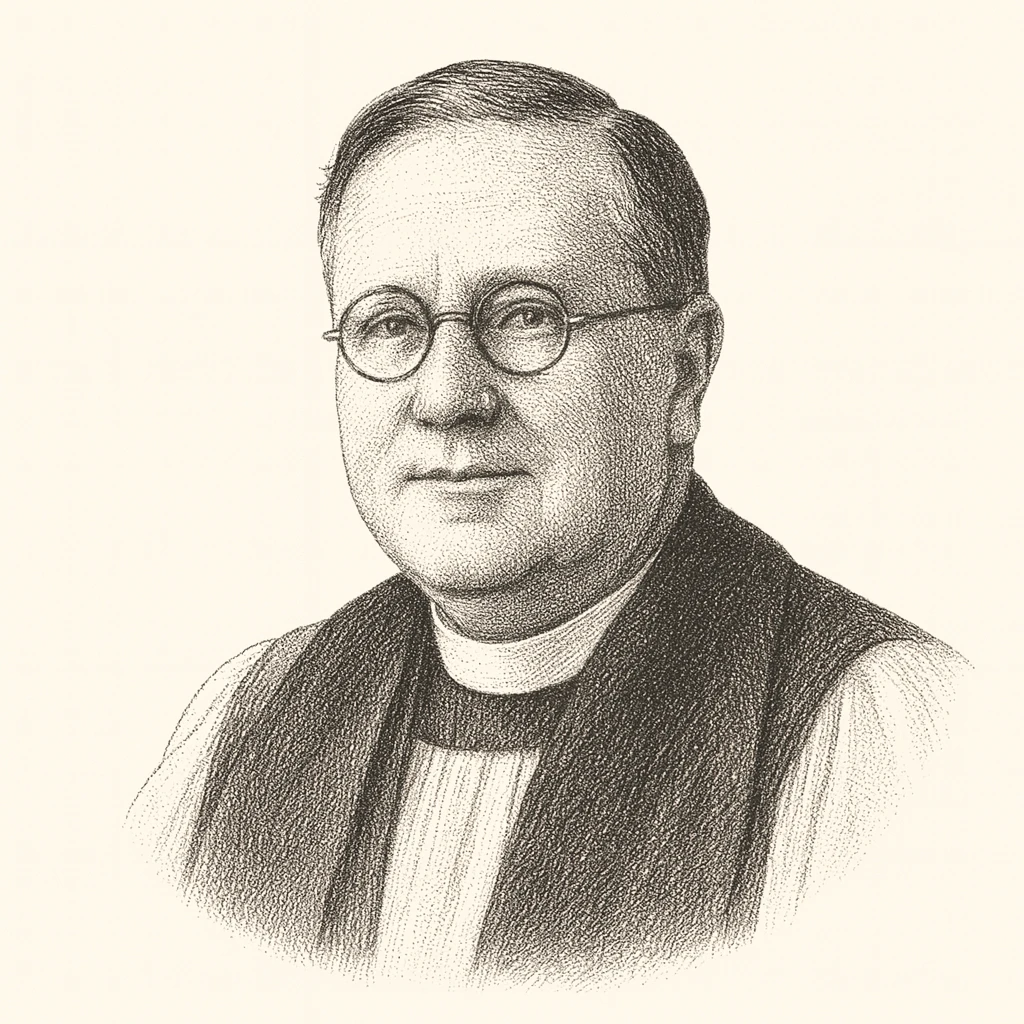
William Temple held the see of Canterbury for barely thirty months, from 1942 until his death in 1944, and used them to put Christian social ethics at the center of British public life. The son of Frederick Temple, he remains the only man to have followed his father as Archbishop of Canterbury. Educated at Rugby and Balliol College, Oxford, he served as president of the Workers' Educational Association from 1908 to 1924 and joined the Labour Party in 1918 while a priest of the Church of England — a combination that scandalized some and announced his settled conviction that faith carried economic obligations.
Christianity and Social Order (1942), a Penguin paperback that sold well over a hundred thousand copies, argued that the church has both the right and the duty to 'interfere' in economic questions, then appended Temple's own program: decent housing, family allowances, an education worth the name, a real voice for labor. He had already set the 'welfare state' against the 'power state' in Citizen and Churchman (1941), the usage credited with moving the term into general circulation. The Beveridge Report appeared months after his Penguin; the moral ground had been prepared from the pulpit.
Temple's method was deliberate: the church proclaims principles (the dignity of every person as a child of God, fellowship, service) and offers 'middle axioms' between principle and policy, leaving technical detail to the laity who know the terrain. He convened the Malvern Conference in 1941, had chaired the sprawling COPEC conference on Christian politics and economics in 1924, and his ecumenical work laid foundations for the World Council of Churches, founded four years after his death. He liked to say that the church is the only society that exists for the benefit of those who are not its members. He died in office in October 1944, mourned across party and class lines.
William Temple is associated with Christian Socialist. See the archetype