
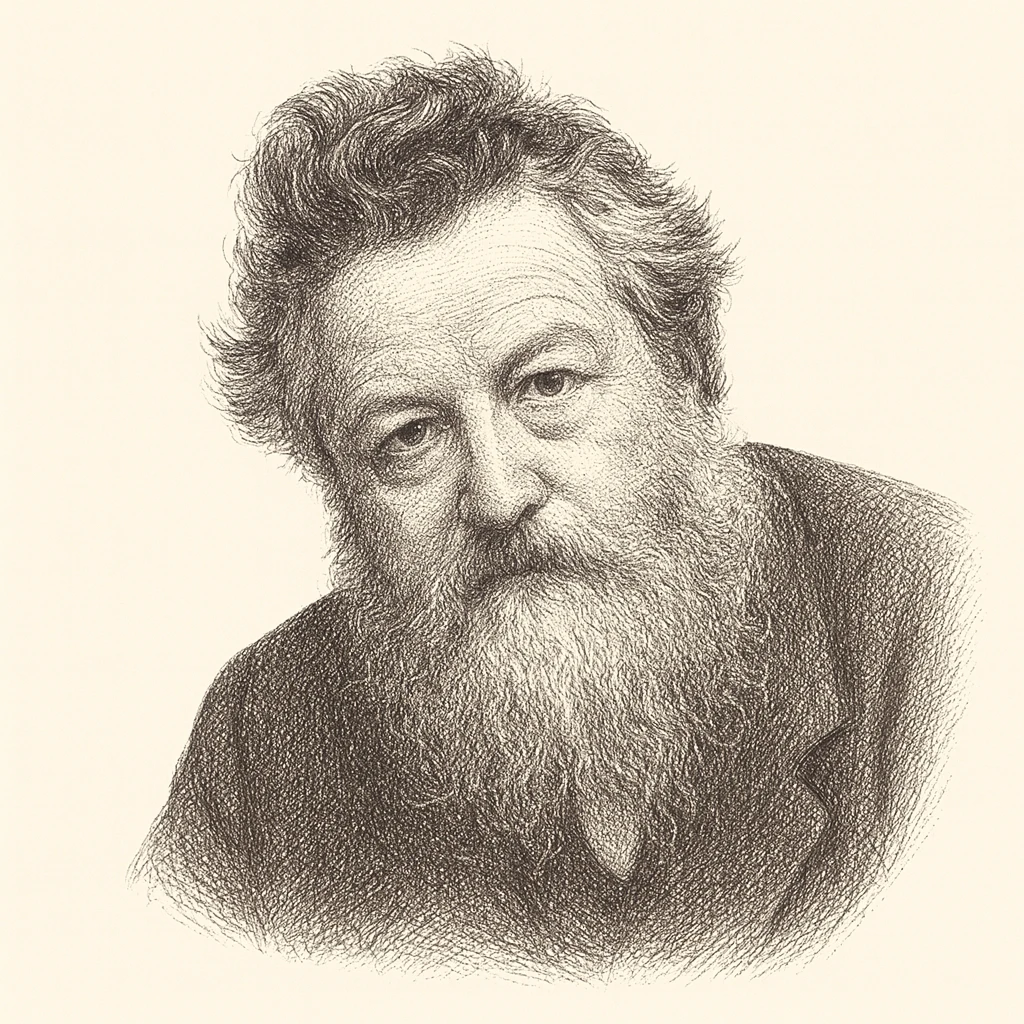
William Morris fitted several careers into one Victorian life: poet, designer, printer, preservationist, and, in his final fifteen years, revolutionary socialist. Born into a wealthy Walthamstow family in 1834, he co-founded the decorative-arts firm that became Morris & Co., whose wallpapers and textiles made him the central figure of the Arts and Crafts movement, and in 1877 launched the Society for the Protection of Ancient Buildings. His poetry, from The Defense of Guenevere to The Earthly Paradise, had already made him one of the most famous writers in England.
The politics grew out of the workshop. Morris concluded that beautiful things could not honestly be made, or enjoyed, in a society that degraded the people who made them. Art, he argued, is the expression of pleasure in labor — and commercial civilization had stripped labor of its pleasure, splitting work into drudgery for the many and idleness for the few. He joined the Democratic Federation in 1883, worked through Marx's Capital in French translation, and in 1884 led the breakaway that founded the Socialist League, editing its paper Commonweal and lecturing at street corners and in radical clubs across Britain.
News from Nowhere (1890), serialized in Commonweal, is his politics as a waking dream: an England after the revolution where wage labor and money are gone, work has turned back into craft, and the Houses of Parliament are used to store manure. The lecture 'Useful Work versus Useless Toil' makes the same case without the fiction. In his last years he founded the Kelmscott Press, finishing its monumental Chaucer in 1896, the year he died. Both the revolutionary left and the gentler English socialist tradition have claimed him since; he belongs to the argument between them.
William Morris is associated with Trad Socialist. See the archetype