
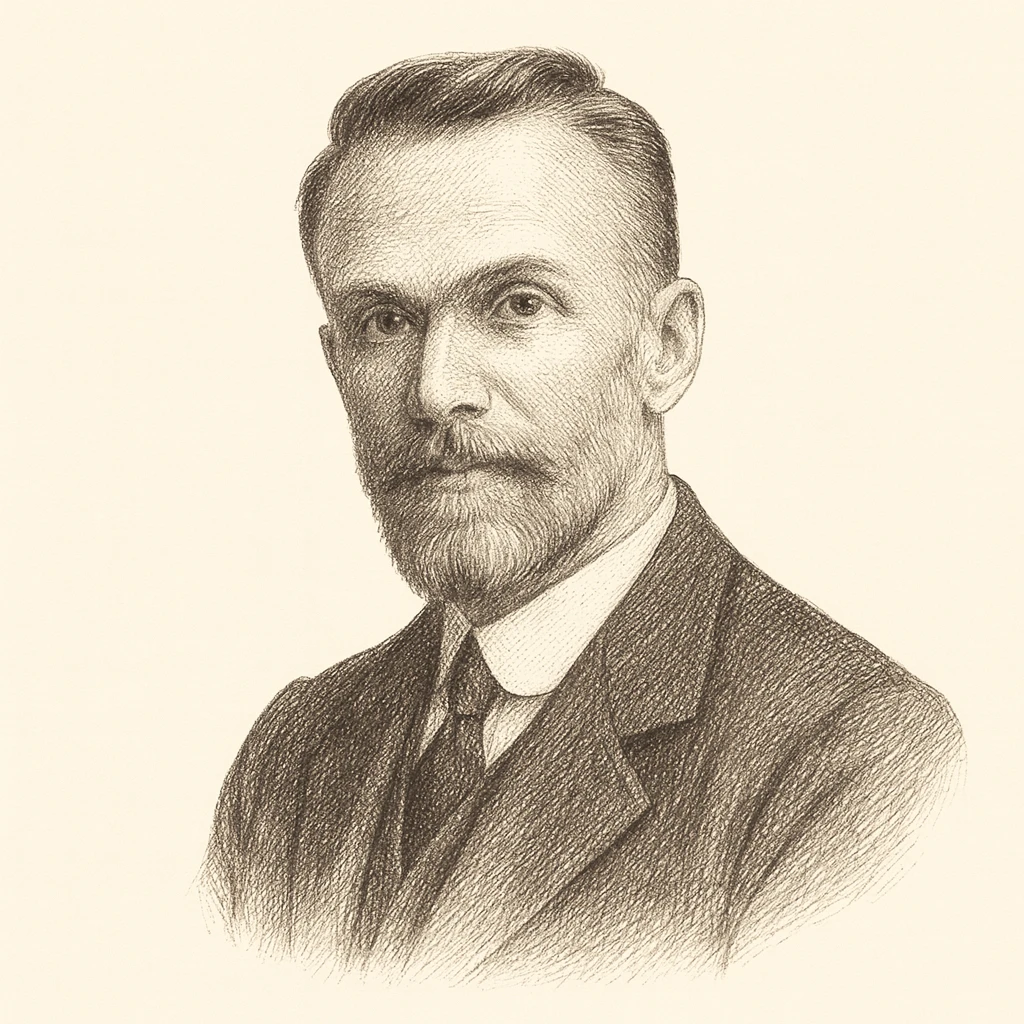
Walter Rauschenbusch was born in 1861 in Rochester, New York, into a family with deep roots in the German pietist tradition. His father August Rauschenbusch had emigrated from Germany as a Lutheran pastor, converted to the Baptist faith under the influence of American revivalism, and become a professor at Rochester Theological Seminary, the Baptist institution where his son would eventually teach for most of his career. The family's German Protestant culture — its seriousness about scripture, its emphasis on individual conscience, its combination of evangelical piety with serious scholarship — shaped Walter's formation profoundly. He attended school in Germany for four years as an adolescent, absorbing both the rigorous biblical scholarship of the German theological tradition and a European social context that made the condition of the industrial working class visible in ways that American middle-class life tended to obscure.
He returned to the United States for college at the University of Rochester and then seminary at Rochester Theological Seminary, graduating in 1886 and receiving his first pastoral appointment at the Second German Baptist Church in New York City — a congregation located at the edge of Hell's Kitchen, the densely packed neighborhood on Manhattan's west side that was, in the 1880s and 1890s, one of the most desperately poor urban environments in the country. He had arrived expecting to save individual souls through the evangelical gospel he had been trained to preach. What he found instead was a neighborhood where poverty was so pervasive and so clearly connected to structural economic conditions that individual moral improvement could not address it. Children from his congregation were dying of preventable diseases. Families were being destroyed by the combination of dangerous work, inadequate wages, and overcrowded housing. No amount of evangelical charity — no personal conversion, no improvement in individual virtue — could address conditions that were produced by the structure of the industrial economy itself.
He stayed in Hell's Kitchen for eleven years, and the experience transformed him. He read Henry George's Progress and Poverty, which argued that land speculation rather than individual moral failure was the primary driver of urban poverty. He read Marx, absorbing the analysis of how industrial capitalism systematically extracted value from workers. He read the British Fabian socialists and the American Social Gospel writers who were beginning to argue that Christian faith required engagement with social structures rather than merely with individual souls. He also traveled to England in 1891, where he encountered the British labor movement and the Christian socialism that was developing alongside it — the argument that Christian faith and socialist politics were not merely compatible but mutually reinforcing.
He began writing and speaking publicly on the relationship between Christian faith and social conditions, developing what would become the Social Gospel theology before he had found the definitive formulation for it. The key move was historical: he returned to the Hebrew prophets — Amos, Hosea, Isaiah, Micah — and found in them not otherworldly religion but fierce social criticism, the denunciation of exploitation and injustice in language that was economic and political rather than narrowly spiritual. Jesus's proclamation of the Kingdom of God was not a promise about the afterlife but an announcement about the transformation of earthly relationships, including economic ones. A Christianity that accepted poverty and exploitation as the permanent backdrop against which individual souls were saved had lost the thread of its own tradition.
He moved to Rochester Theological Seminary in 1897, where he spent the rest of his career teaching church history and developing the theology that Christianity and the Social Crisis (1907) would present to a national audience. The book sold 50,000 copies in its first year, was translated into multiple languages, and became foundational to the progressive reform movement of the early twentieth century. Theodore Roosevelt read it and wrote to Rauschenbusch about it. Woodrow Wilson was influenced by it. Jane Addams and the settlement house workers drew on it. It gave the political reform movement a moral vocabulary that purely secular progressivism could not supply — an account of why social reform was not merely pragmatic or utilitarian but morally obligatory, why the church could not remain neutral in conflicts between capital and labor without effectively siding with capital.
Rauschenbusch was not a Marxist. He believed in private property, was suspicious of the state as an instrument of redemption, and thought cooperative economic organization rather than state socialism was the appropriate Christian economic alternative. His socialism, such as it was, was decentralized and mutualist rather than statist, rooted more in the cooperative tradition than in Marxist political economy. What he shared with the secular left was the conviction that industrial capitalism, as it actually functioned in the Gilded Age, was incompatible with the Christian vision of human dignity and community. Christianizing the Social Order (1912) and A Theology for the Social Gospel (1917) developed and systematized his position. He died in 1918, the year the war ended, having spent the war years in the peculiar position of a German-American who loved his ancestral culture and was horrified by the war it was waging. The Social Gospel tradition he founded proved more durable than he knew: it runs, directly and indirectly, through Reinhold Niebuhr's Christian realism, through Martin Luther King Jr.'s theology of social transformation, and into the present.
Walter Rauschenbusch is associated with Christian Socialist. See the archetype