
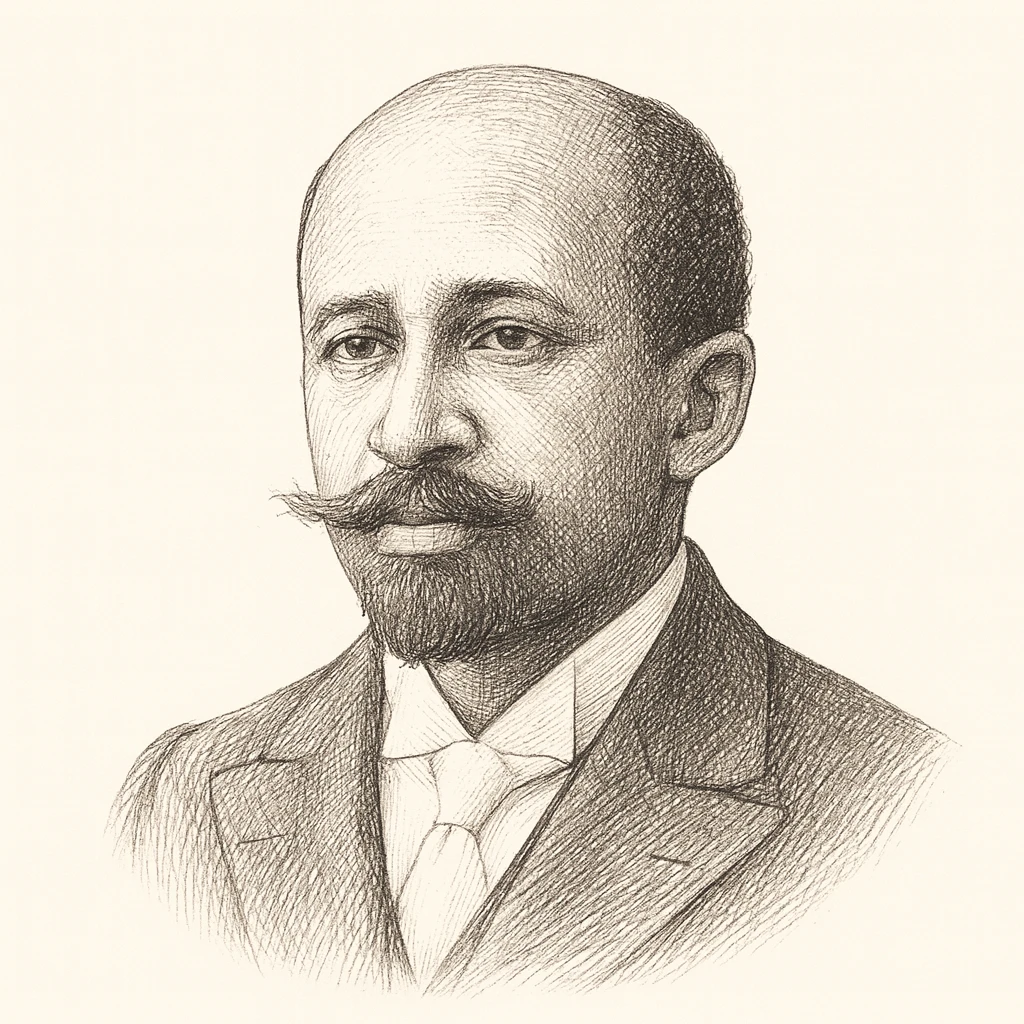
W.E.B. Du Bois was a giant of 20th century American political thought, a scholar whose work across sociology, history, political philosophy, and literary criticism spanned nearly seventy years and reshaped how scholars across disciplines understood the relationship between race, capitalism, and democracy. He was the first African American to earn a PhD from Harvard, the founder of academic sociology in the United States through his empirical studies of Philadelphia's Black community, a co-founder of the NAACP, the editor of The Crisis magazine during its most influential years, a Pan-African movement leader, a civil rights activist, a historian whose Black Reconstruction in America (1935) fundamentally reframed the study of American history, and a controversial late-career communist whose final years were spent in exile in Ghana. His life and work make him one of the most important American intellectuals of his century, and his political philosophy remains essential reading for any serious engagement with the American political tradition.
Du Bois was born in 1868 in Great Barrington, Massachusetts, into a family that had been free in New England for generations. He grew up in a racially mixed town where his experience of anti-Black prejudice was real but not crushing, and he came of age intellectually at a moment when the American promise of Reconstruction had collapsed and the long nadir of Jim Crow was beginning. He attended Fisk University in Nashville, where he first encountered the full reality of segregated Southern life, and then Harvard, where he earned a bachelor's degree and went on to complete the first PhD Harvard ever awarded to an African American. His doctoral dissertation, The Suppression of the African Slave-Trade to the United States (1896), was a landmark work of economic and legal history that launched his academic career.
His first major work of political philosophy was The Souls of Black Folk (1903), a collection of essays that remains one of the foundational texts of African American intellectual life. The book developed several concepts that shaped subsequent political thinking. "Double consciousness" — the psychological condition of always seeing oneself through the eyes of a hostile dominant society — became one of the most widely cited concepts in 20th century social theory. The essay "Of the Sons of Master and Man" analyzed the structural dynamics of race relations in the post-Reconstruction South. The famous line "The problem of the twentieth century is the problem of the color line" predicted with remarkable accuracy that race would be one of the defining political issues of the century that had just begun. The book also contained his sharpest early critique of Booker T. Washington's accommodationist politics, arguing that Washington's willingness to accept segregation in exchange for economic opportunity was selling out the rights and dignity of African Americans.
Du Bois's most important single work of historical and political philosophy was Black Reconstruction in America (1935), a massive revisionist history of the Reconstruction era that overturned nearly a century of white Southern historiography. The dominant view at the time, pushed by the influential Dunning School of historians, held that Reconstruction had been a disaster of misrule by ignorant former slaves and corrupt Northern carpetbaggers, and that the restoration of white Southern political control had been the necessary and just end of the experiment. Du Bois argued the opposite: that Reconstruction had been a genuine attempt at multiracial democracy, that formerly enslaved people had been competent and often visionary participants in democratic government, that the period had seen real achievements in education, land reform, and civil rights, and that its collapse had been engineered by a combination of Southern white terrorism and Northern white indifference that had permanently warped American democracy. The book was largely ignored by mainstream historians when it was published, but by the 1960s and 70s it had become recognized as one of the most important works of American historical scholarship ever produced, and contemporary historians of the period work within the framework Du Bois established.
Du Bois's broader political philosophy integrated several traditions into a synthesis all his own. He drew on Marxist class analysis without becoming a doctrinaire Marxist, on Weberian sociology while pushing its analysis of race beyond what Weber had done, on pragmatist philosophy through his connection to William James and the broader Harvard intellectual tradition, and on the African American political tradition running from Frederick Douglass through the abolitionist and civil rights movements. His distinctive contribution was to show that race in the American context was not a secondary or derivative political category but a primary structural feature of American capitalism and democracy that had to be central to any honest analysis of either. Contemporary debates about racial capitalism, structural racism, and the relationship between race and class all operate within categories Du Bois helped establish.
Du Bois's political life was as consequential as his scholarship. He co-founded the NAACP in 1909 and served as editor of its magazine, The Crisis, for decades, shaping African American political discourse and the broader American civil rights conversation during the period when segregation was at its most entrenched. He organized a series of Pan-African Congresses that linked African American civil rights struggles to anti-colonial movements across Africa and the Caribbean. He traveled widely, became increasingly disillusioned with American democratic capitalism after the failures of the New Deal and the persistence of segregation, and in his final years publicly joined the Communist Party USA and moved to Ghana at the invitation of Kwame Nkrumah. He died in Ghana in 1963, at ninety-five, on the eve of the March on Washington — the day before Martin Luther King Jr. delivered the "I Have a Dream" speech at a rally whose organization had drawn heavily on the civil rights infrastructure Du Bois had helped build more than half a century earlier.
W.E.B. Du Bois is associated with Progressive Activist. See the archetype