
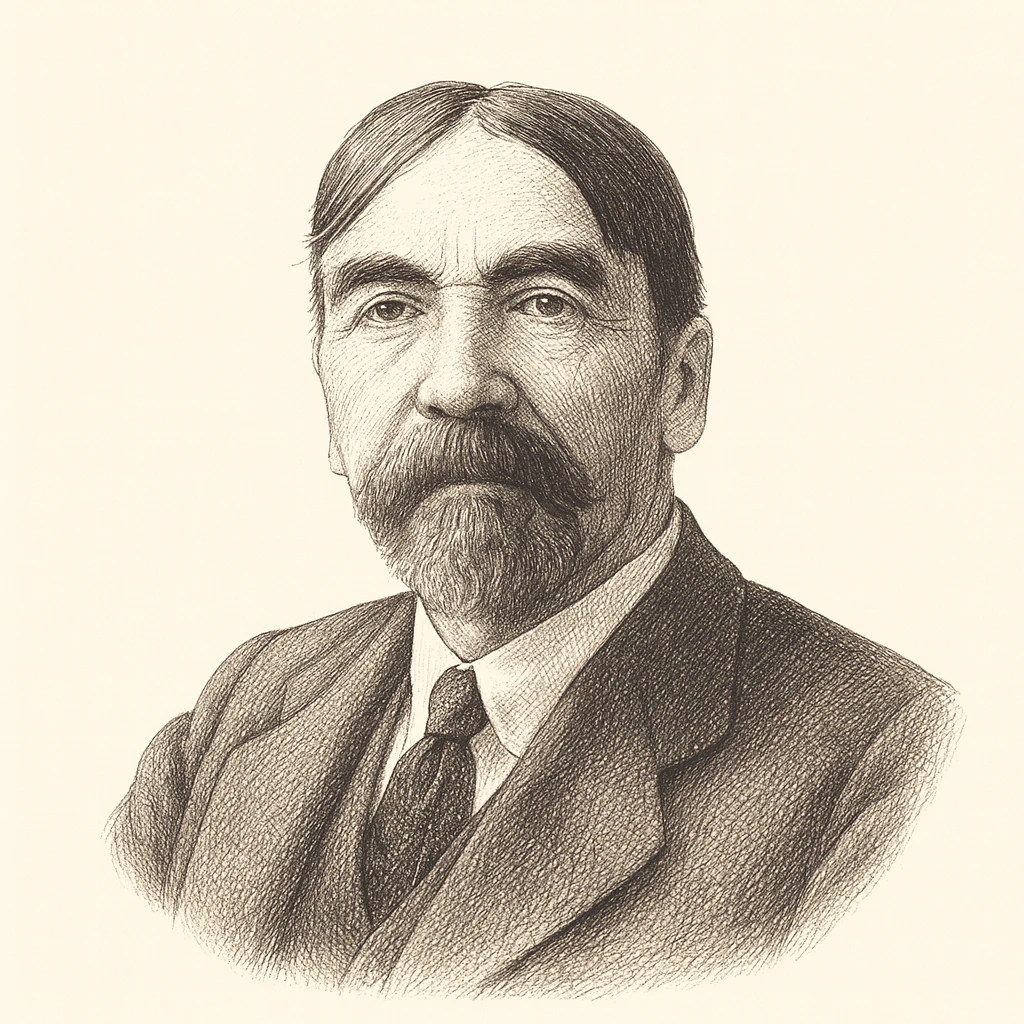
Thorstein Bunde Veblen was born in 1857 in Cato Township, Wisconsin, the sixth of twelve children of Thomas Anderson Veblen and Kari Bunde, Norwegian immigrants who had come to America in 1847 and established a farm in the Norwegian immigrant community of the upper Midwest. He grew up speaking Norwegian as his primary language, did not learn English fluently until he was a teenager, and spent his childhood in the tight-knit, culturally distinct Norwegian farming community that maintained its own social world within the broader American one. This double consciousness — insider to one world, permanent outsider to another — shaped everything about his intellectual style: the ironic distance, the capacity to see the taken-for-granted assumptions of American middle-class culture as the products of specific historical circumstances rather than natural necessities, and the mordant humor that made his work simultaneously unreadable in academic settings and widely quoted outside them.
He attended Carleton College in Northfield, Minnesota, where he was a student of John Bates Clark, the neoclassical economist, and demonstrated from early on the combination of intellectual brilliance and social difficulty that would characterize his academic career. He went on to Johns Hopkins and then Yale for graduate work in philosophy, studying under Noah Porter and William Graham Sumner — the latter being one of the most committed American advocates of Spencerian evolutionary individualism, whose positions Veblen would spend his career dismantling. He received his doctorate from Yale in 1884, with a dissertation on Kant's ethical theory, and then could not find an academic position — partly because there were few positions available, partly because he was Norwegian and therefore culturally suspect in the Anglo-Saxon academic world, and partly because he was already exhibiting the social unconventionality that would eventually cost him every position he managed to obtain.
He returned to his family's farm in Minnesota and spent seven years reading, writing, and doing essentially nothing visible. This extended period of apparent idleness was not wasted: he was absorbing evolutionary biology, anthropology, and economic history, developing the framework that would organize his subsequent work. He enrolled at Cornell for further graduate work in economics in 1891, then moved to the University of Chicago when J. Laurence Laughlin, the head of the economics department, brought him along when Laughlin moved in 1892. At Chicago, Veblen edited the Journal of Political Economy, published the articles that became his first books, and began establishing his intellectual reputation while simultaneously establishing his reputation for personal conduct that made him difficult to employ. He had affairs; he was careless about domestic arrangements; he said uncomfortable things in social settings. He was eventually asked to leave Chicago.
The Theory of the Leisure Class (1899) was the work that made him famous, though "famous" understates the peculiarity of its reception: it was widely read and widely quoted in social circles that regarded it as a diagnosis of their neighbors rather than themselves, and it introduced into the common language two concepts that proved irresistible: conspicuous consumption and conspicuous leisure. His argument was evolutionary and sardonic. The leisure class — the class that did not engage in productive labor and whose status depended on demonstrating that it did not need to — had developed the practice of waste as the primary indicator of honor. Conspicuous consumption was spending visibly in excess of need, to demonstrate the ability to spend without regard to necessity. Conspicuous leisure was the visible abstaining from productive work, demonstrating the ability to survive without it. The working class aspired to imitate the leisure class as best it could, producing a cascade of emulative waste that organized much of what passed for American culture.
The Theory of Business Enterprise (1904) developed the other half of the analysis: the distinction between industry — the productive process by which engineers and workers made useful things — and business — the financial and organizational process by which owners appropriated the value that industry created. Business was essentially parasitic: its function was to restrict the output of industry to maintain prices and profits, rather than to maximize the output of serviceable goods. The engineer was the productive figure in capitalist society; the financier and the corporate executive were the predatory figures who captured value without creating it.
His subsequent career was as itinerant as it was productive. Stanford dismissed him after three years over a domestic situation. Missouri kept him for longer but without promotion. He taught briefly at the New School for Social Research, which had been founded partly by people who admired his work, and then retired to a shack in Palo Alto where he died in 1929, having watched the boom of the 1920s confirm his analysis of business enterprise and having anticipated, at least in structure, the crash that came three months after his death. He had been offered the presidency of the American Economic Association and declined; he would have found the office unworthy of him and him unworthy of the office.
Thorstein Veblen is associated with Establishment Progressive. See the archetype