
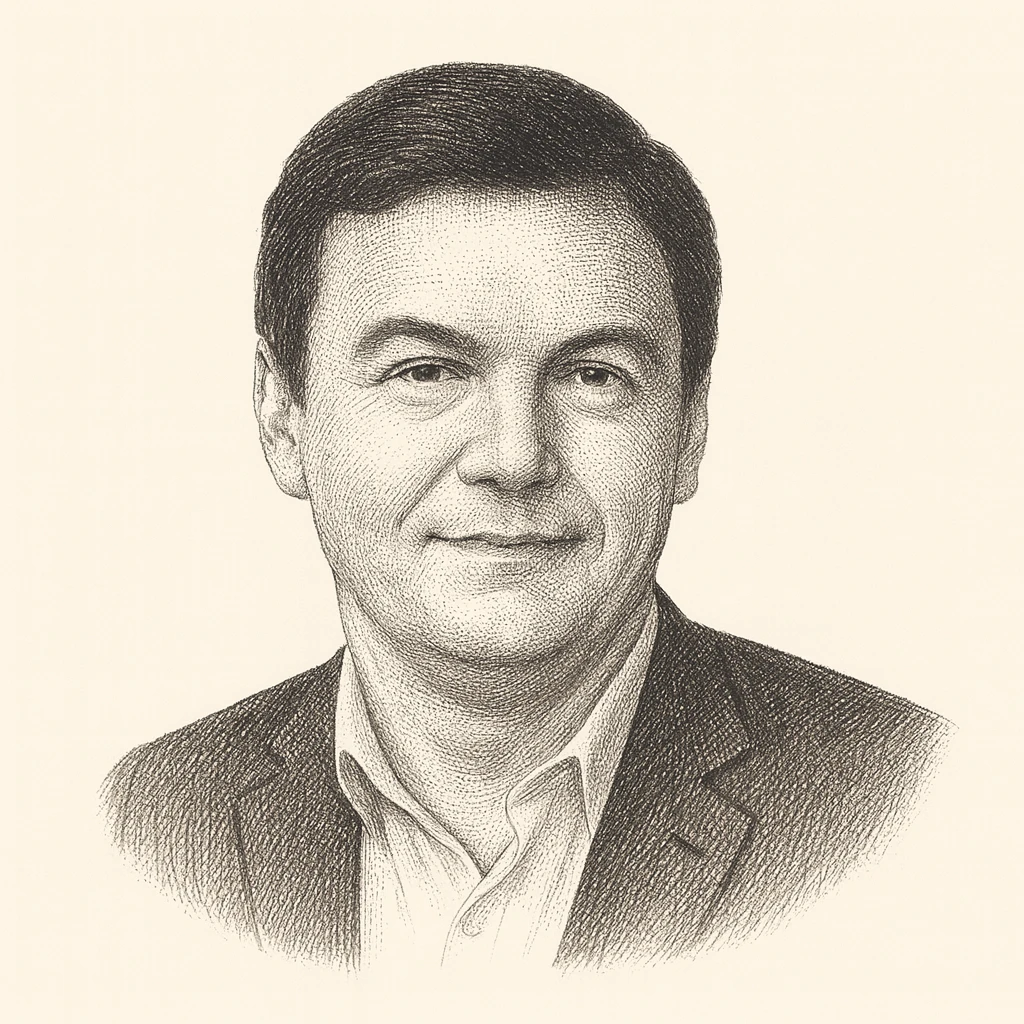
Thomas Piketty is a French economist whose work has made the long-run distribution of income and wealth a central question of contemporary political debate. Building on extensive historical data drawn from tax records and national accounts, he argued that capitalist economies exhibit a tendency toward rising concentration of wealth, particularly when the rate of return on capital exceeds the overall rate of economic growth. His best-known book, "Capital in the Twenty-First Century," became an unexpected international bestseller and turned technical questions of measurement into a broad public argument about the political consequences of inequality. He has also worked collaboratively with other economists to build long-term databases documenting the share of income and wealth held by top earners across many countries.
Politically, Piketty situates himself broadly on the left and in a social-democratic and egalitarian tradition, though his emphasis on empirical measurement distinguishes his approach from purely theoretical or ideological argument. He contends that extreme inequality is not an inevitable feature of markets but is shaped by institutions, policy choices, and political power, and that periods of reduced inequality in the twentieth century owed much to wars, crises, and deliberate policy rather than to natural market equilibrium. From this analysis he draws prescriptions favoring progressive taxation of income, inheritance, and wealth, and he has advocated for coordinated action at levels beyond the nation-state to address the mobility of capital.
His later work broadened from measurement toward the study of ideology and the political justifications societies construct to legitimize inequality, examining how belief systems sustain particular distributions of property and power. He has also analyzed shifts in the political coalitions of left and right, notably the tendency of educated voters and higher-income voters to align with parties in ways that reshape traditional class-based politics.
Piketty's influence extends well beyond academic economics. He has become a reference point for debates about redistribution, the taxation of the wealthy, and the relationship between capitalism and democracy, cited by activists, policymakers, and critics alike. Supporters credit him with restoring distributional questions to the heart of economics and public policy, while critics dispute elements of his theoretical framework, his data interpretations, and the political feasibility of his proposals. Either way, his work has durably framed how many people think about wealth and political power.
Thomas Piketty is associated with Progressive Activist. See the archetype