
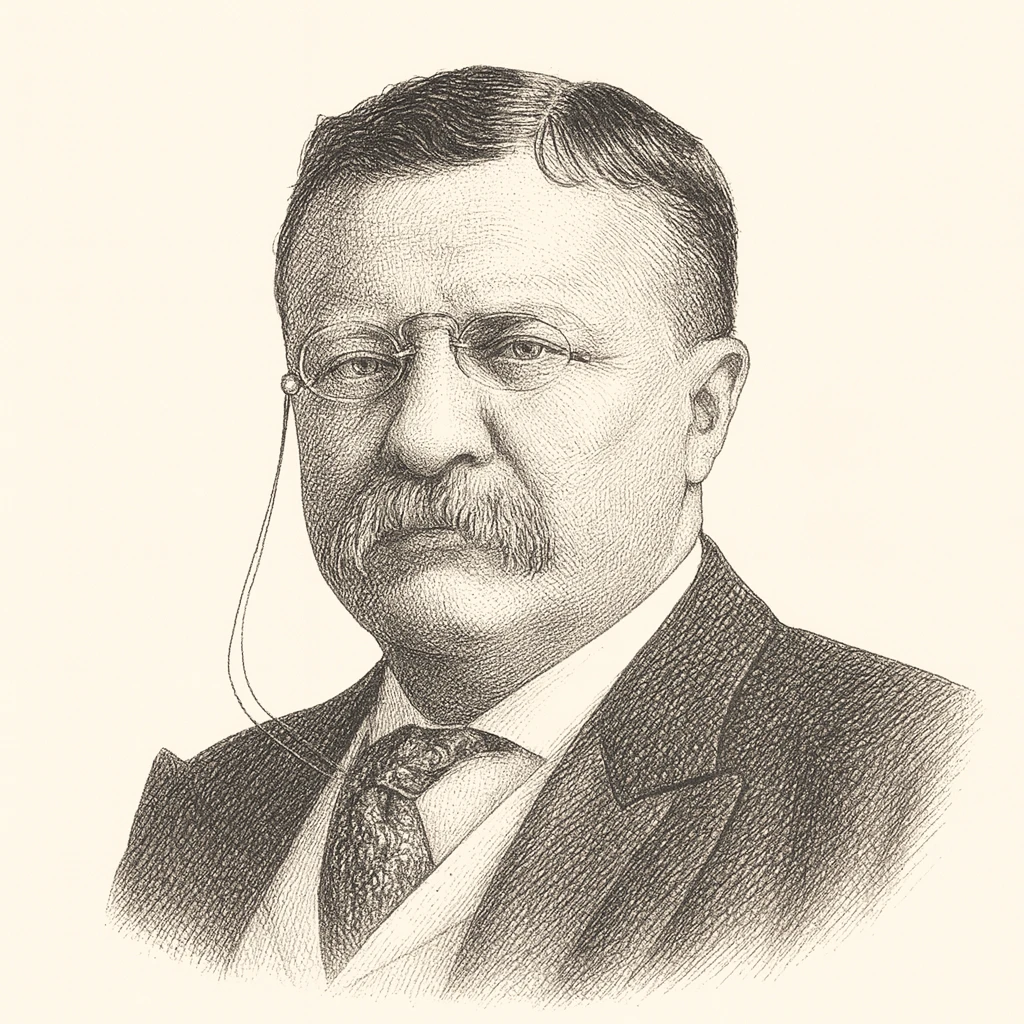
Theodore Roosevelt was the 26th President of the United States, whose tenure expanded the reach of the presidency and of the federal government. Born into a wealthy, established New York family, Roosevelt overcame childhood illness through vigorous exercise and made 'the strenuous life' a personal and public creed. He was a rancher, police commissioner, Rough Rider, and New York governor before becoming Vice President.
When McKinley's assassination made him president at 42, the youngest ever, Roosevelt greatly expanded the use of executive power. He pursued antitrust prosecutions, regulated railroads, signed the Pure Food and Drug Act, whose enforcement office became the FDA, and set aside five national parks, 18 national monuments and 150 national forests. His 'Square Deal' promised fairness between capital and labor. He mediated the end of the Russo-Japanese War, winning the Nobel Peace Prize, and sent the Great White Fleet around the world. Underlying these actions was what he called a 'stewardship' conception of the office: the president was steward of the whole people and could do whatever the nation's needs demanded unless explicitly forbidden by the Constitution or the laws.
Roosevelt's political thought answered the disruptions of the industrial age. Against laissez-faire orthodoxy, he argued that concentrated corporate power required a correspondingly strong national government to discipline it, distinguishing good from bad big business and favoring regulation over indiscriminate dissolution. This view matured into his 'New Nationalism,' which subordinated property rights to human welfare and the public good, and called for an activist federal state. His progressivism thus combined reform with nationalism and imperialism: he believed in strong government directing national development while expanding American power abroad, and saw the two as complementary.
William Howard Taft, his successor, rejected the stewardship theory, holding that a president could exercise only powers traceable to a specific grant. Abroad, the Roosevelt Corollary to the Monroe Doctrine asserted a U.S. right to intervene in Latin American states. His enthusiasm for war and empire rested on assumptions of racial and civilizational hierarchy.
After leaving office, he split the Republican Party in 1912 with his Bull Moose campaign, whose platform advanced labor protections, social insurance, and direct democracy. Shot in Milwaukee while campaigning, he delivered his speech with the bullet in his chest before seeking treatment.
Theodore Roosevelt is associated with National Conservative. See the archetype