
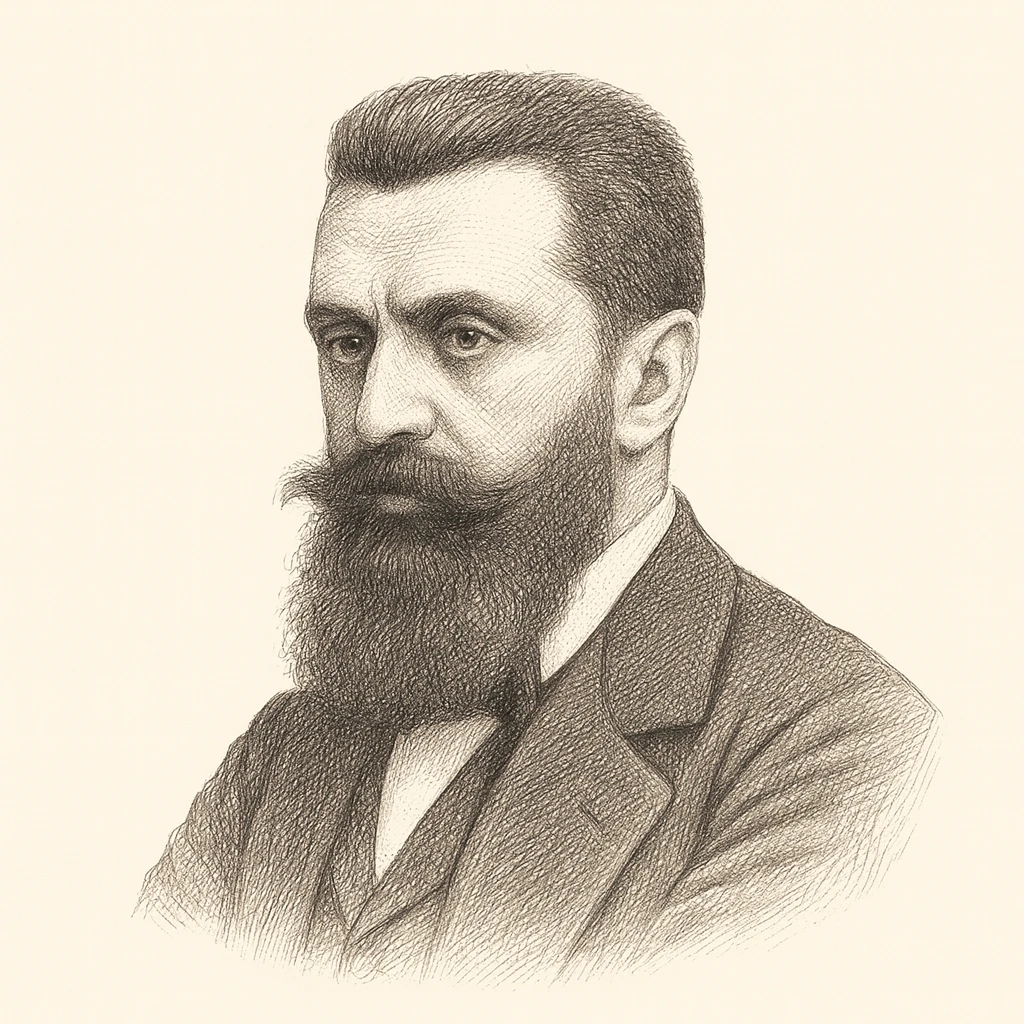
Theodor Herzl was an Austro-Hungarian journalist and playwright who became the central organizing theorist of political Zionism. Working as a Paris correspondent for the Viennese press, he grew convinced that the liberal promise of Jewish assimilation into European society had failed, and that antisemitism was not a passing prejudice but a durable structural feature of the nations in which Jews lived as minorities. His central political argument, laid out in Der Judenstaat (The Jewish State), was that the "Jewish question" was a national question requiring a national solution: the creation of a Jewish polity with recognized sovereignty, achieved through diplomacy and international sanction rather than gradual settlement alone.
Herzl's contribution was less philosophical than organizational and rhetorical. He reframed Jewish identity in the vocabulary of nineteenth-century European nationalism — a people with a right to self-determination and a state of its own — and translated that vision into institutions. He convened the First Zionist Congress in 1897 and helped found the World Zionist Organization, giving a dispersed movement a representative body, a program, and a diplomatic strategy aimed at securing a charter for Jewish settlement from the great powers. In this he blended nationalist aspiration with a modern, secular, and administrative sensibility, imagining the future state in the utopian novel Altneuland as a liberal, technologically advanced society.
His thought sits at the intersection of national liberation and state-building, which is why it resonates across nationalist traditions that fuse peoplehood with social modernization. Herzl himself was flexible about location and means, at one point entertaining proposals for territory outside Palestine, a stance that provoked lasting controversy within the movement. His legacy is also deeply contested: as the intellectual architect of a project that culminated in the State of Israel, he is celebrated by supporters as a visionary of national self-determination and criticized by others for a settlement vision that paid little attention to the Arab population already living in the land. He died in 1904, decades before the state he envisioned came into being.
Theodor Herzl is associated with Left Nationalist. See the archetype