
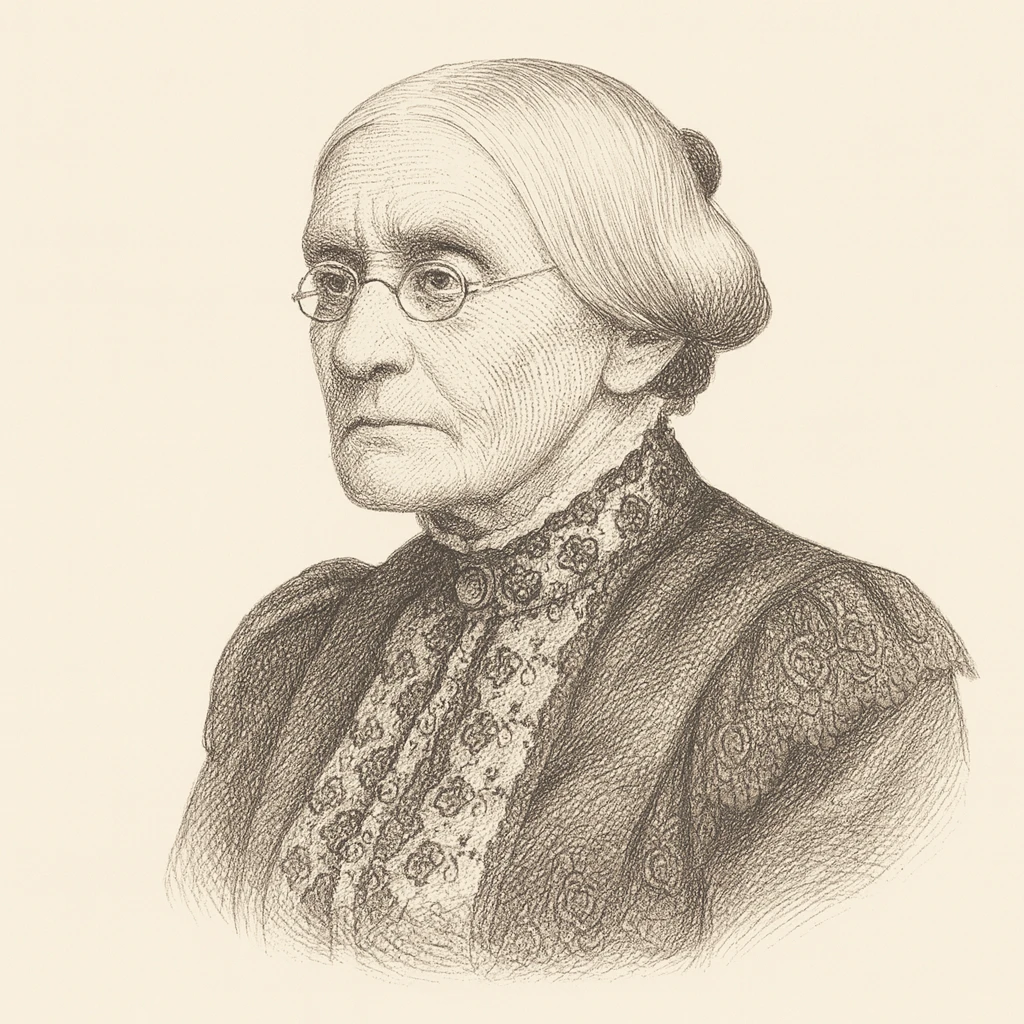
Susan Brownell Anthony was the most recognized leader of the American women's suffrage movement, devoting over 50 years to the cause of women's right to vote. Raised in a Quaker family committed to social reform, Anthony began as an abolitionist and temperance activist before focusing on women's rights.
With Elizabeth Cady Stanton, Anthony founded the National Woman Suffrage Association in 1869 and edited The Revolution newspaper. Her political argument rested on natural-rights and constitutional grounds: she held that women were already citizens and that the vote was inherent in that citizenship, requiring no new grant of privilege. This reasoning shaped her most famous act of protest. In 1872, she was arrested for voting illegally in Rochester, New York; at her trial she argued that as a citizen she had committed no crime, and the proceedings—in which she was fined but refused to pay—brought national attention to the cause. She traveled constantly, speaking, organizing, and petitioning.
Her career was also marked by a bitter and lasting controversy. After the Civil War, Anthony and Stanton opposed ratification of the Fifteenth Amendment because it enfranchised Black men while leaving all women disfranchised, breaking with former abolitionist allies and helping split the movement into rival organizations. Some of the rhetoric she and Stanton used in this period appealed to the interests of educated white women; Angela Davis, in Women, Race & Class (1981), wrote that they framed their opposition with "arguments invoking the privileges of white supremacy." The wings reunited in 1890 as the National American Woman Suffrage Association.
Anthony worked to build an institutional and documentary foundation for the movement, contributing to the multivolume History of Woman Suffrage that shaped how the struggle was remembered. She framed suffrage not as a favor to be granted but as a right long denied, an argument later generations of reformers inherited and extended.
Anthony never saw victory—the 19th Amendment granting women's suffrage passed in 1920, fourteen years after her death. The amendment is sometimes called the 'Susan B. Anthony Amendment' in her honor. Her single-minded dedication and organizational genius transformed women's rights from radical idea to inevitable reform. Her image appears on the U.S. dollar coin.
Susan B. Anthony is associated with Progressive Activist. See the archetype