
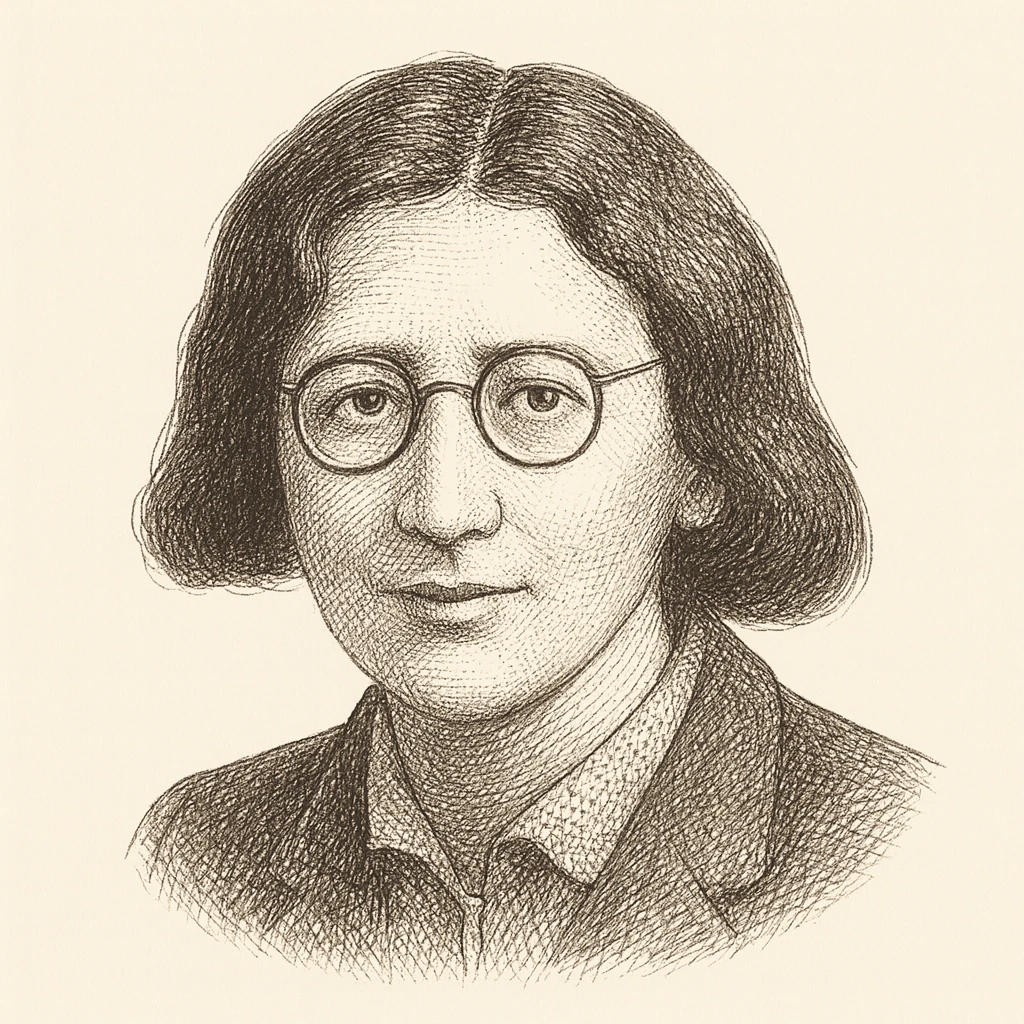
Simone Weil was born in 1909 in Paris into a secular Jewish family of considerable intellectual cultivation — her father Bernard Weil was a doctor, her brother André became one of the great mathematicians of the twentieth century, and the household maintained the rigorous intellectual atmosphere that produced both children. She was precocious in the way that produces either geniuses or wreckage: she had taught herself Greek by twelve and was reading Sanskrit at fifteen, felt genuine remorse for her own intellectual gifts when she encountered people who lacked them, and at the age of ten refused to eat sugar in solidarity with soldiers at the front during the First World War. The compulsion to identify with suffering — not as sentiment but as practice — was present before she had any systematic account of it.
She attended the École Normale Supérieure, the most prestigious educational institution in France, passing the agrégation in philosophy in 1931 in the same cohort as Simone de Beauvoir (who ranked just above her). She then did something almost no one with those credentials did: she taught philosophy at provincial lycées while simultaneously engaging in labor organizing, participating in union activities and workers' study circles, writing for radical labor publications, and eventually, in 1934-35, taking a year's leave from teaching to work as an unskilled factory hand at Renault and other Parisian factories. The factory year was the decisive experience of her mature life. She worked at the grinding repetition of machine operation, absorbed the culture of the factory floor, and experienced what she later called "affliction" — the particular degradation that consists in the destruction of a person's sense of their own value through the brutal, impersonal mechanism of industrial production. She emerged exhausted, physically damaged, and intellectually transformed.
The Renault year produced a journal and an extended essay on the condition of factory workers that remain among the most searching analyses of industrial labor ever written. What she found was not primarily exploitation in the Marxist sense — the extraction of surplus value — but something more fundamental: the destruction of thought, the impossibility of genuine human presence in a form of work that reduced the worker to the reflex execution of operations designed by others. The slave and the worker in antiquity had at least been present as persons in their work, however degraded; the factory worker was not even present as a person, only as a component in a mechanical system. This led her to conclude that the problem with industrial capitalism was not primarily the distribution of property — who owned the machines — but the nature of the machines themselves and the form of labor they required. Substituting workers' ownership of the means of production for capitalist ownership would not change the fundamental degradation if the means of production themselves remained the same.
She went to Spain in August 1936 to fight for the Republican side in the Civil War, was wounded when she stepped in a pot of boiling oil (not in combat), and witnessed enough of the war to arrive at conclusions that many on the left found inconvenient: that the Republicans were committing atrocities as well as the Nationalists, that political violence had its own logic that corroded the moral commitments it was supposed to serve, and that the left's willingness to excuse its own violence while condemning the right's was a form of bad faith she could not maintain.
Her religious development was gradual and her relationship to institutional religion remained deliberately external. She had a series of mystical experiences in the late 1930s — at Solesmes attending Gregorian chant, in Assisi at the Porziuncola chapel, in Portugal at a festival where she saw fishermen's wives processing with candles by the sea — that she described as contact with something wholly beyond herself. She read George Herbert's poem "Love" and described it as entering her — entering her as she had been reading it as a poem and then discovering that she had been praying without knowing it. She was drawn to Catholicism with an intensity that she consistently refused to formalize in baptism, insisting that her vocation was to remain on the threshold, in the borderland between the Church and the world, as a witness available to those who could not enter.
The Need for Roots, written in London in 1943 at the request of the Free French and published posthumously, was her most systematic political work — an analysis of what human beings required for genuine life (rootedness, in the multiple dimensions of community, history, language, work, and faith) and what industrial civilization and totalitarianism had done to destroy it. She argued that the French intellectual and political tradition had itself contributed to its own defeat by abstracting from the concrete conditions of human rootedness into the universalism that proved empty when faced with genuine power. She died in August 1943 of tuberculosis exacerbated by her refusal to eat more than the rations she believed were available to people in occupied France. She was thirty-four. Whether this was suicide or a form of sacrifice through identification with suffering is a question that her interpreters have not resolved and that she would probably have found beside the point.
Simone Weil is associated with Christian Socialist. See the archetype