
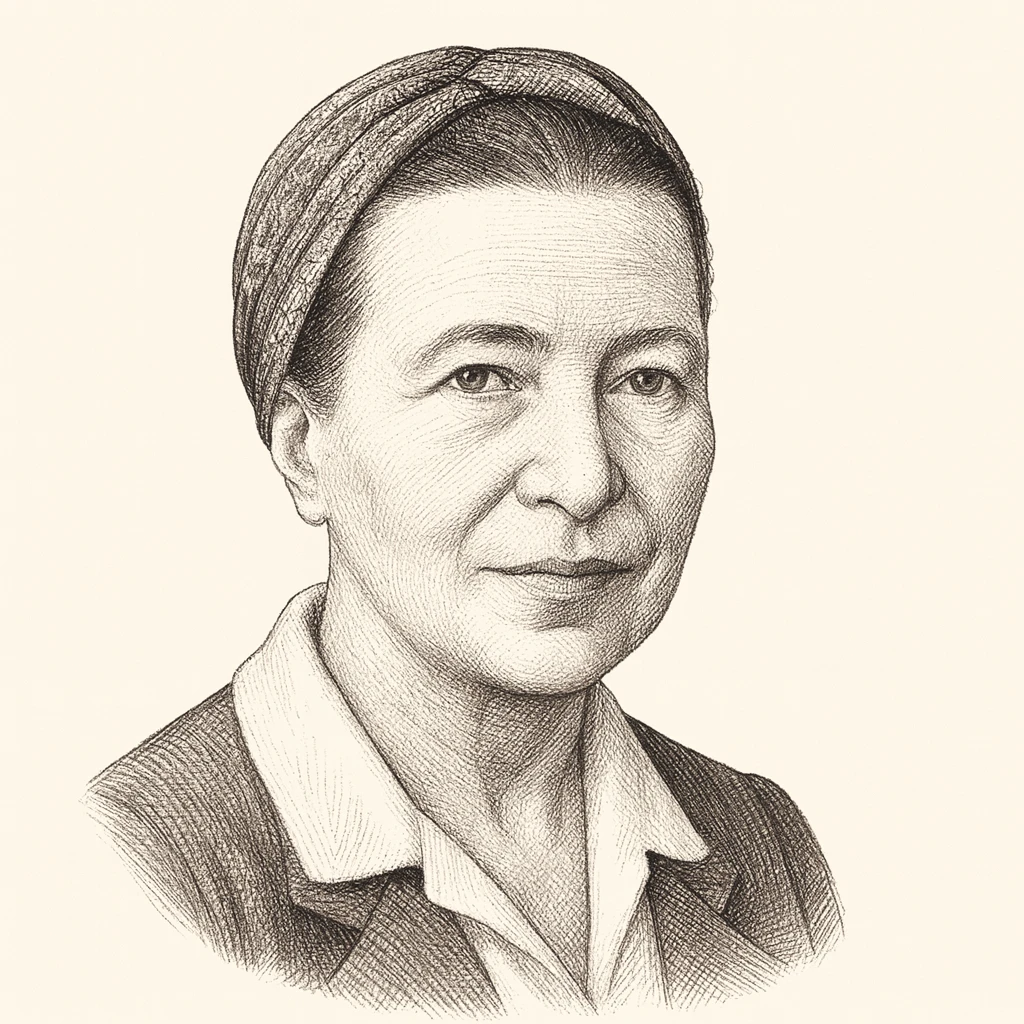
Simone de Beauvoir is the most important feminist philosopher of the 20th century and one of the central figures of French existentialism, a writer whose The Second Sex (1949) reshaped feminist theory in ways that still structure contemporary discussions of gender, identity, and liberation. For most of her career she was treated as a secondary figure in the orbit of Jean-Paul Sartre, her longtime partner and philosophical collaborator, and her own independent contributions were systematically undervalued by a male-dominated academic establishment that treated her as a novelist and essayist rather than as a serious philosopher. Contemporary scholarship has recovered her as an original philosopher whose work shaped Sartre's as much as his shaped hers, whose ethical framework in The Ethics of Ambiguity (1947) made her one of the most important existentialist theorists of the postwar period, and whose feminist writing founded a tradition that has continued to shape political philosophy, gender theory, and social movements into the 21st century.
Beauvoir was born in 1908 in Paris into a bourgeois Catholic family whose financial decline during her childhood shaped her early determination to achieve intellectual and economic independence. She was an extraordinary student, earning her agrégation in philosophy in 1929 at twenty-one (one of the youngest people ever to achieve the qualification) and finishing second in her class only to Sartre himself. She and Sartre began the famously unconventional partnership that would last until his death in 1980: they never married, maintained separate residences most of the time, kept no children, and had other sexual and romantic relationships alongside their primary commitment to each other. They read each other's work constantly, shaped each other's philosophical development fundamentally, and formed what Beauvoir called an "essential" relationship that nonetheless allowed for "contingent" relationships with others. Whether this arrangement actually worked in practice as well as the public image suggested has been debated ever since, with evidence from their letters and journals suggesting it was more painful and more complicated for Beauvoir than her public statements acknowledged.
Beauvoir began her writing career with novels, and her first major novel, She Came to Stay (1943), explored the philosophical and personal complexities of the open relationship she and Sartre had developed. Her novel The Mandarins (1954) won the Prix Goncourt, France's most prestigious literary prize, and drew on her experience of the postwar Parisian intellectual left. But her most important philosophical work came in two nonfiction books that she wrote in the late 1940s.
The Ethics of Ambiguity (1947) was Beauvoir's systematic contribution to existentialist ethics, and it addressed the most common criticism of existentialist philosophy: that if there are no pre-existing values and each person must create their own meaning, then existentialism provides no foundation for genuine moral obligations to others and collapses into nihilism or pure subjectivism. Beauvoir's response was that freedom itself was the foundation for ethics. If what makes human existence distinctive is the capacity for free self-creation, then respecting that capacity in oneself requires also respecting it in others. Oppression is wrong not because it violates some pre-existing moral law but because it denies other people the freedom that makes them human. This framework allowed existentialist philosophy to ground political commitments without sacrificing the anti-foundationalist insights that made existentialism distinctive, and it remains one of the most elegant attempts to derive ethical obligations from existential freedom.
The Second Sex (1949) was Beauvoir's masterwork and arguably the single most important work of feminist philosophy ever published. The book ran to nearly a thousand pages and examined the situation of women across biology, psychology, history, literature, and everyday experience, developing a sustained philosophical argument about how women had been constructed as the "Other" in relation to men — as not-men, as the secondary and derivative sex, as objects rather than subjects of their own existence. Her famous formulation "One is not born, but rather becomes, a woman" captured the central insight: that femininity was not a biological given but a social construction imposed on female humans through a lifetime of conditioning, expectations, and constraints. The book drew on existentialist categories — subject and object, freedom and facticity, authenticity and bad faith — to analyze how women had been denied the possibility of existing as free subjects in their own right, and it called for a fundamental transformation of the conditions under which women lived.
The Second Sex was immediately controversial and has remained so. It was placed on the Catholic Church's Index of Prohibited Books. It was denounced in the French press. It was also enormously influential, shaping second-wave feminism in the 1960s and 1970s and providing the theoretical framework within which later feminist philosophers like Kate Millett, Shulamith Firestone, and Judith Butler developed their own contributions. Butler's concept of gender performativity is unintelligible without Beauvoir's earlier framework of becoming rather than being a woman, and Butler has acknowledged the debt explicitly. The book's influence extended well beyond the academy into social movements, popular feminist consciousness, and the broader cultural transformation of gender roles across the Western world in the second half of the 20th century.
Beauvoir's later work continued to engage with political and ethical questions. The Coming of Age (1970) was a study of old age that combined philosophical analysis with the same kind of interdisciplinary breadth she had brought to The Second Sex. Her autobiographical writings, particularly Memoirs of a Dutiful Daughter (1958) and The Prime of Life (1960), became widely read both as personal history and as contributions to the philosophical tradition of reflective autobiography that ran from Augustine through Rousseau. She remained politically active throughout her life, taking public stances on Algerian independence, the Vietnam War, women's rights in France, and the broader emancipation of women globally. In her final decade, after Sartre's death in 1980, she became more publicly identified with feminism as its own movement rather than as a subsidiary of broader leftist politics, and her influence on contemporary French and international feminism grew substantially.
Beauvoir died in 1986 at seventy-eight in Paris, and was buried in the Montparnasse Cemetery alongside Sartre. Her reputation as a philosopher has continued to grow since her death, as scholars have systematically recovered her contributions from the shadow of her partnership with Sartre and recognized her as an original philosopher in her own right. The Second Sex remains one of the essential texts for anyone serious about political philosophy, gender theory, or the broader philosophical tradition of the 20th century.
Simone de Beauvoir is associated with Progressive Activist. See the archetype