
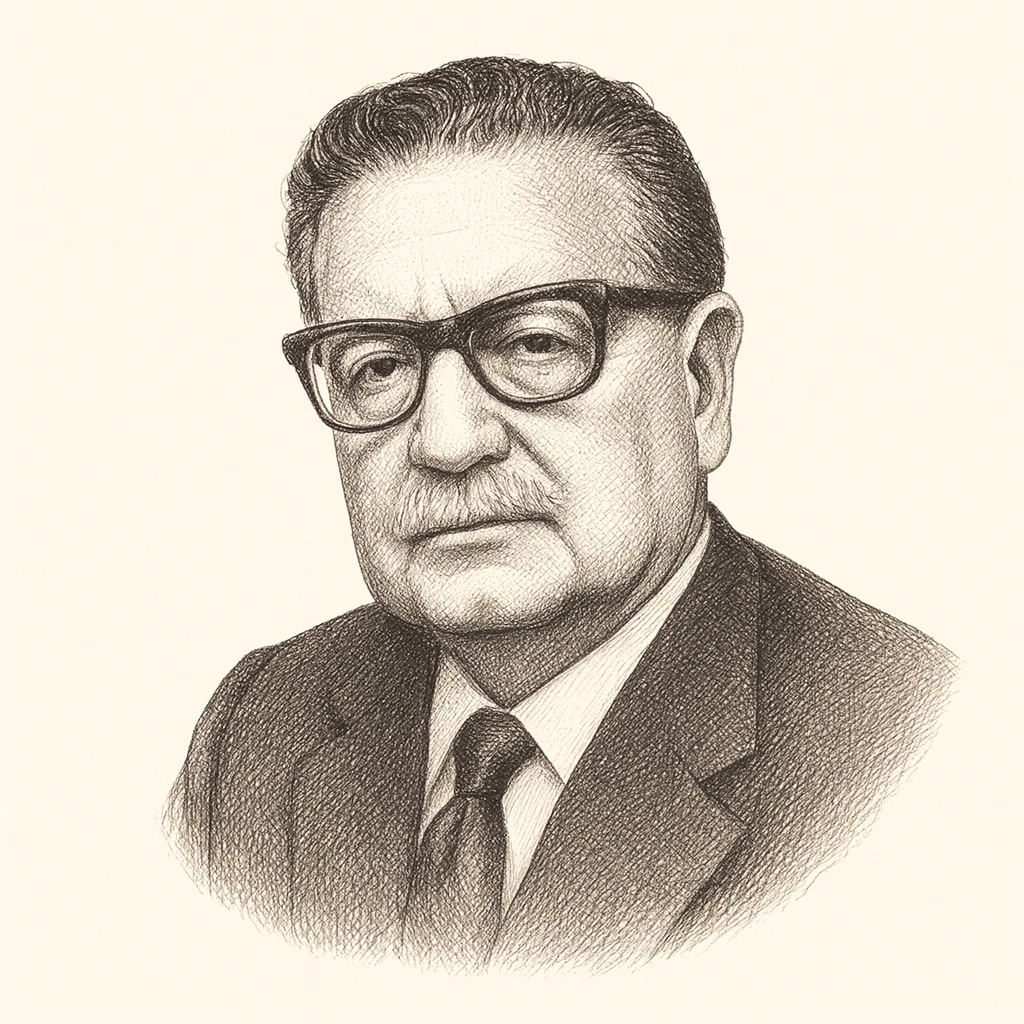
Salvador Allende was a Chilean politician who spent decades in electoral politics, serving as a legislator and cabinet minister before winning the presidency in 1970 as the candidate of the Popular Unity coalition. Trained as a physician, he brought to politics a conviction that social medicine and public health were inseparable from questions of poverty, class, and the structure of the economy. He was a founder of the Chilean Socialist Party and a committed Marxist, but his lasting political significance lies in his insistence that a transition to socialism could and should proceed through constitutional means, respecting elections, parliament, and civil liberties rather than armed revolution.
This idea, often called the "Chilean road to socialism," placed Allende in tension with more orthodox revolutionary currents that regarded parliamentary democracy as a bourgeois trap. His government pursued nationalization of major industries—most prominently copper—along with agrarian reform and expanded social programs, while operating within Chile's existing democratic institutions and under intense polarization. That experiment tested a central question of twentieth-century left politics: whether deep economic transformation is achievable without abandoning pluralism, or whether entrenched interests will not permit it peacefully.
The answer, in Allende's case, was brutal. His presidency unfolded amid severe economic crisis, sharp social conflict, and documented efforts by domestic opponents and the United States to undermine him. In September 1973 the military under Augusto Pinochet overthrew his government in a coup, and Allende died in the presidential palace during the assault. The dictatorship that followed carried out widespread repression, torture, and killings.
Allende's afterlife as a political symbol is contested. To much of the democratic left he became a martyr for the proposition that socialism and constitutional democracy are compatible, and a warning about the fragility of that project against organized reaction and foreign intervention. Another reading holds that his program advanced faster than its political and economic base could sustain, contributing to the instability that preceded the coup. Either reading treats his government as a pivotal reference point in debates over reform versus revolution, and over how far democratic institutions can be stretched toward transformative ends before they break.
Salvador Allende is associated with Democratic Socialist. See the archetype