
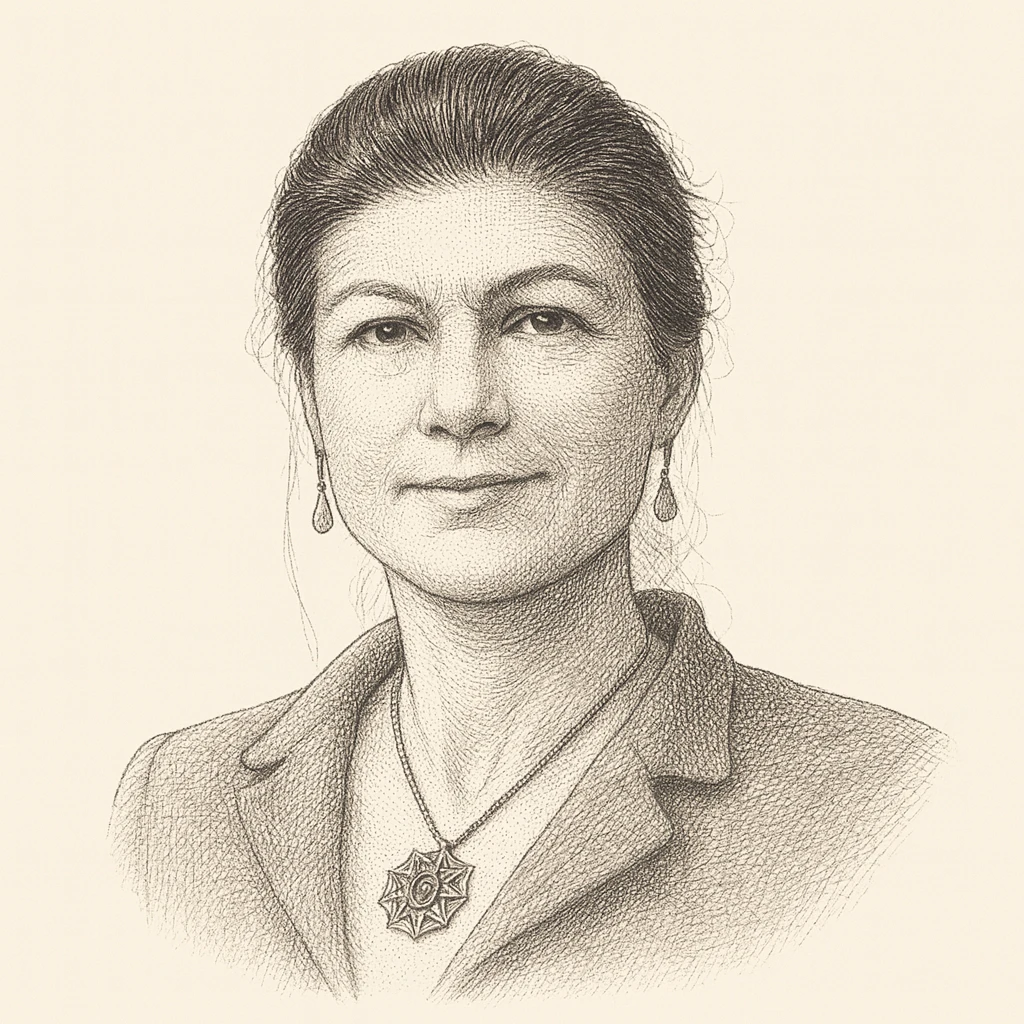
Sahra Wagenknecht is a German politician and author whose thought represents a distinctive and controversial current on the European left. Long associated with the party Die Linke (The Left) and its predecessor traditions, she rose to prominence as a leading voice of the party's more orthodox Marxist wing, having been affiliated in her early career with the Communist Platform. Her economic thinking emphasizes redistribution, the defense of the welfare state, robust public investment, and sharp criticism of neoliberalism, financial capitalism, and what she portrays as an elite disconnected from ordinary working people. She has drawn on socialist and, at times, older ordoliberal economic ideas, arguing for an economy oriented toward productive labor rather than speculation.
What sets Wagenknecht apart is her combination of left-wing economics with cultural conservatism. She has been openly skeptical of large-scale immigration and of what she describes as a cosmopolitan, identity-focused "lifestyle left" that she believes has abandoned the material interests of workers. She coined critiques of what she has called "left-wing liberalism," contending that progressive elites prioritize symbolic and cultural questions over economic security, thereby alienating traditional working-class voters and pushing them toward the right. This diagnosis links her to broader debates across Europe and North America about the realignment of class and cultural politics.
Wagenknecht has also been a persistent critic of NATO, U.S. foreign policy, and Western military engagements, favoring diplomacy and a more independent German and European posture. Her positions on Russia and on Germany's support for Ukraine have generated significant controversy. In 2024 she broke from Die Linke to found a new party bearing her own name, the Bündnis Sahra Wagenknecht, explicitly built around her synthesis of social justice, economic sovereignty, peace-oriented foreign policy, and restrictive migration positions.
As a political thinker, Wagenknecht matters less for systematic theory than for embodying and articulating a wager: that a viable left must speak to economic grievance and cultural belonging simultaneously. Her arguments have fueled intense discussion about populism, class politics, and whether the traditional left-right spectrum adequately captures contemporary political divisions, making her a reference point for those who see cultural liberalism and economic egalitarianism as increasingly detachable.
Sahra Wagenknecht is associated with Left Nationalist. See the archetype