
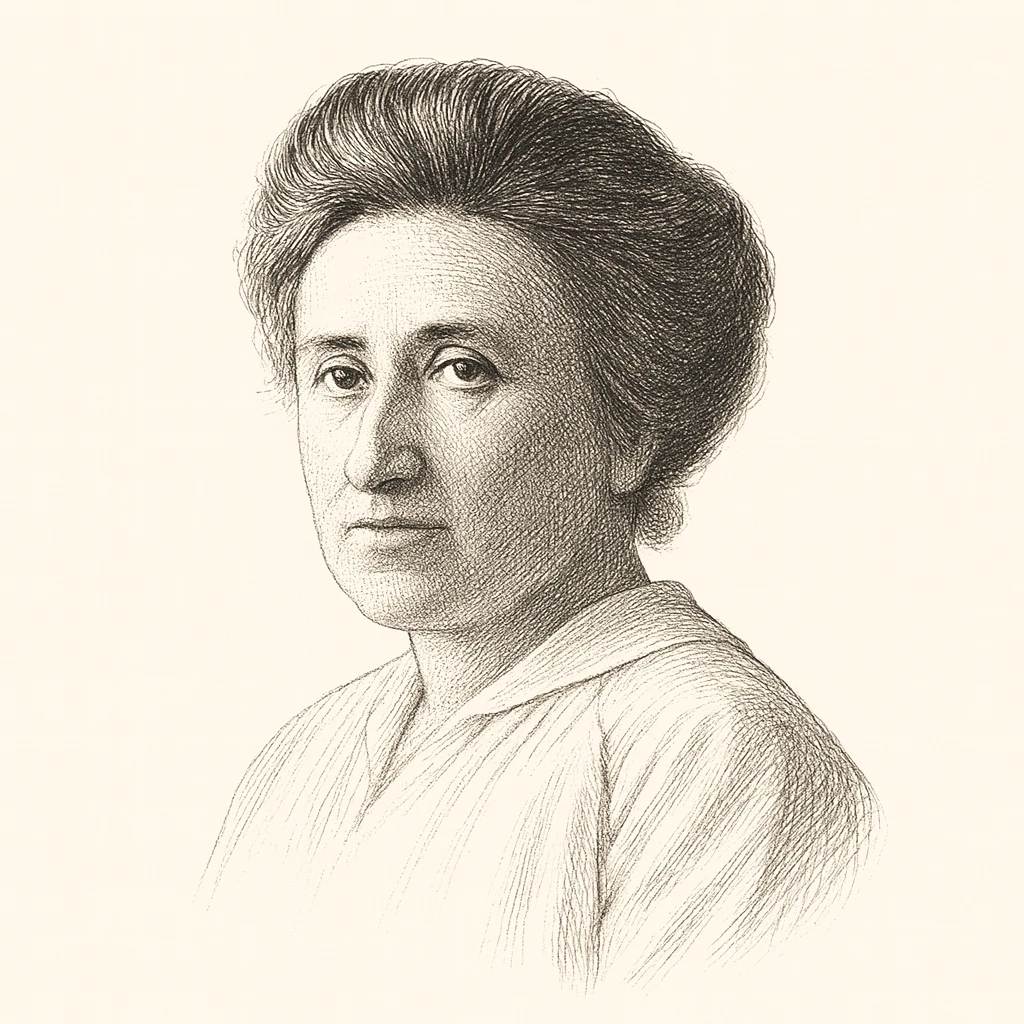
Rosa Luxemburg was born in 1871 in Zamość, a small city in Russian-occupied Poland, the youngest of five children in a middle-class Jewish family. Her father was a merchant with a genuine intellectual culture, and she absorbed from her family both the Yiddish-inflected radicalism of Polish Jewish life and the classical German literature that she would later cite with the ease of someone who had grown up inside it. She was politically conscious from adolescence — she participated in illegal revolutionary activities in Warsaw while still a schoolgirl — and fled to Zurich in 1889 to escape arrest, enrolling at the University of Zurich in natural science before switching to political economy and law. Her doctoral dissertation, on the industrial development of Poland, demonstrated from the beginning the combination of empirical rigor and political argument that would characterize her major theoretical work.
She arrived in Germany in 1898 with a hastily arranged marriage to a German citizen that gave her the nationality she needed to participate in German political life, and threw herself immediately into the German Social Democratic Party, then the largest and most theoretically sophisticated socialist organization in the world. Within months she had produced the pamphlet that made her famous — Reform or Revolution — as a direct response to Eduard Bernstein's revisionism. Where Bernstein argued from empirical evidence that capitalism was not collapsing as Marx had predicted, and that the path to socialism ran through parliamentary reform, Luxemburg insisted that his empirical observations were correct but his conclusions were wrong: precisely because capitalism was stable in the short run, revolutionary rather than reformist transformation was the only honest goal. The parliamentary road led not to socialism but to the absorption of the socialist movement into capitalist politics. The debate defined the fault lines of the European left for the next two decades.
What distinguished her from other revolutionary Marxists of her generation was the quality of her theoretical imagination and her willingness to follow the argument wherever it led, even when that meant criticizing her own camp. The Accumulation of Capital (1913) was her major theoretical contribution: a 500-page work of economic analysis arguing that Marx's reproduction schemas left unresolved a fundamental problem about where the demand for capitalism's surplus product came from. Her answer was that capitalism required constant expansion into non-capitalist territories and economies — that imperialism was not a policy choice made by aggressive states but a structural necessity of the capitalist system itself. When there was no more non-capitalist world to expand into, the system's internal contradictions would become unmanageable. This was her explanation for why capitalism had survived past its predicted collapse: it had bought time by perpetually expanding its frontier.
Her political work was inseparable from her theoretical work and equally unsparing. She spent significant portions of the years between 1906 and 1918 in various German and Russian prisons, producing from confinement some of her most important writing. The Junius Pamphlet (1916), written during her first major wartime imprisonment, was a devastating critique of the SPD's decision to support the German war effort — a betrayal, she argued, of everything the socialist movement existed to do. Her letters from prison, collected as the Prison Letters, reveal a woman of extraordinary personal warmth and intellectual vitality, someone who could spend her days analyzing capitalism and her evenings writing with genuine tenderness about the birds she watched from her cell window. The letters to her friend Sophie Liebknecht, written during the darkest years of the war, are among the most remarkable personal documents of the period.
Her 1918 critique of Lenin, written during her second major imprisonment, was the text that established her permanent importance for the democratic left. The Russian Revolution had happened; the Bolsheviks had taken power. Almost everyone on the European left was celebrating. Luxemburg celebrated the seizure of power while condemning what the Bolsheviks were doing with it. Concentrating all power in the vanguard party, suppressing opposition parties, eliminating the freedom of the press — these were not, she argued, temporary tactical necessities. They were structural choices that would produce bureaucratic dictatorship rather than socialist democracy, that would strangle the creative energy of the masses that revolution was supposed to liberate. "Freedom," she wrote in the sentence that has outlasted almost everything else, "is always and exclusively freedom for the one who thinks differently." History confirmed this analysis with a precision that should have been embarrassing to her critics, and never quite was.
She was released from prison in November 1918 as the German Empire collapsed, and immediately threw herself into the revolutionary situation that seemed to be opening. The Spartacist uprising of January 1919 — an attempt by the revolutionary left to emulate the Bolshevik seizure of power in Germany — was poorly planned and ruthlessly suppressed by the Social Democratic government using right-wing paramilitary forces. Luxemburg was captured on the evening of January 15, beaten, shot, and thrown into the Landwehr Canal. She was forty-seven years old. Her body was not recovered until months later. The Social Democratic government that ordered her murder was the political tradition she had spent twenty years criticizing from the left — and whose support she had accepted for the revolution that killed her.
Rosa Luxemburg is associated with Democratic Socialist. See the archetype