
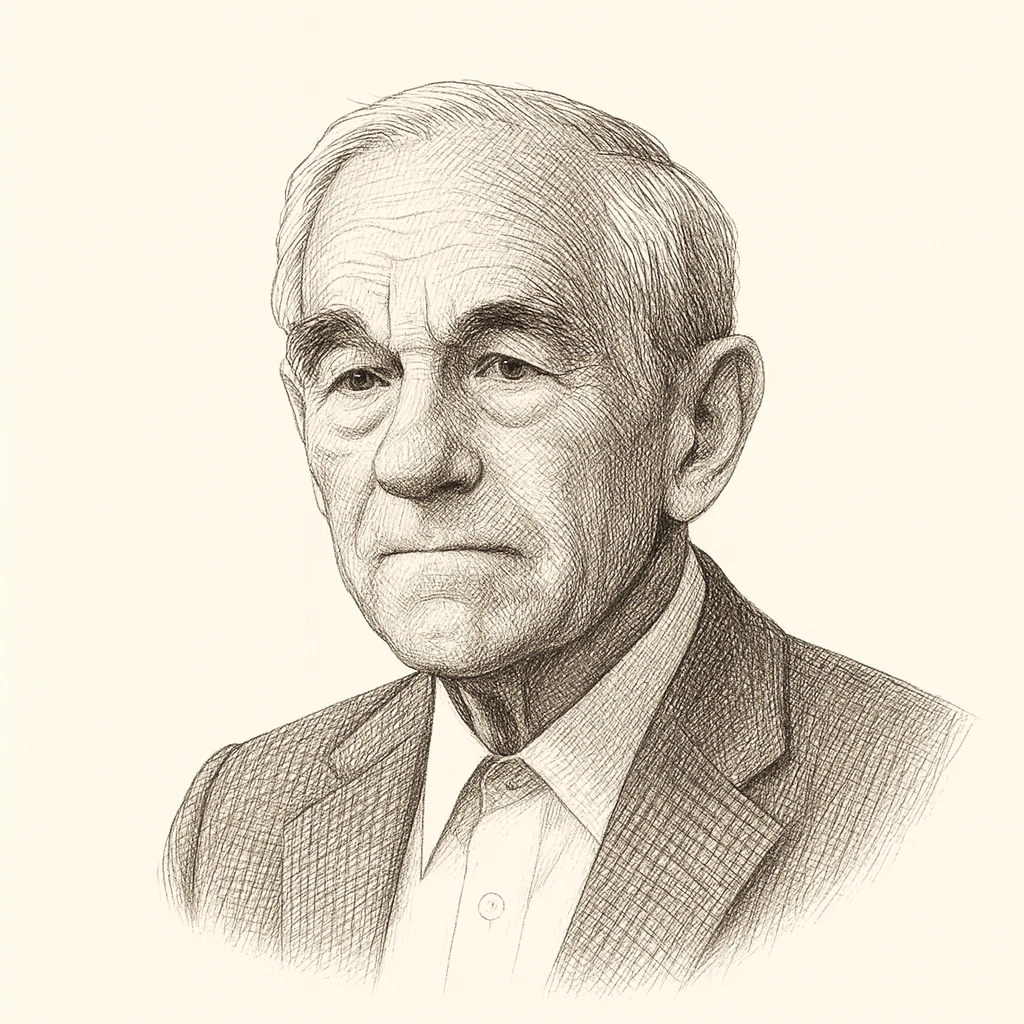
Ron Paul is an American physician and politician who represented Texas in the U.S. House of Representatives across several stints between the late 1970s and 2013, and who mounted presidential campaigns as both a Libertarian and a Republican, most consequentially in 2008 and 2012. Though his electoral victories were modest, his significance lies in the ideas he championed and the movement he catalyzed. Drawing heavily on the Austrian School of economics—especially Ludwig von Mises and Murray Rothbard—Paul built a political program around a small set of consistent commitments: sound money, sharply limited federal government, non-interventionist foreign policy, and civil liberties grounded in a strict reading of the Constitution.
Particularly identified with the cause of monetary reform, Paul became the most prominent political critic of the Federal Reserve in modern American life, arguing that central banking fuels inflation, financial bubbles, and the expansion of state power, and advocating a return to a commodity-backed currency. He linked this critique to a broader Austrian-influenced view of the business cycle and to hostility toward deficit spending and the welfare-warfare state. His foreign policy—opposition to military intervention, foreign aid, and what he described as an American empire abroad—set him apart from mainstream conservatives and made him a distinctive voice within the Republican Party.
Paul's thought is often described as libertarian with a paleolibertarian inflection, blending free-market economics with a states'-rights constitutionalism and a suspicion of centralized authority. He drew on classical liberal and Old Right traditions, favoring decentralization, individual liberty, and voluntary exchange over federal regulation. This combination attracted a coalition that cut across conventional party lines, uniting fiscal conservatives, antiwar activists, and younger voters drawn to his uncompromising message.
His lasting influence is less legislative than intellectual and organizational. Through his campaigns, prolific writing, and advocacy, Paul helped popularize Austrian economics and libertarian arguments among a new generation, seeding activist networks and organizations that outlasted his time in office. He is frequently credited with helping to spark broader grassroots ferment on the right and with mentoring a cohort of libertarian-leaning politicians, including his son, Senator Rand Paul. Whether admired or criticized, he is widely recognized as the figure who moved libertarian ideas from the ideological margins toward the center of American political debate.
Ron Paul is associated with Traditional Libertarian. See the archetype