
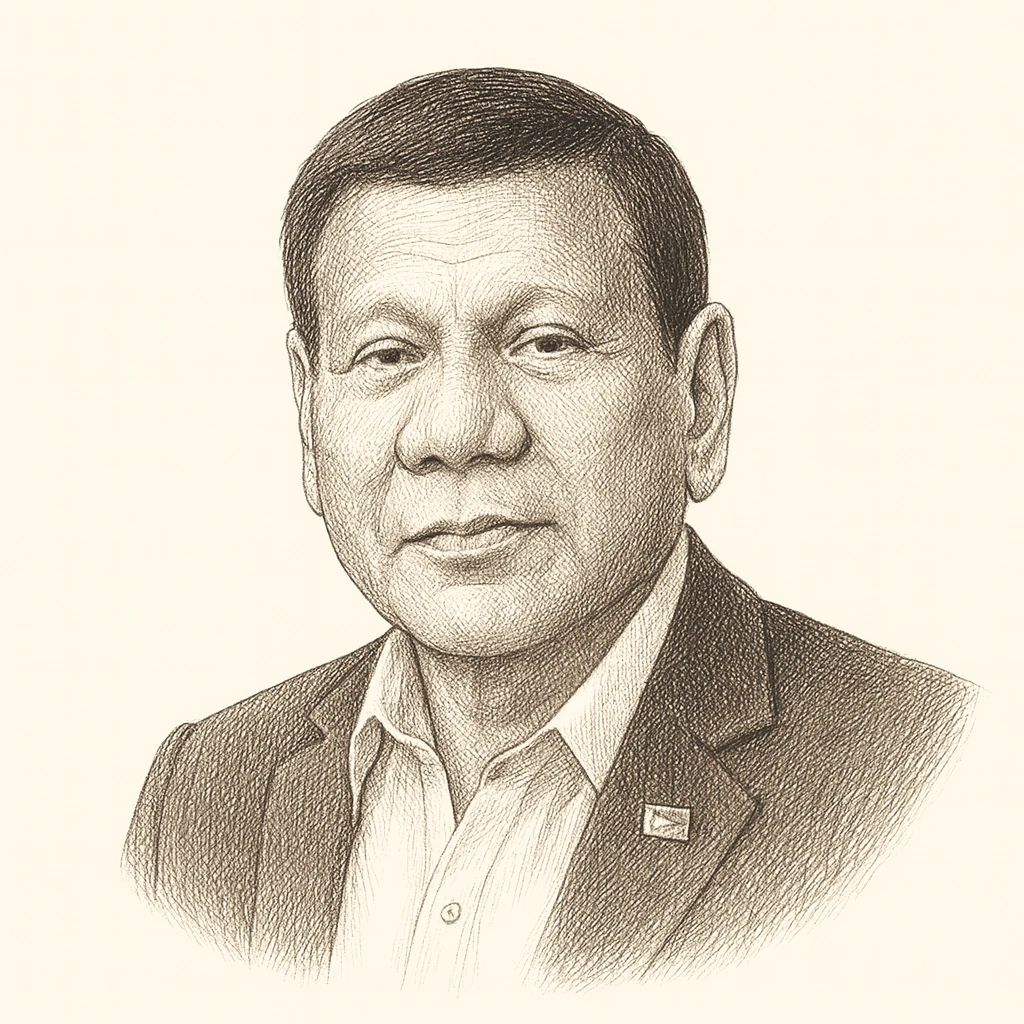
Rodrigo Duterte, who governed the Philippines from 2016 to 2022 after decades as mayor of Davao City, became the defining exemplar of a punitive, personalist populism in contemporary Southeast Asian politics. His political thought centered on the primacy of public order and the claim that ordinary citizens' safety justified extraordinary state coercion. Framing crime—particularly the illegal drug trade—as an existential threat to the nation, he argued that conventional legal procedures were obstacles to protecting the majority, and he presented himself as a decisive father-figure willing to bear moral responsibility for violence that others would not. This law-and-order absolutism, coupled with a deliberately profane and anti-elite rhetorical style, allowed him to position himself against Manila's political establishment, liberal reformers, and human-rights advocates whom he cast as detached from the fears of common people.
Duterte's governing philosophy fused populist majoritarianism with a strong emphasis on national sovereignty and skepticism toward Western liberal norms. He frequently rejected external criticism of his human-rights record as neocolonial interference, and he recalibrated Philippine foreign policy toward closer ties with China and Russia while questioning long-standing alignment with the United States. His signature "war on drugs" produced thousands of killings and drew condemnation from international bodies, yet it also commanded substantial domestic popularity, illustrating how demands for security and order can override procedural and rights-based concerns in democratic settings. In this sense he crystallized a broader global pattern in which elected leaders claim popular mandates to concentrate power and marginalize institutional checks.
His influence lies less in any systematic doctrine than in demonstrating the political potency of the strongman archetype within an electoral democracy. Duterte showed that a leader could combine transgressive candor, promises of ruthless efficiency, and appeals to a besieged silent majority to build durable loyalty, offering a template studied and debated across the region and beyond. His trajectory—from popular president to detainee at the International Criminal Court, where he was taken into custody in 2025 to face crimes-against-humanity charges connected to the drug war—has also made him a focal point in arguments about accountability, sovereignty, and the reach of international justice. Debates over his legacy continue to shape how Filipinos and outside observers weigh security against human rights and populist authority against constitutional restraint.
Wondering where you land? Take the 4-minute assessment