
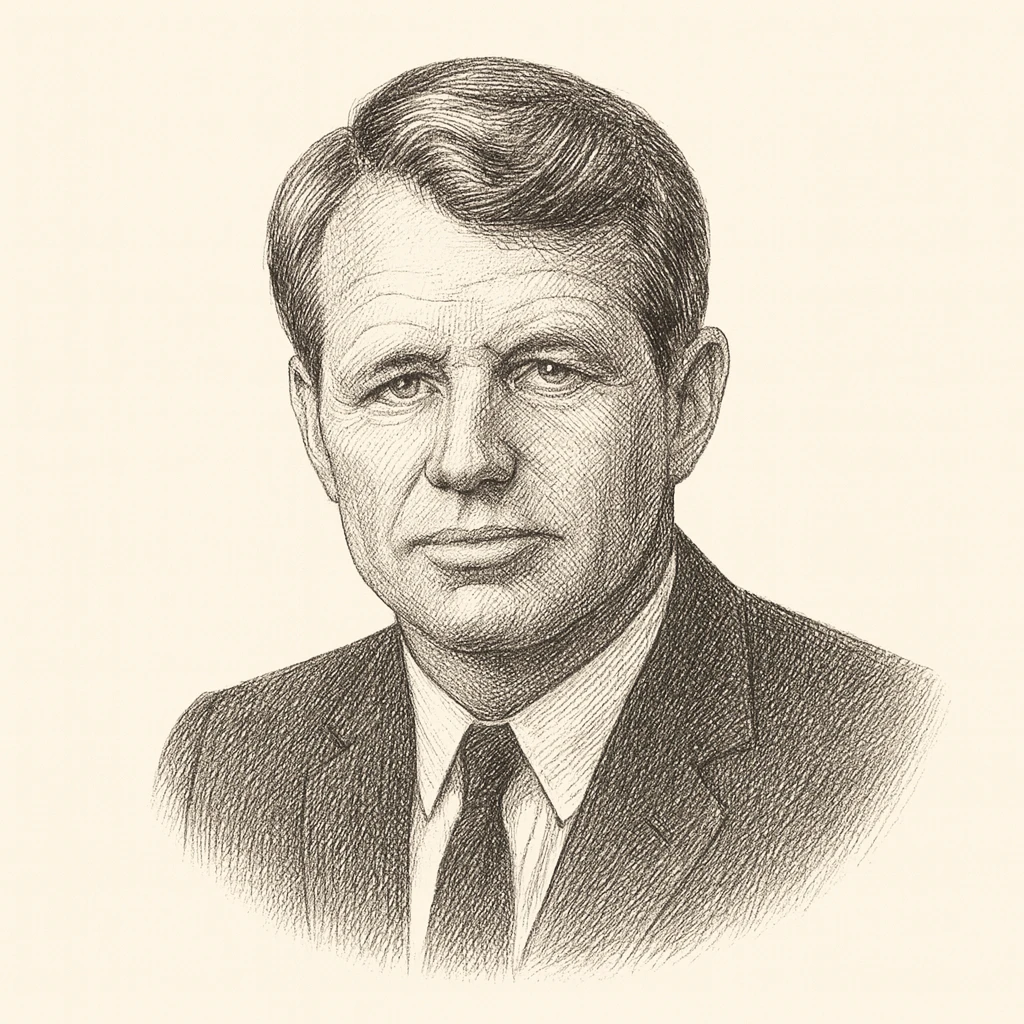
Robert Francis Kennedy (1925–1968) began his public career as a combative counsel and campaign manager, first gaining prominence investigating labor corruption and organized crime before serving as Attorney General during his brother John F. Kennedy's presidency. In that role he became a central figure in the federal government's confrontation with segregation, deploying the powers of the Justice Department to enforce court orders, protect civil rights activists, and expand voting rights. His early reputation was that of a tough, results-driven operator, and this pragmatic strain remained a defining feature of his political identity: he was skeptical of ideology for its own sake and attentive to the mechanics of power and enforcement.
Over the 1960s, and especially after his brother's assassination, Kennedy's public thought took on a more expansive and morally urgent character. As a senator from New York and eventually a candidate for the presidency in 1968, he articulated a liberalism increasingly concerned with poverty, racial injustice, and the alienation of ordinary citizens from institutions. He drew attention to conditions among migrant farm workers, urban Black communities, and impoverished regions such as Appalachia, arguing that prosperity and legal equality meant little without economic dignity and genuine inclusion. He was also a critic of the Vietnam War, framing dissent in terms of national conscience.
Kennedy is often described as bridging older and newer currents of American politics. He combined an inherited Cold War liberalism and Catholic moral sensibility with a growing emphasis on empowerment, community, and skepticism toward large, impersonal bureaucracies—both governmental and corporate. This blend allowed him to appeal simultaneously to working-class and traditional constituencies and to younger activists and minority voters, a coalition that later commentators have treated as a road not taken in American liberalism. His questioning of unchecked economic growth as a measure of national wellbeing anticipated later debates about the limits of material metrics for social health.
His assassination in June 1968 cut short this evolving synthesis, and his political meaning has been contested ever since. Admirers see in him a model of morally serious, empathetic politics capable of uniting divided groups; critics point to his earlier ruthlessness and question how coherent his late-career vision truly was. Either way, he remains a touchstone for arguments about whether liberalism can combine toughness with compassion and reach across class and racial lines.
Robert F. Kennedy Sr. is associated with Conservative Democrat. See the archetype