
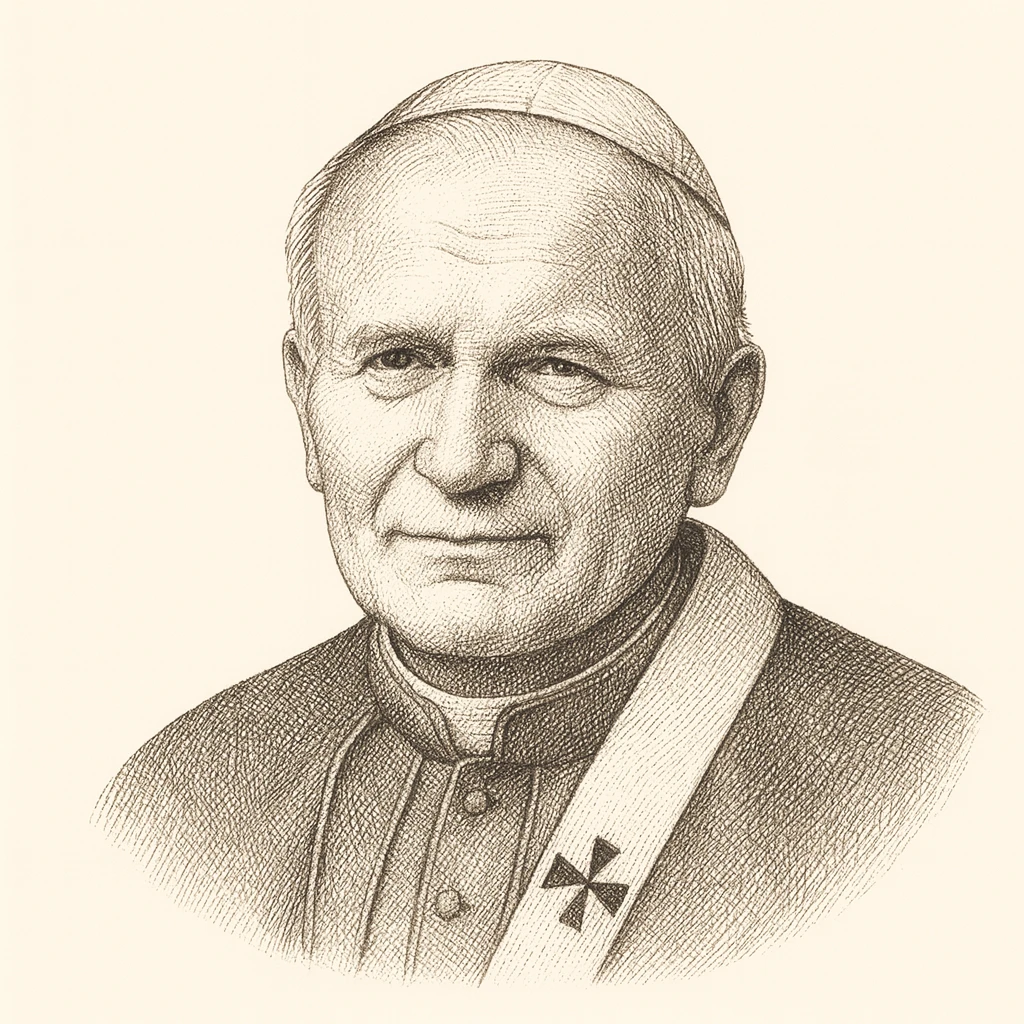
Karol Wojtyła, who became Pope John Paul II in 1978, brought to the papacy a philosophical formation in phenomenology and personalism that shaped a distinctive political theology centered on the dignity of the human person. Having lived under both Nazi occupation and Soviet-backed communism in Poland, he treated the defense of human freedom and conscience not as abstract principle but as urgent moral necessity. His pastoral visits to Poland and his moral encouragement of the Solidarity movement are widely credited with helping to galvanize the resistance that contributed to the collapse of communism in Central and Eastern Europe, making him one of the most consequential political figures of the late twentieth century, even as he held no state office.
His political thought is most systematically expressed in his social encyclicals, above all Centesimus Annus, issued in 1991 to mark the centenary of Leo XIII's Rerum Novarum. There he offered a considered verdict on the post-communist order: a firm rejection of Marxist collectivism and atheistic materialism, a qualified endorsement of free enterprise and private initiative, and a simultaneous insistence that markets operate within moral and juridical limits. He argued that economic freedom must serve human ends, that consumerism and the reduction of persons to producers or consumers deform society, and that solidarity and the common good constrain what markets may be permitted to do.
Across his writings, John Paul II elaborated a vision in which authentic freedom is inseparable from truth and moral order, opposing what he described as a drift toward relativism in liberal democracies. He defended the rights of workers, families, and the unborn, framing a consistent ethic that resisted easy alignment with either left or right. This positioning made him a touchstone for religious conservatives who share his conviction that political and economic arrangements must answer to a transcendent account of the human person.
His record is not without serious criticism: his governance of the clerical sexual-abuse crisis is now widely judged a failure — he defended Legion of Christ founder Marcial Maciel for years despite credible allegations, and the Vatican's own 2020 McCarrick Report found he advanced Theodore McCarrick despite explicit warnings. Critics also fault his doctrinal conservatism, discipline of dissenting theologians, and teachings on sexuality and the role of women. Supporters and detractors alike, however, acknowledge the scale of his influence on how faith, freedom, and politics are understood.
Pope John Paul II is associated with Religious Conservative. See the archetype