
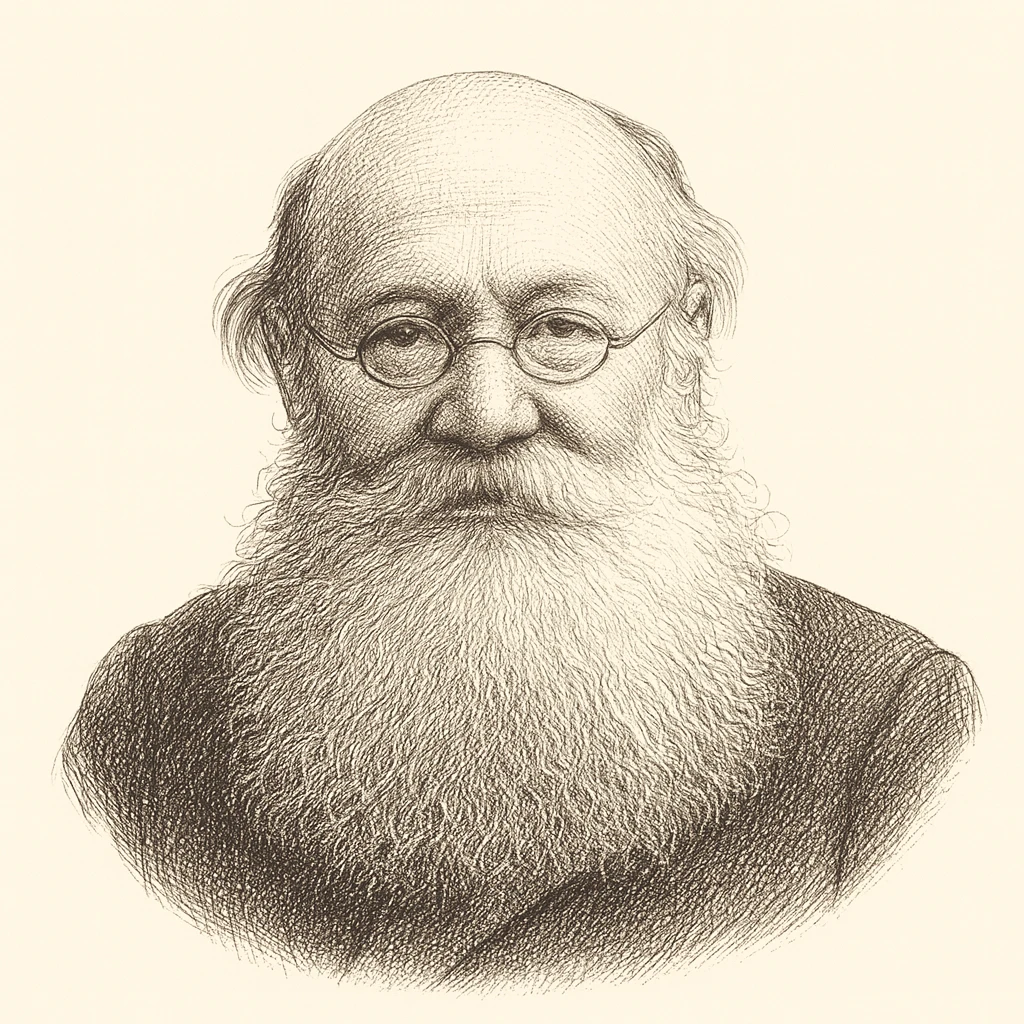
Peter Kropotkin was the most important systematic philosopher of anarchism in the late 19th and early 20th centuries, a Russian aristocrat turned revolutionary whose scientific training as a geographer and naturalist shaped his distinctive contribution to anarchist thought: the argument that cooperation, mutual aid, and voluntary association were natural rather than artificial features of human life, and that a society organized on anarchist principles was not a utopian fantasy but a recovery of something that had always been present in human evolution. Where earlier anarchists had focused primarily on critique of the state and capitalism, Kropotkin built a positive vision of what a voluntary cooperative society might actually look like, drawing on historical examples from medieval free cities to contemporary mutual aid societies. His influence on the anarchist tradition was enormous, and his work remains essential reading for anyone trying to understand anarchism as a serious political philosophy rather than just a set of complaints about existing power structures.
Kropotkin was born in 1842 in Moscow into one of the most prominent noble families in Russia, with a direct lineage from the medieval rulers of Kyiv. He could have had any career the Russian aristocracy offered — diplomatic service, the military, or a comfortable sinecure at the imperial court. Instead he chose military service in Siberia, where he served in a Cossack regiment from 1862 to 1867 and used the opportunity to conduct extensive geographical research in a region that was largely unmapped at the time. His observations transformed the scientific understanding of Siberian geography, earned him a distinguished reputation among Russian scientists, and gave him the direct experience of peasant communities and non-hierarchical social organization that would shape his later political thinking.
By the early 1870s, Kropotkin had become convinced that the Russian autocracy was fundamentally incompatible with human flourishing and that meaningful change required revolutionary political transformation. He joined the Russian radical movement, was arrested in 1874, imprisoned in the Peter and Paul Fortress (from which he made a famous escape in 1876), and spent the next four decades in European exile, first in Switzerland, then England, France, and back to England. During these exile years he produced the body of work that made him the most widely read anarchist philosopher of his era.
His major theoretical contribution was the concept of mutual aid, developed most fully in the book of that name published in 1902. Kropotkin was writing against the Social Darwinist interpretation of evolution that had dominated late 19th century popular thought, which held that nature was fundamentally competitive and that "survival of the fittest" meant the survival of the most ruthlessly individualistic and aggressive. Kropotkin, drawing on his own biological research and on a careful reading of Darwin himself, argued that this interpretation missed what was actually observable in nature. Cooperation and mutual aid were as biologically significant as competition, and in many species — including humans — cooperation was the decisive factor in evolutionary success. Ants cooperated. Bees cooperated. Wolves cooperated. Early human bands cooperated. The idea that civilization had to be built against nature by imposing discipline on our supposedly selfish biological inheritance was backwards. Civilization was built from a biological inheritance that already included deep capacities for cooperation, and political arrangements that suppressed these capacities were the actual distortions of human nature rather than correctives to it.
This argument had enormous implications for political philosophy. If human beings were naturally cooperative rather than naturally competitive, then the traditional justification for state authority — that only coercive central power could prevent the war of all against all — was built on a false anthropology. The Hobbesian picture of the state of nature was wrong. Human beings left to themselves would not descend into chaos. They would spontaneously form the kinds of cooperative associations that they had formed throughout human history, from the Germanic village communes to the medieval craft guilds to the Russian peasant communes to the modern trade unions and mutual aid societies. The state was not necessary to produce social order. The state was an institution that suppressed the natural social order that humans would produce on their own and replaced it with an artificial hierarchical order that served the interests of ruling classes.
Kropotkin's positive vision of anarchist society was developed most accessibly in The Conquest of Bread (1892), a book written for a general working-class audience. The book argued that modern industrial production had reached a level of abundance that made socialist scarcity politics obsolete. There was enough food, enough housing, enough clothing for everyone to live comfortably. The problem was not production but distribution, and the distribution problem was created by capitalist property relations and state power working together. An anarchist communist society would simply reorganize distribution according to need, through voluntary associations of producers and consumers cooperating without central authority. Kropotkin went into considerable detail about how this might work practically, drawing on contemporary examples of cooperatives, mutual aid societies, and voluntary associations that were already functioning successfully. The Conquest of Bread became one of the most widely read anarchist texts of the late 19th and early 20th centuries, influencing movements from the Spanish anarchist unions to the Russian revolutionary left to American radical immigrant communities.
Kropotkin's relationship with the Russian Revolution was complicated and ultimately tragic. He supported the February 1917 revolution that overthrew the czar and returned to Russia after four decades of exile. But he quickly became a sharp critic of the Bolshevik seizure of power in October 1917 and of the authoritarian direction the revolution took under Lenin. He spent his final years in a small Russian town writing on ethics and correspondent with the new Bolshevik leadership, warning them that they were betraying the revolution's promise by rebuilding state authority in more centralized form than the czars had ever managed. He died in 1921, and his funeral was the last public demonstration of anarchist sentiment in Russia before the Soviet state finally crushed the anarchist movement entirely. Tens of thousands of people attended, and anarchist banners were displayed publicly for the last time in what would become the Soviet Union.
Kropotkin's influence on subsequent anarchist thought has been enormous. His vision of anarchist communism as a positive cooperative politics rather than mere opposition to the state shaped the Spanish anarchist movement during the Civil War, the broader international anarchist tradition throughout the 20th century, and contemporary anarchist and libertarian left thought. His argument about mutual aid has also had influence beyond explicitly anarchist circles — it shaped debates about the biological foundations of human sociality, influenced the development of evolutionary theory in the 20th century, and continues to be cited in contemporary discussions about the nature of cooperation and altruism in human behavior.
Peter Kropotkin is associated with Progressive Activist. See the archetype