
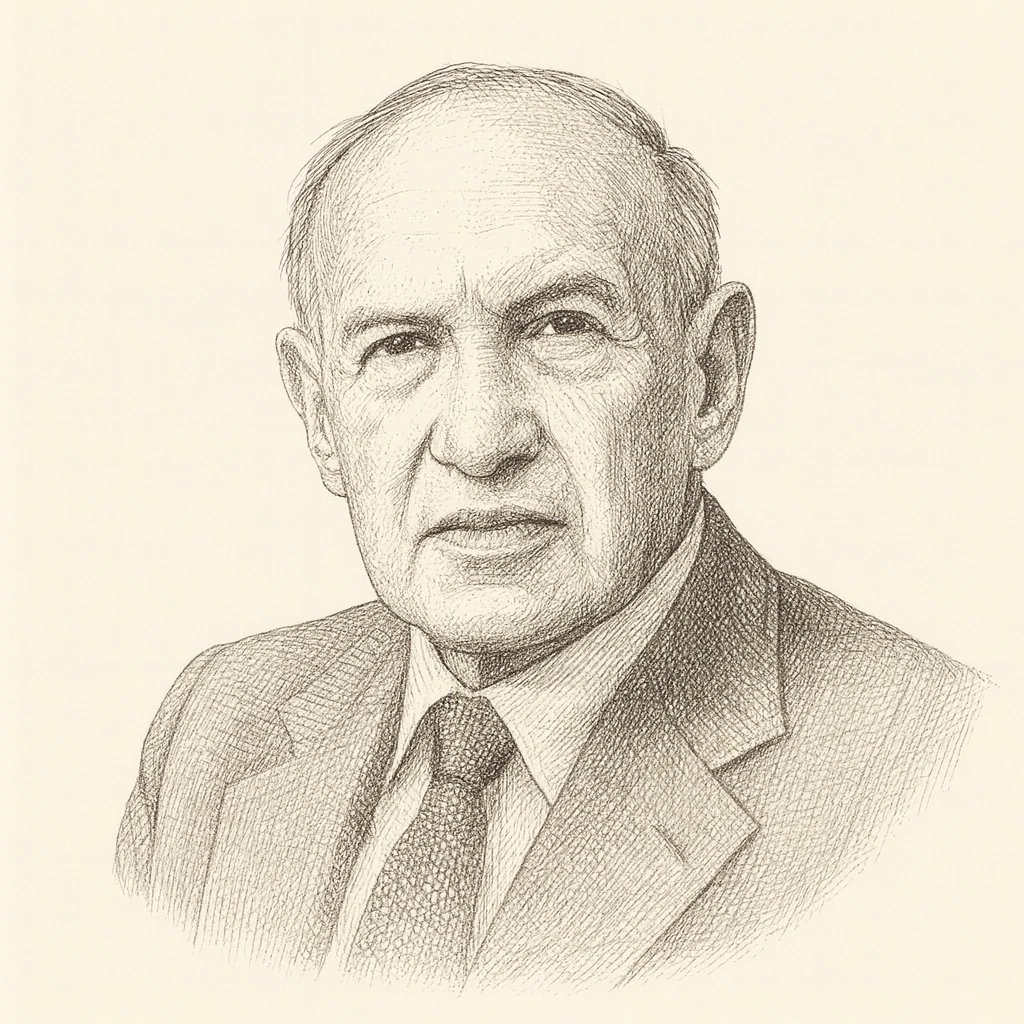
Peter Drucker (1909–2005) was born in Vienna and educated in the German-speaking intellectual world before fleeing the rise of Nazism, eventually settling in the United States. Though best remembered as the founder of modern management studies, Drucker consistently framed management as a fundamentally political and social problem rather than a merely technical one. His early work responded directly to the collapse of European liberal order, examining how totalitarianism filled the vacuum left when older communities and institutions failed to give ordinary people meaning, status, and function. This concern with the sources of legitimacy and social cohesion runs through his entire body of thought.
Drucker's central political insight was that the large business corporation had become the representative social institution of industrial society, comparable in importance to the church, the guild, or the nation-state in earlier eras. He argued that because so much of modern life is lived within organizations, these institutions must be evaluated not only by economic efficiency but by whether they confer dignity, community, and a functioning role on the individual. In this sense he sought a middle path between unregulated capitalism and centralized state planning, favoring decentralized, self-governing institutions and a pluralist society of competing centers of authority rather than concentrated power.
His vision has been described as broadly conservative in temperament yet reformist in aim: skeptical of utopian schemes and grand ideologies, attentive to the limits of government, but insistent that private power carries public responsibilities. He emphasized that authority in any institution must be legitimate and accountable, and he was wary of both bureaucratic gigantism and the erosion of intermediate communities that stand between the individual and the state. He also foresaw the rise of what he called the knowledge worker and a society organized around organizations, with profound implications for how power, participation, and social order would be distributed.
Drucker's influence on political thought is indirect but substantial. By treating institutions and their governance as the arena where freedom is either secured or lost, he shaped how thinkers across the spectrum understand civil society, corporate responsibility, and the conditions for a functioning free society. His pluralism and his emphasis on legitimacy and social function continue to inform debates about the proper roles of markets, government, and the many organizations that structure modern life.
Peter Drucker is associated with Establishment Progressive. See the archetype