
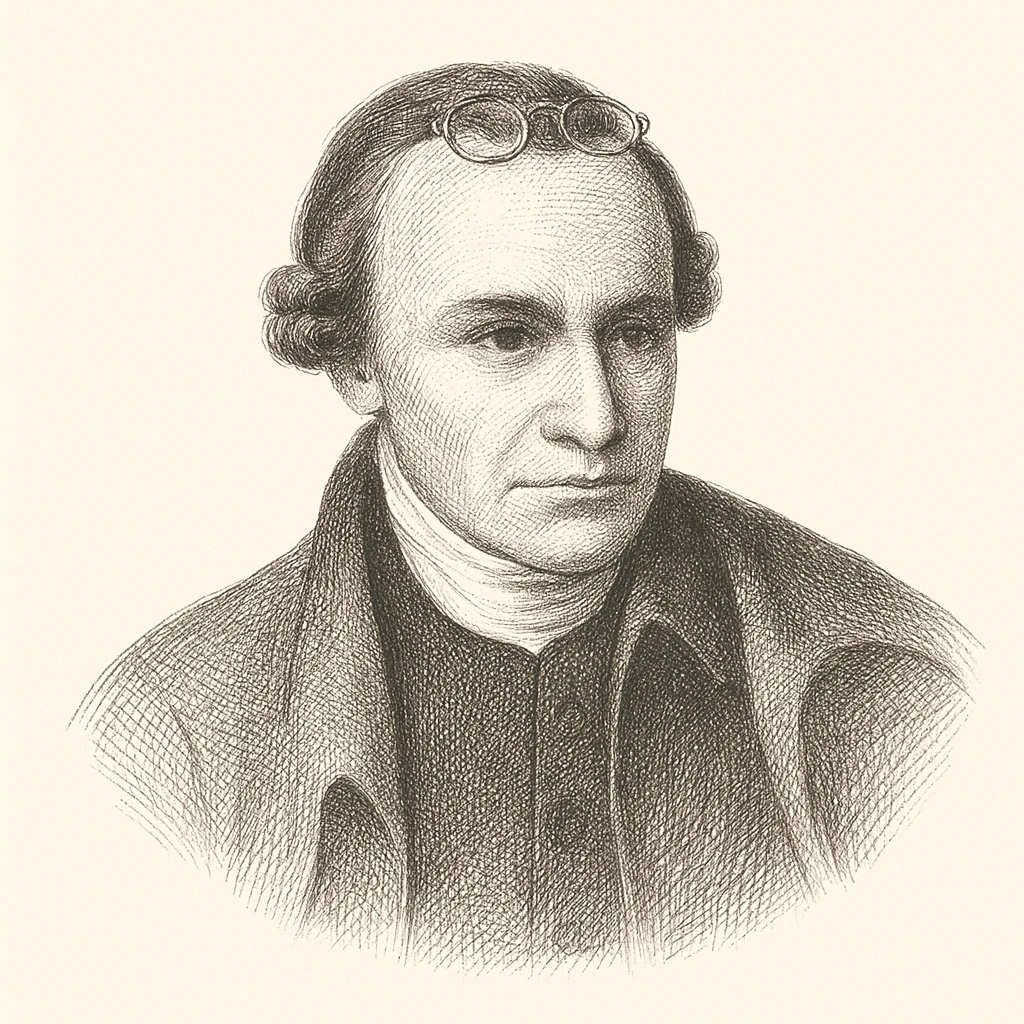
Patrick Henry was the fiery orator of the American Revolution whose speeches rallied colonists to independence. A self-taught Virginia lawyer, Henry first gained fame for the 'Parsons' Cause' case challenging British authority in 1763, arguing that a king who vetoed beneficial colonial laws forfeited his subjects' obedience. He soon pressed the same logic in the Virginia legislature, where his resolutions against the Stamp Act in 1765 gave forceful voice to the principle that only elected colonial assemblies, not a distant Parliament, could tax the people they represented. His 1775 speech to the Virginia Convention—'Give me liberty, or give me death!'—became the Revolution's rallying cry.
Henry served as Virginia's first post-colonial governor and was instrumental in revolutionary politics. His political thought rested on a deep distrust of distant, unaccountable authority and a conviction that liberty is safest close to the people who must defend it. That same instinct made him oppose the Constitution as giving too much power to the federal government, and he became a leading Anti-Federalist. At Virginia's 1788 ratifying convention he warned that the new charter would consolidate the states into a single national government, arguing that its language spoke of 'We the People' rather than the sovereign states, and that a strong central authority, backed by taxation and a standing army, threatened the freedoms so recently won. He clashed directly with James Madison over these questions.
Henry lost the ratification fight, but his demand for explicit protections of individual rights contributed to the Bill of Rights, which Madison drafted partly to answer Anti-Federalist objections. In this sense the amendments enshrining freedoms of speech, religion, and the press, and limits on federal power, are in part a monument to the arguments Henry pressed and lost.
In later years, Henry's politics shifted conservative as he worried about democratic excess and supported the Federalists. He declined Washington's offers of cabinet positions and a Supreme Court seat. Like many Virginia planters of his era, he owned enslaved people even as he acknowledged slavery to be a moral evil, a contradiction he never resolved in practice.
Henry represents the libertarian strain in American political thought—suspicious of concentrated power whether British or federal. Later champions of states' rights, limited government, and individual liberty against centralized authority have repeatedly claimed his legacy, though his warnings against consolidation have been invoked across a wide and often conflicting range of causes.
Patrick Henry is associated with Traditional Libertarian. See the archetype