
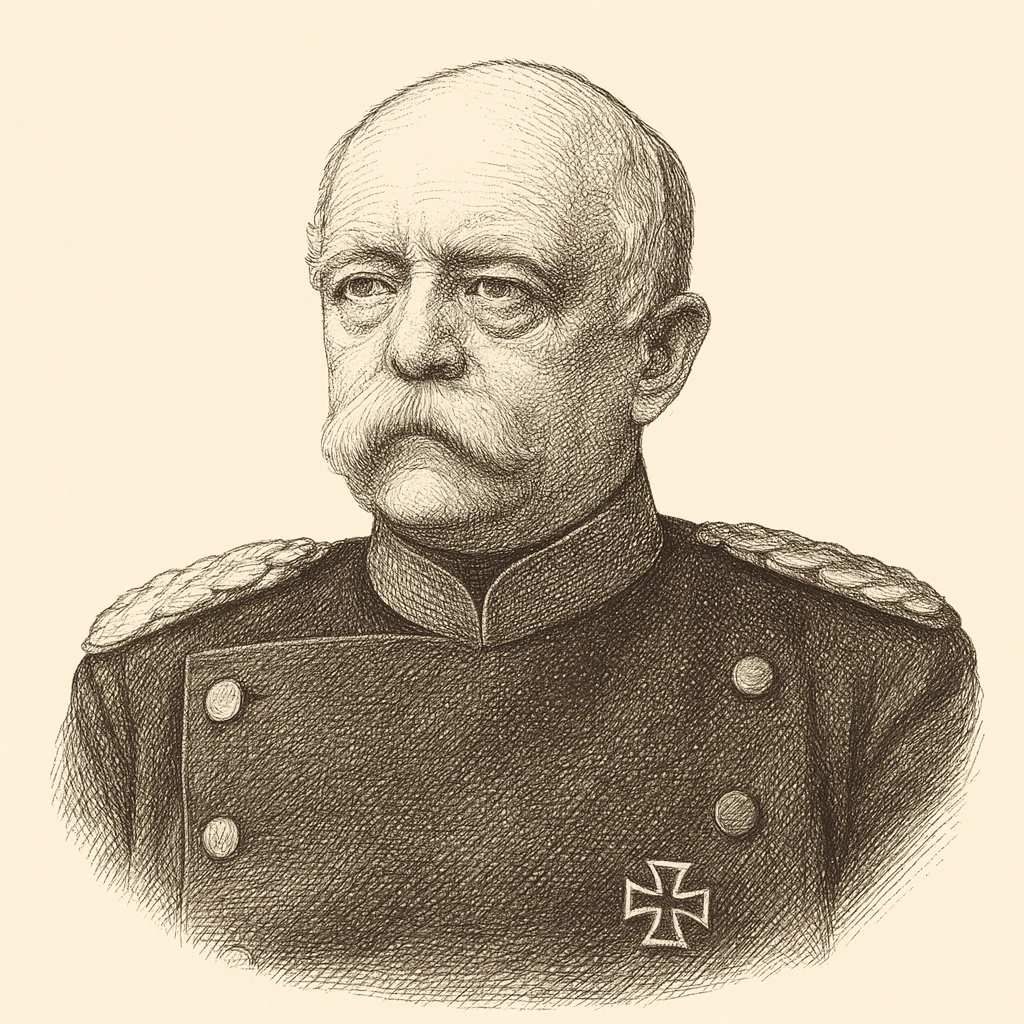
Otto von Bismarck was the 'Iron Chancellor' who unified Germany through 'blood and iron' and then dominated European diplomacy for two decades. A Prussian Junker, Bismarck served as Prussia's minister-president before engineering three wars that created the German Empire with Prussia at its head. His best-known formulation, that the great questions of the day would be settled not by speeches and majority votes but by iron and blood, was addressed to the liberal parliamentarians opposing him in Prussia and invoked the failure of 1848.
Bismarck's method was Realpolitik—politics based on practical calculation rather than ideology. He provoked wars with Denmark, Austria, and France precisely when conditions favored Prussia, creating a unified Germany in 1871. An opponent of bourgeois liberalism, he pursued unification as a means to Prussian dominance in Germany and Europe. As Chancellor, he built an intricate alliance system to isolate France and maintain peace, a balance that depended on keeping several powers tied to Berlin and that collapsed after his dismissal.
Domestically, Bismarck pioneered the welfare state (accident insurance, health insurance, old-age pensions) to undercut socialist appeal. The logic was explicitly instrumental: by having the state provide security, he hoped to detach workers from the Social Democrats, whom he simultaneously suppressed through anti-socialist laws. He fought Catholics (Kulturkampf) and socialists alike, treating both as threats to the unity and authority of the new empire; the Kulturkampf was eventually wound down without achieving its aims.
His constitution balanced parliamentary forms with authoritarian substance. Universal male suffrage for the Reichstag coexisted with a chancellor responsible to the emperor rather than to the Reichstag, and with Prussia's three-class franchise, which weighted votes by the taxes each voter paid. Kaiser Wilhelm II dismissed Bismarck in 1890, and his departure destabilized the system he had created: his successors let the Reinsurance Treaty with Russia lapse that year, and France and Russia soon moved into alliance.
His legacy includes German unification, modern welfare states, and the Realpolitik tradition in international relations. From the 1970s, the Sonderweg school of German historiography associated with Hans-Ulrich Wehler argued that the empire he founded kept an anti-democratic elite in power, and traced the fall of German democracy in 1933 in part to that elite.
Otto von Bismarck is associated with Welfare Nationalist. See the archetype