
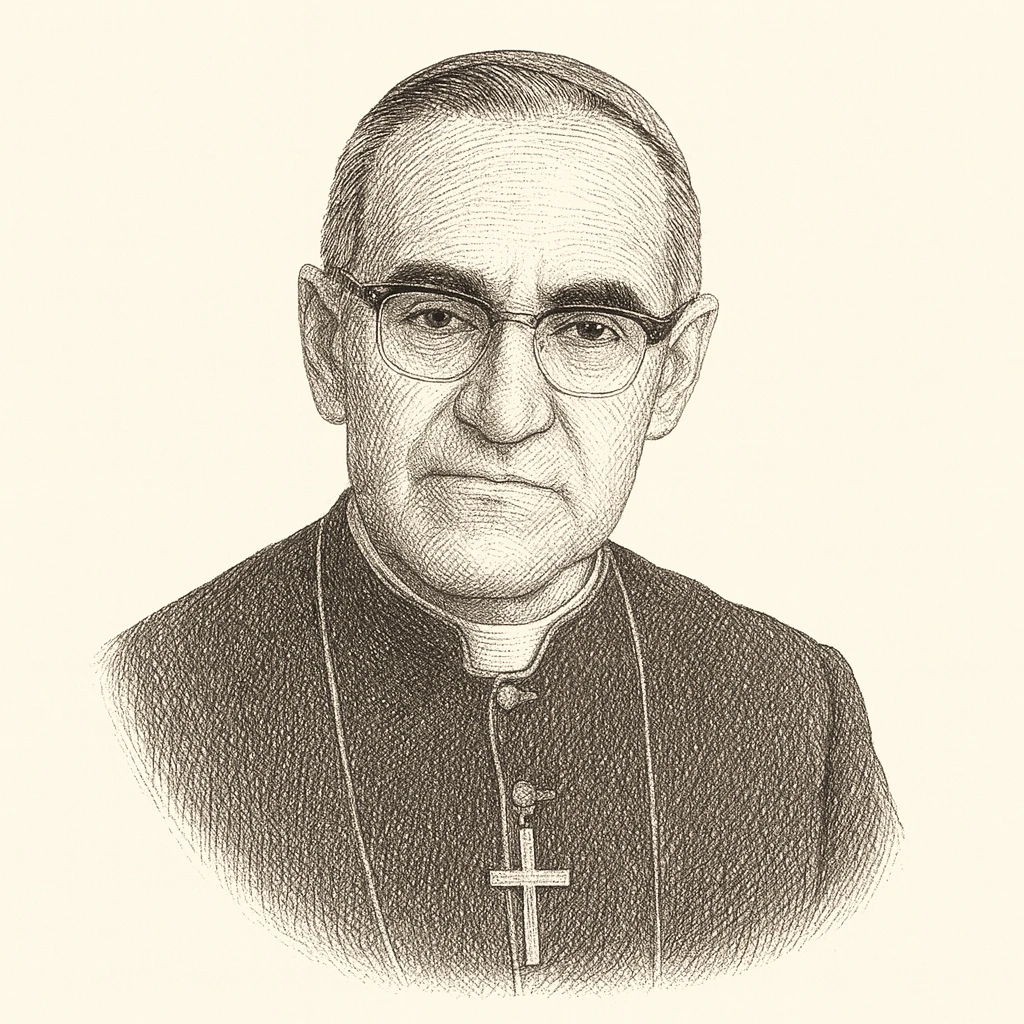
Óscar Romero (1917–1980) was the Roman Catholic Archbishop of San Salvador during the escalating repression that preceded El Salvador's civil war. Initially regarded as a theologically conservative and cautious choice for the post, Romero underwent a widely documented transformation in the late 1970s as he witnessed the killing of priests and lay Catholics and the systematic persecution of peasants and organizers. His outlook came to reflect the concerns of liberation theology, the movement, formalized at the Latin American bishops' conferences at Medellín and Puebla, that insisted the church exercise a "preferential option for the poor" and read the Gospel as a call to confront structural injustice, not merely to offer private consolation.
Romero's political thought is best understood through his public voice as a pastor rather than through systematic treatises. In weekly homilies broadcast by radio, he denounced state violence, documented disappearances and killings, and argued that the church could not remain neutral in the face of institutionalized poverty and repression. He distinguished between the church's spiritual mission and partisan politics while insisting that defending human dignity and denouncing injustice were intrinsic to faith. He famously appealed to soldiers to disobey orders to kill, invoking the primacy of conscience and God's law over unjust commands from the state—a position that placed him in sharp conflict with the military-backed government and El Salvador's ruling elites.
He was assassinated in 1980 while celebrating Mass, an act widely attributed to elements linked to right-wing death squads. His killing made him an international emblem of the costs of speaking against state terror and of the church's engagement with the poor. Romero's legacy has been contested: critics on the right long portrayed liberation theology as a vehicle for Marxist influence, while defenders emphasized his grounding in traditional Catholic social teaching and his rejection of violence. Canonized as a saint by the Catholic Church, he remains a reference point for debates about the relationship between religion and political power, the moral limits of obedience to authority, and the responsibility of institutions toward the marginalized. His witness continues to shape thinking about faith-based resistance, human rights, and solidarity with the poor across Latin America and beyond.
Oscar Romero is associated with Christian Socialist. See the archetype