
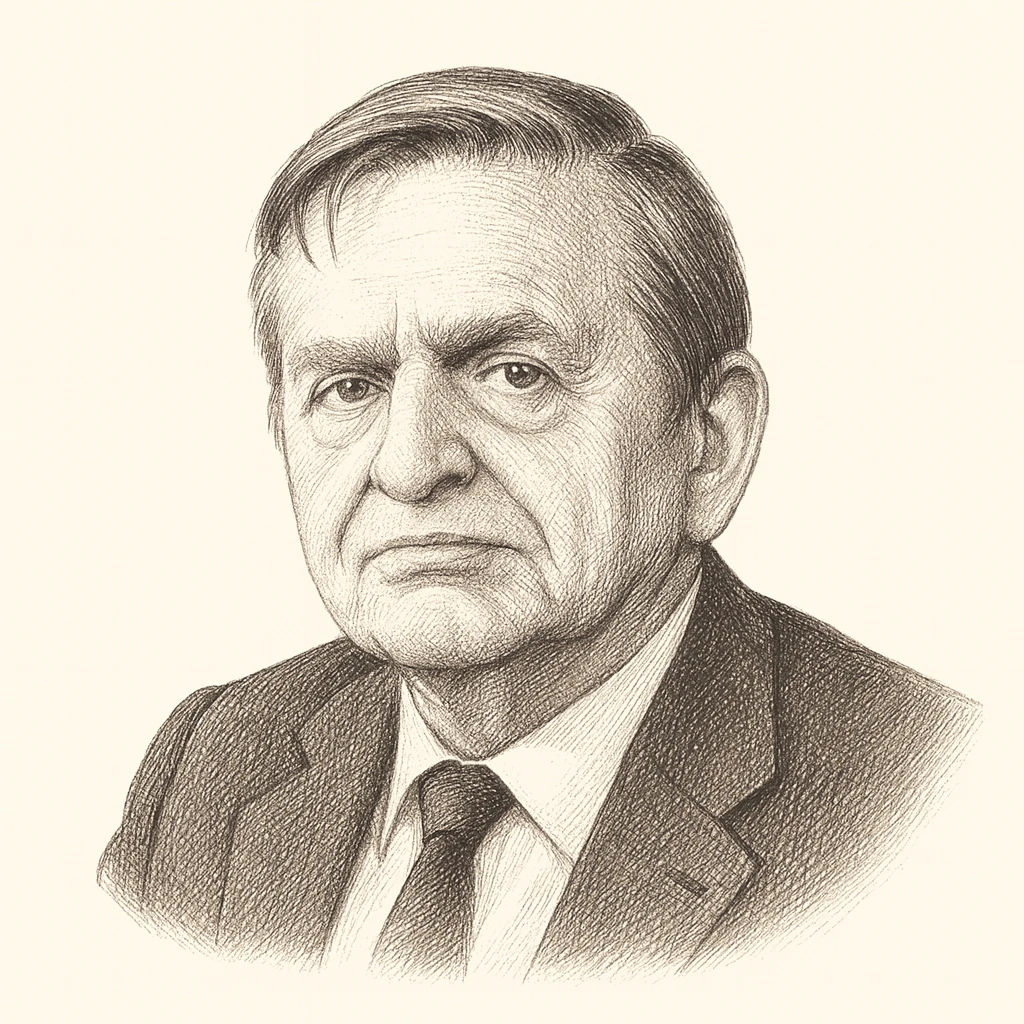
Olof Palme was the defining statesman of Swedish social democracy in its most ambitious phase, leading the Social Democratic Workers' Party and serving as prime minister across the 1970s and again in the mid-1980s. His political thought fused a firm commitment to parliamentary democracy with an expansive vision of equality: he argued that political liberty was hollow without social and economic security, and that the state could be an instrument of solidarity rather than a threat to freedom. Coming from a well-off background, he became an unlikely tribune of the labor movement, insisting that the welfare state was not charity but a shared undertaking that widened the real freedom of ordinary people.
Domestically, Palme is associated with the consolidation and deepening of the Nordic model — universal social provision, high but broadly accepted taxation, strong trade unions, and an ethos of leveling class differences. He framed democracy as an ongoing project extending beyond the ballot box into working life, education, and the distribution of power. His rhetoric of solidarity, both within Sweden and internationally, positioned social democracy as a reformist "third way" between unregulated capitalism and Soviet-style communism, achieving redistribution through consent and institutions rather than revolution.
Abroad, Palme became one of the most visible voices of a moralized foreign policy from a small, neutral state. He was an outspoken critic of the United States' war in Vietnam, of apartheid in South Africa, and of authoritarian regimes across the political spectrum, and he championed disarmament, North-South solidarity, and the interests of developing nations. This willingness to speak bluntly won him admirers abroad and opponents at home, who saw sanctimony or naivety in it; his interventions nonetheless helped define what an activist small-power internationalism could look like.
Palme's assassination in 1986, still surrounded by unresolved questions, cut short his career and turned him into a symbol. For admirers he embodies the confident, egalitarian social democracy of the postwar decades; for critics his combative style and the strains of the Swedish model invite sharper scrutiny. Either way, he remains a central reference point for how democratic socialists imagine reconciling liberty, equality, and internationalism within a functioning democracy.
Olof Palme is associated with Democratic Socialist. See the archetype