
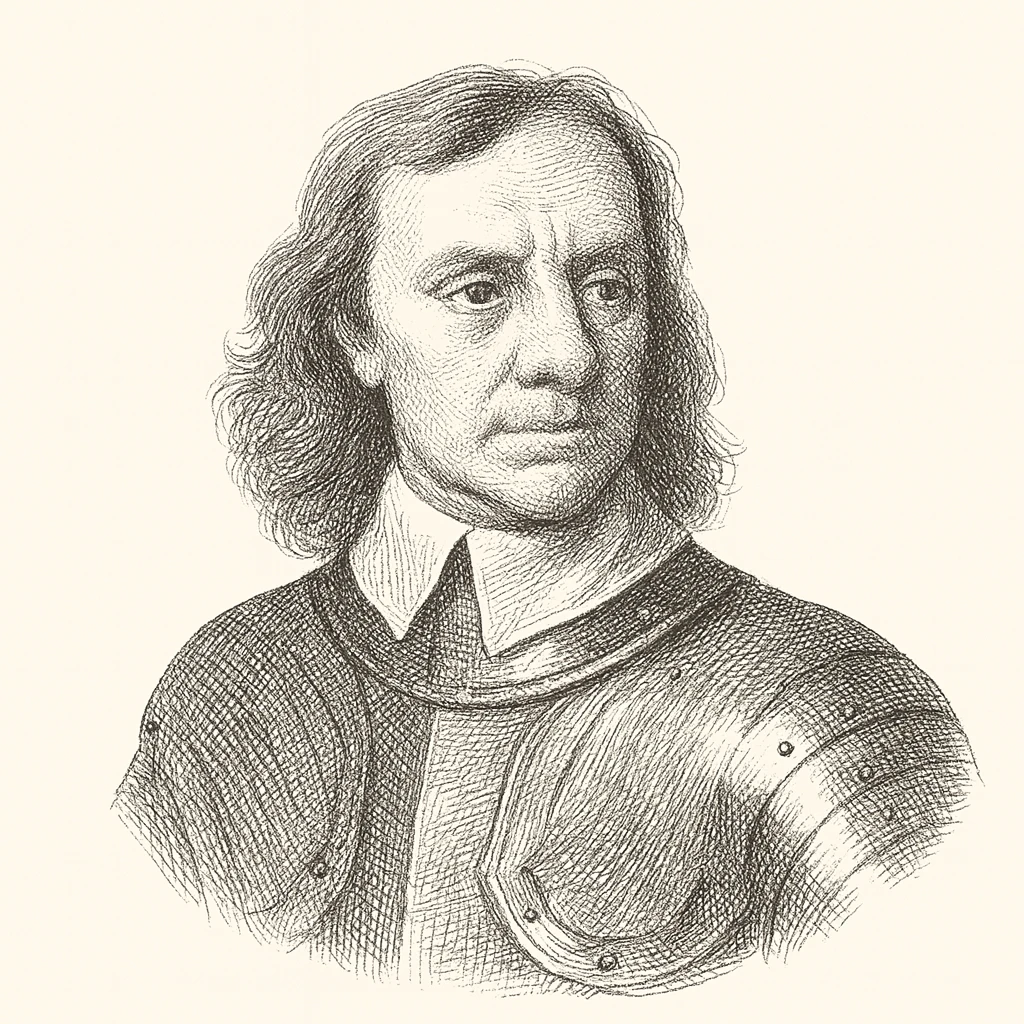
Oliver Cromwell was the first non-royal to rule England as head of state, leading the Parliamentary forces to victory in the Civil War, signing Charles I's death warrant, and governing as Lord Protector. A Puritan country gentleman radicalized by religious and political conflict, Cromwell created the New Model Army that defeated the Royalists.
Cromwell was less a systematic theorist than a man of action whose politics flowed from a deep Calvinist providentialism: he read military victories as signs of God's favor and framed the struggle against the crown as a work of divine deliverance. This conviction underwrote his willingness to break with precedent by trying and executing an anointed king, while it also limited his radicalism. In the Putney Debates of 1647, he and his son-in-law Henry Ireton resisted the Levellers' demands for a broadly democratic franchise, defending a property-based political order against those who argued that even the poorest man had a right to consent to his government.
Cromwell's Commonwealth (1649-1660) was England's only republic. He dissolved the Rump Parliament and ruled through major-generals. Under the Instrument of Government of 1653, England's first written constitution, he governed as Lord Protector, yet he repeatedly clashed with the Parliaments he convened, dissolving them when they challenged his authority. In 1657 he rejected Parliament's offer of the crown while continuing to exercise powers comparable to a monarch's. His conquest of Ireland included massacres at Drogheda and Wexford, where his forces killed thousands of people, including soldiers who had surrendered and clergy. He also promoted religious tolerance (for Protestants) and readmitted Jews to England after centuries of exclusion, reflecting a commitment to liberty of conscience within Protestant bounds.
His rule joined a stated devotion to lawful, parliamentary government with practical reliance on the army as the ultimate source of power. He sought godly government and, through the major-generals, moral reform, but no constitutional settlement he attempted outlasted him: the Protectorate collapsed after his death in 1658, and the monarchy was restored in 1660.
After the Restoration his body was exhumed, hanged at Tyburn, and beheaded as a regicide. Thomas Carlyle's edition of his letters and speeches (1845) reversed, for Victorian readers, the long-standing view of him as a ruthless hypocrite, tracing his conduct to sincere Puritan conviction, while in Ireland his name has long been tied to the conquest and its massacres.
Wondering where you land? Take the 4-minute assessment