
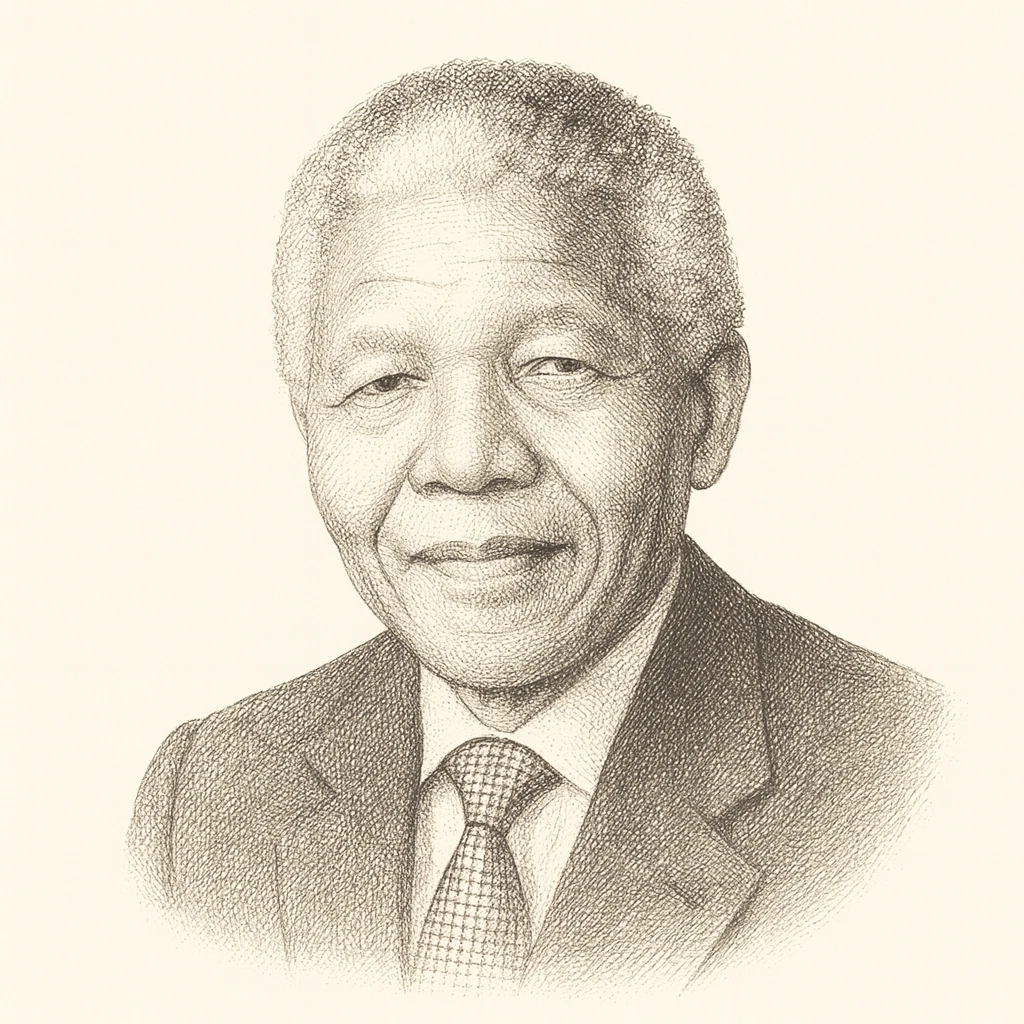
Nelson Mandela was the anti-apartheid revolutionary who spent 27 years in prison before emerging to lead South Africa's transition to multiracial democracy as its first Black president. Born to Thembu royalty, Mandela became a lawyer and joined the African National Congress, eventually leading its armed wing after the ANC concluded that nonviolent resistance had failed. He was a member of the ANC Youth League and later championed the nonracialism of the 1955 Freedom Charter, which declared that South Africa belonged to all who lived in it, black and white, a principle set against both apartheid and the exclusivist Africanism of rival movements.
Mandela argued that the government's resort to force, including the shootings at Sharpeville, had foreclosed peaceful protest, and he defended sabotage as a disciplined last resort rather than terrorism. Captured in 1962, he was sentenced to life imprisonment at the Rivonia Trial, where his statement from the dock, which ended by calling a free, democratic society an ideal for which he was prepared to die, received wide international publicity. His decades on Robben Island made him the world's most famous political prisoner and symbol of resistance to apartheid.
Released in 1990 as the system crumbled, he negotiated South Africa's peaceful transition alongside F.W. de Klerk, with whom he shared the Nobel Peace Prize. The settlement produced a Government of National Unity, in which any party holding at least 20 seats was entitled to cabinet posts, and a constitution under which the courts are independent and subject only to the Constitution and the law.
As president from 1994 to 1999, Mandela prioritized reconciliation over retribution, establishing the Truth and Reconciliation Commission, which offered amnesty in exchange for full disclosure and privileged restorative over punitive justice. His forgiveness of his jailers and commitment to building a "Rainbow Nation" made him a global icon. In economic policy his government moved away from the Charter's language of nationalization toward market-oriented, investor-reassuring policies, a shift opposed by the ANC's alliance partners, the trade-union federation COSATU and the South African Communist Party.
The transition took place without civil war and established a constitutional democracy, while economic inequality, among the highest in the world, persisted. Mandela left office after a single term.
Nelson Mandela is associated with Democratic Socialist. See the archetype