
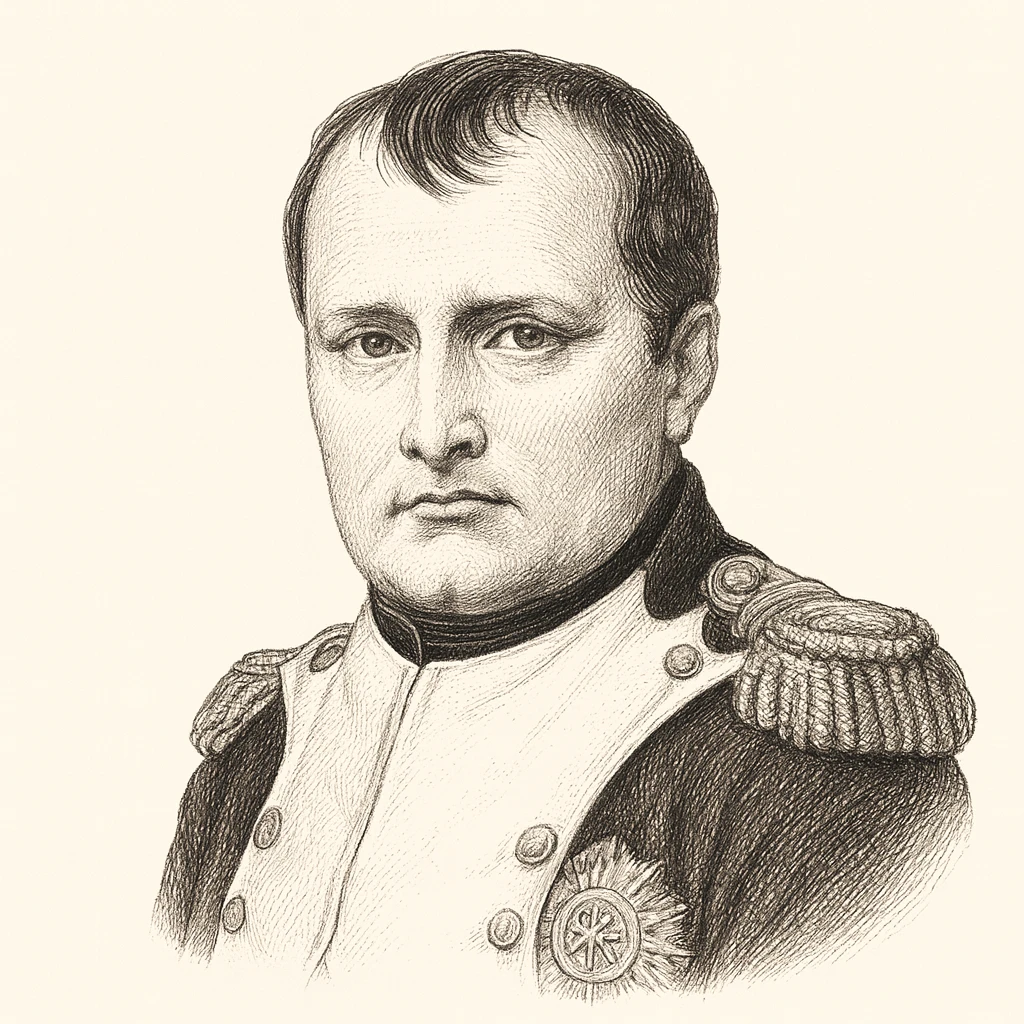
Napoleon Bonaparte was a French general and emperor whose conquests reshaped Europe and whose legal and administrative reforms modernized much of the Western world. A Corsican artillery officer who rose through Revolutionary armies, Napoleon seized power in 1799 and crowned himself Emperor in 1804.
Napoleon won major victories at Austerlitz, Jena, and Wagram, creating an empire stretching from Spain to Poland. His most durable reform was the Napoleonic Code—civil law based on equality before the law, property rights, and secular authority. The Code spread wherever French armies marched and remains the foundation of legal systems across Europe and Latin America.
Napoleon concentrated power in a centralized state run by prefects, sub-prefects, and mayors appointed from above and assisted by non-elected councils. He legitimized his rule by plebiscite, invoking popular sovereignty even as he suppressed dissent through censorship and an extensive police apparatus. The Concordat of 1801 with the papacy re-established the Catholic Church in France. He founded the Bank of France (1800), the lycées (1802), and the Legion of Honor (1802).
In 1802 he restored slavery in the French colonies, reversing the Revolution's abolition of 1794, and sent an expedition to reimpose French control on Saint-Domingue; the war that followed ended in Haitian independence in 1804. His empire rested on continual war and mass conscription, and deaths in the Napoleonic Wars are estimated in the millions.
Napoleon's ambition outran his resources. The disastrous Russian campaign of 1812, defeat at Leipzig, exile to Elba, return during the Hundred Days, final defeat at Waterloo, and death on St. Helena ended his career. Whether he was the Revolution's fulfillment or betrayal, liberator or tyrant, modernizer or warmonger divided French historians, a division the Dutch historian Pieter Geyl surveyed in Napoleon: For and Against (1949). He left his mark on nationalism, warfare, law, and politics.
Napoleon Bonaparte is associated with Reactionary Strongman. See the archetype