
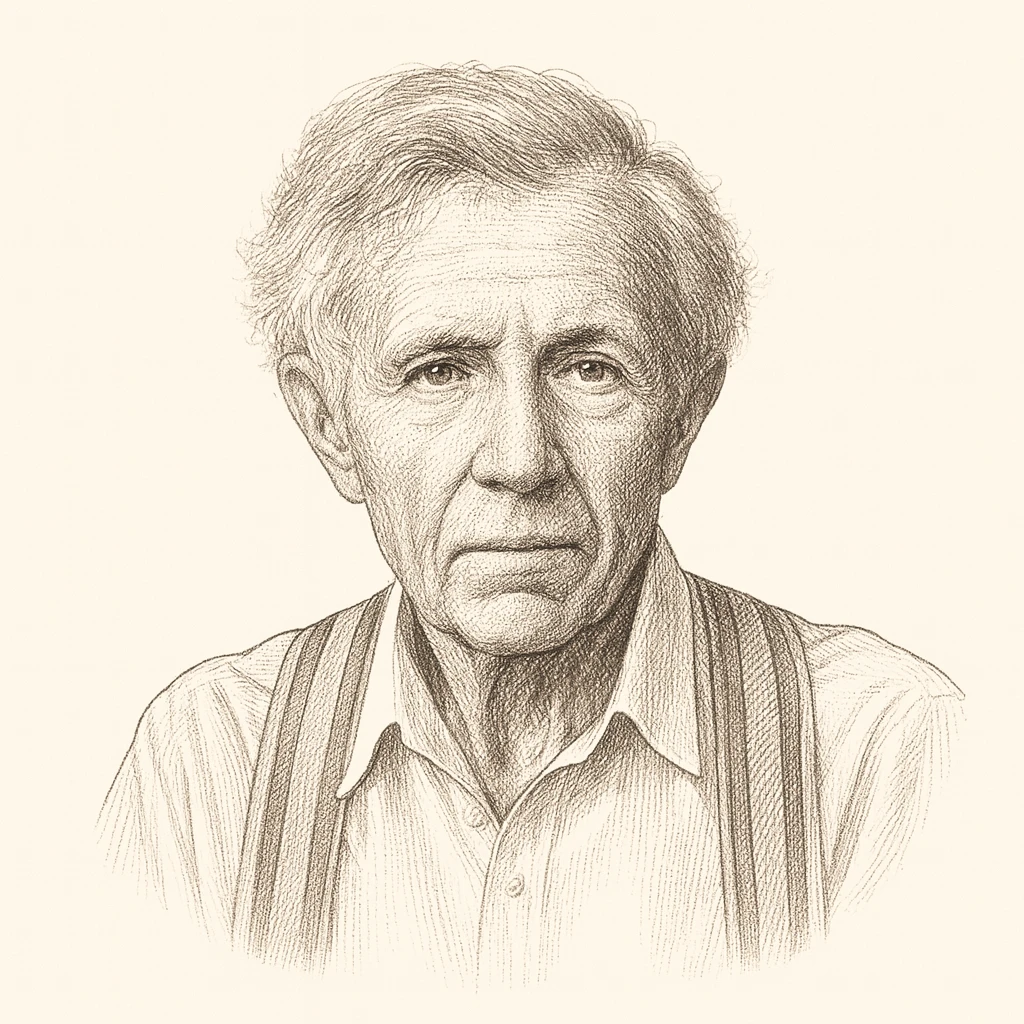
Michael Harrington was born in 1928 in St. Louis, Missouri, into a thoroughly Irish Catholic family — his parents were both devout, his father a patent lawyer, the family comfortable and conventionally middle-class. He attended Holy Cross College and then Yale Law School, though he abandoned law almost immediately for the literary and political life that his temperament was actually suited to. He came to New York in 1949, and the New York he arrived in was the city of the Village Voice and the bohemian milieu of the Greenwich Village intellectual world — writers, poets, socialists, and Catholic radicals living cheaply in cold-water flats and arguing about everything with a seriousness that American suburban life did not permit.
The decisive early formation was his period at the Catholic Worker, Dorothy Day's movement on the Lower East Side, where he lived and worked from 1951 to 1953. Day's insistence on the direct personal encounter with poverty — not charity administered from a distance but actual community with the poor, sharing their conditions and their lives — gave Harrington something that purely theoretical socialism could not: a visceral understanding of what poverty actually felt like from the inside, what it did to people's bodies and spirits and relationships and self-understanding. He would later say that the years at the Catholic Worker were the most important in his intellectual formation, the period when the abstract argument for socialism became concrete through actual contact with the people whom the economy was destroying. He drifted from Day's Catholicism — he was agnostic by his mid-twenties — but never from the moral seriousness she embodied or the direct engagement with poverty that she had modeled.
He became a leader of the Young People's Socialist League, the socialist student organization, in the early 1950s, and through it connected with the broader democratic socialist tradition — with Norman Thomas, with the Socialist Party, with the international networks of democratic socialist parties and trade unions that were rebuilding themselves in the postwar period. He was a democratic socialist in the Bernstein tradition rather than the Leninist one: committed to achieving socialist ends through democratic politics, deeply impatient with both the Communist Party's subservience to Moscow and the New Left's later rejection of electoral politics and labor alliances. He regarded the American labor movement as the necessary, imperfect, indispensable vehicle for socialist advance in American conditions.
The Other America (1962) grew from a long essay he had written for Commentary magazine and from years of thinking about why the postwar prosperity that everyone was celebrating was so unevenly distributed. Its argument was both empirical and moral: empirical in its documentation of the extent and character of American poverty — perhaps forty to fifty million people in 1962, living in conditions invisible to the suburban middle class because hidden by geography, by the design of highways and subdivisions that bypassed poor neighborhoods, by the fact that the comfortable encountered the poor primarily as servants or in hospital waiting rooms — and moral in its insistence that this was not an unfortunate residue that growth would automatically eliminate but a structural condition that required structural response.
The book reached John F. Kennedy through an intermediary — Dwight Macdonald's long review essay in The New Yorker — and is regularly credited with catalyzing the Johnson administration's War on Poverty. Harrington spent the rest of his life uncomfortable with that credit. The War on Poverty had been far too underfunded, too bureaucratically fragmented, too easily abandoned when the Vietnam War consumed the fiscal and political space that serious antipoverty policy required. The structural poverty he had described required structural remedies — full employment as an explicit policy goal, universal health care, strong labor unions, housing policy — not the targeted programs that treated symptoms while leaving causes intact.
He led Democratic Socialists of America from its founding in 1982 until his death, maintaining the argument that electoral politics within the Democratic Party was the necessary terrain for socialist advance in American conditions, even as the Party moved rightward and the labor movement declined. His later books — The New American Poverty (1984) and The Long-Distance Runner (1988) — tracked the transformation of poverty under deindustrialization, the crack epidemic, and the Reagan retrenchment with the same empirical care as the original work. He died of esophageal cancer in 1989 at sixty-one, still writing, still arguing that the distance between what America was and what it could be was not an inevitable fact of nature but a political choice that different politics could reverse.
Michael Harrington is associated with Democratic Socialist. See the archetype