
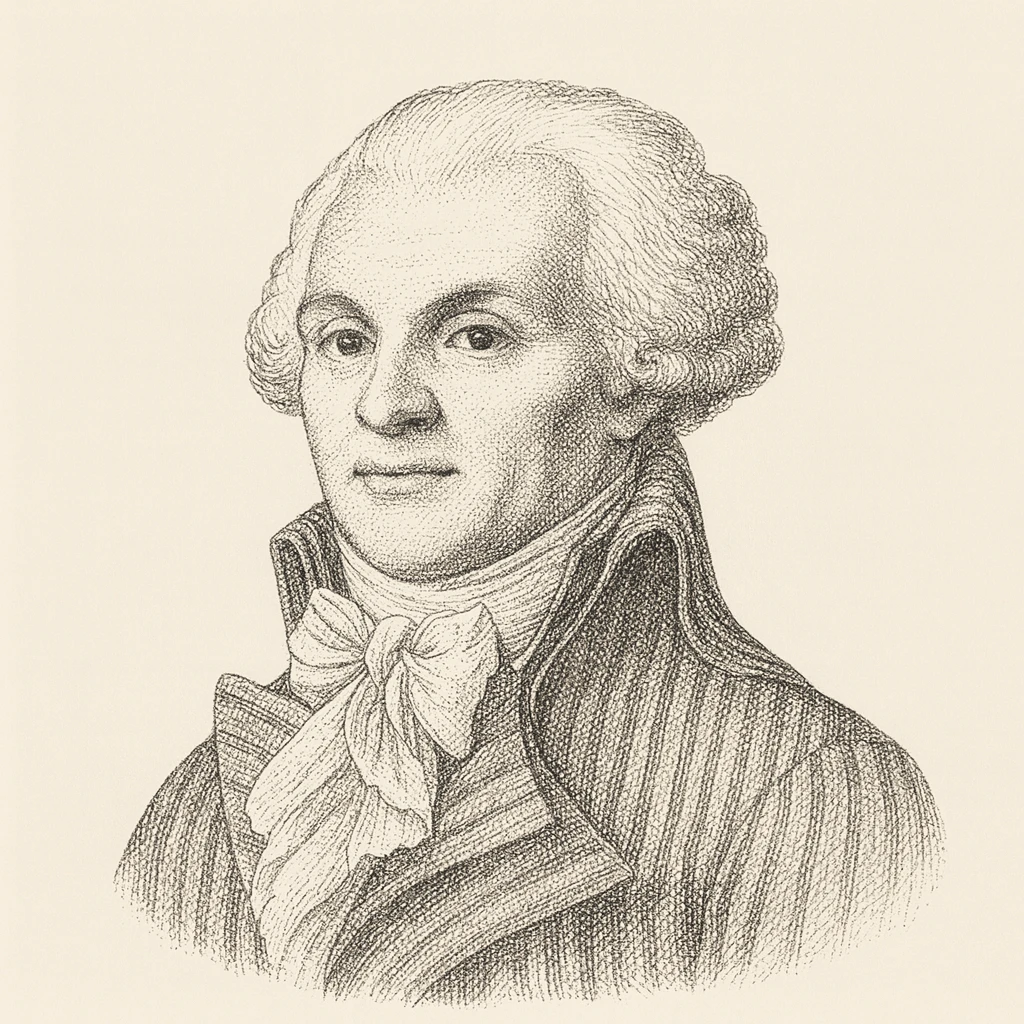
Maximilien Robespierre was a lawyer from Arras who rose to prominence in the French Revolution as a deputy and, later, as a leading voice on the Committee of Public Safety. Steeped in the thought of Jean-Jacques Rousseau, he built his politics around the idea of a "general will" that expressed the true interest of the people, and around civic virtue as the animating principle of a republic. In the Revolution's early phases he was associated with democratic and egalitarian causes: he argued against property qualifications for voting, spoke for broad suffrage, and famously opposed the death penalty and the war that many of his rivals favored. This gives his record a genuinely radical-democratic dimension that sits uneasily beside what followed.
His lasting significance in political thought lies in the argument he came to make during the period known as the Terror: that in revolutionary conditions, virtue must be joined to terror, since virtue without the means to enforce it is powerless and terror without virtue is mere tyranny. This formulation—the claim that a virtuous vanguard may use coercion and even mass violence to defend the republic and purify it of enemies—makes Robespierre a recurring reference point for debates about revolutionary justice, emergency power, and the danger of identifying one's own faction with the will of the whole people.
Robespierre also promoted the Cult of the Supreme Being, an attempt to ground republican virtue in a civic religion, reflecting his conviction that a moral and spiritual foundation was necessary for a free state. He was executed in July 1794 during the Thermidorian reaction, and his fall came to symbolize the exhaustion and self-consumption of revolutionary terror.
For later thinkers he became less a program than a warning and a puzzle. Critics across the political spectrum treat him as the archetype of how utopian idealism and moral certainty can license state violence; some on the left have sought to recover his egalitarianism while acknowledging the terror. His record is genuinely contested and inseparable from mass executions carried out in the name of the people—a legacy that any serious engagement with radical politics has to confront rather than soften.
Maximilien Robespierre is associated with Vanguard Collectivist. See the archetype