
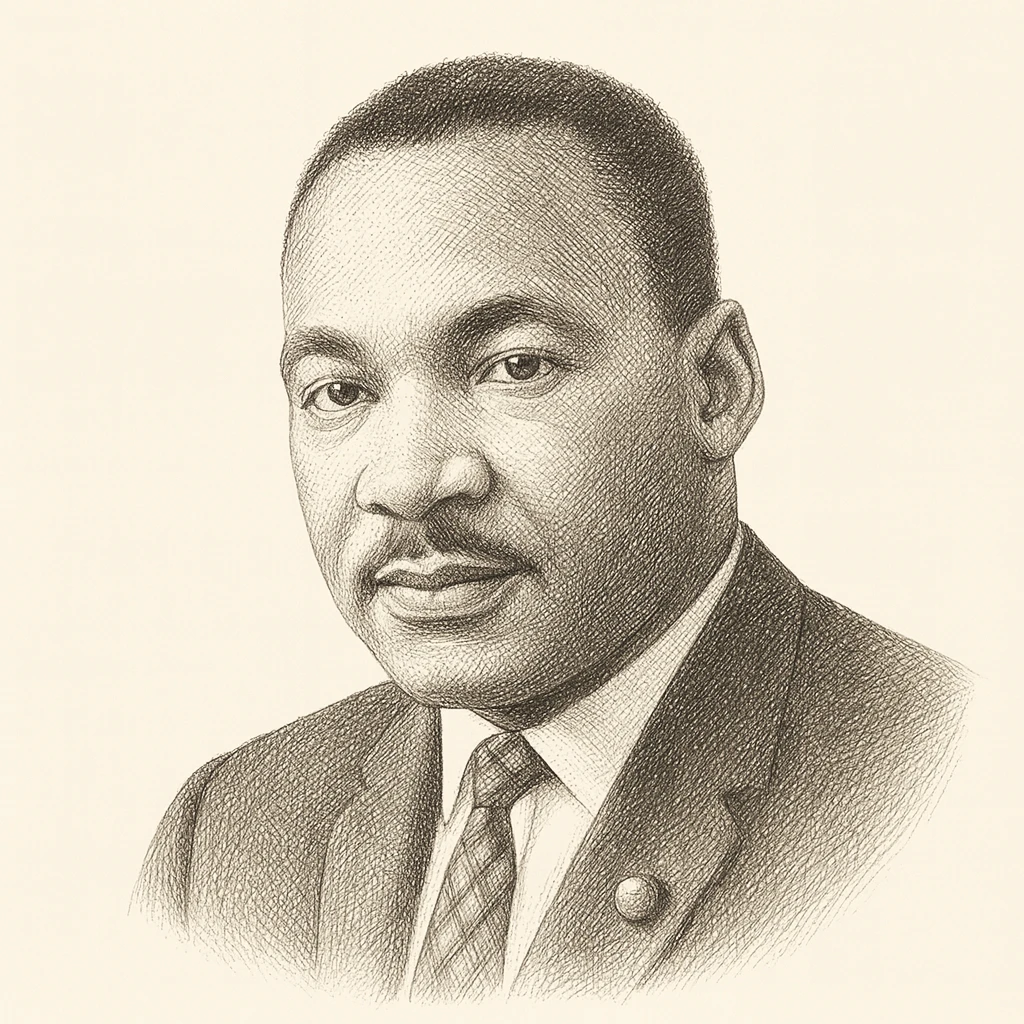
Martin Luther King Jr. was born in 1929 in Atlanta, Georgia, the second child of Martin Luther King Sr., a Baptist minister of considerable personal authority, and Alberta Williams King, the daughter of a Baptist minister who had built Ebenezer Baptist Church into one of Atlanta's most prominent Black congregations. He grew up in the Sweet Auburn district of Atlanta, in a household that combined middle-class comfort with a deep consciousness of racial subordination — his father was a man who refused to accept humiliation from white Atlantans and who modeled for his son a form of Black dignity that did not depend on white validation. King later said that his mother told him, when he was very young, that he must never feel inferior and that segregation was a problem with society rather than with himself. The psychological grounding this provided was not incidental to what he became.
He was a prodigy. He skipped two grades, entering Morehouse College at fifteen in 1944, and studied there under Benjamin Mays, the college's president, who became one of his formative intellectual influences. Mays was a social gospeller in the tradition of Rauschenbusch — deeply committed to the argument that Christian faith required engagement with social justice — and he exposed King to the intellectual tradition that would organize his life's work. King was licensed to preach at fifteen, graduated from Morehouse at seventeen, and then went to Crozer Theological Seminary in Pennsylvania, where his intellectual formation deepened considerably. At Crozer he read Niebuhr's Moral Man and Immoral Society and described it as transforming his understanding of the relationship between love and power — Niebuhr's insistence that social change required political power rather than mere moral appeal was a permanent acquisition. He read Rauschenbusch's Christianity and the Social Crisis and described it as profoundly influential. And he heard A.J. Muste lecture on Gandhian nonviolence and began the engagement with Gandhi's thought that would shape his political method.
He went from Crozer to Boston University for his doctorate in systematic theology, studying under Edgar Brightman and then L. Harold DeWolf, both personalists — philosophers who held that the person was the fundamental category of reality and that social institutions derived their legitimacy from their service to persons. Personalism gave King a philosophical grounding for his insistence on the inviolable dignity of every human being that was more systematic than simple evangelical assertion, and that could engage the philosophical tradition on its own terms. He also spent significant time in Hegel while at Boston — his dissertation compared Tillich and Wieman, but his broader reading gave him a sense of the historical dialectic that inflected his understanding of social change. He received his doctorate in 1955 and accepted a call to Dexter Avenue Baptist Church in Montgomery, Alabama, a congregation that had employed several of its most distinguished men.
The Montgomery Bus Boycott began in December 1955, eleven months after his arrival, triggered by Rosa Parks's arrest. King was chosen to lead the Montgomery Improvement Association almost accidentally — he was new enough that he had not made enemies among the established leadership — and he rose to the occasion with a combination of rhetorical power, organizational intelligence, and moral seriousness that surprised everyone, including himself. The boycott lasted 381 days. The Supreme Court ruled Montgomery's bus segregation unconstitutional in November 1956. King had become a national figure and the boycott had demonstrated that organized, disciplined nonviolent resistance could force institutional change in the American South.
He co-founded the Southern Christian Leadership Conference in 1957, resigned from his Montgomery church to move to Atlanta and work for the SCLC full-time, and spent the next decade building the movement that would transform American law. His method was Gandhian in structure but distinctively American in content: the deliberate provocation of unjust authority into revealing its violence, the maintenance of nonviolent discipline under conditions designed to break it, the use of mass media to make the injustice visible to the national audience that would have to force Southern compliance. Birmingham in 1963 — Bull Connor's fire hoses and police dogs, King's Letter from Birmingham Jail written in the margins of newspapers smuggled into his cell — was the strategic logic at its most precise.
The Letter from Birmingham Jail was his most systematic philosophical statement. Written as a response to white Alabama clergymen who had called his demonstrations "unwise and untimely," it engaged the just war tradition from Aquinas and Augustine to argue that unjust laws — laws that degraded human personality, that a majority imposed on a minority that had no political voice in making them — were not laws in the binding sense but violations of natural law, and that there was not only a right but a moral obligation to disobey them openly, lovingly, and with willingness to accept the legal penalty. It was also a devastating critique of the white moderate who preferred order to justice and who counseled patience to people who had been counseled patience for a century. The letter is, in its combination of classical philosophical argument, Christian moral theology, and political practical wisdom, one of the great documents of American political thought.
The March on Washington in August 1963, the Civil Rights Act of 1964, the Selma to Montgomery marches and the Voting Rights Act of 1965 — these were the political achievements of a movement he led. The Nobel Peace Prize came in 1964, when he was thirty-five. He was not yet halfway through his public career.
The last three years were marked by his turn toward economic questions and his public opposition to the Vietnam War, positions that cost him the support of the Johnson administration and of significant parts of the liberal establishment that had backed the civil rights legislation. Beyond Vietnam (1967) was one of the most powerful speeches against the war produced by anyone of his standing, and it was received as a betrayal by those who thought he should stay in his lane. The Poor People's Campaign — his attempt to build a multiracial coalition around economic demands — was interrupted by his assassination in Memphis on April 4, 1968, where he had gone to support striking sanitation workers. He was thirty-nine years old.
Martin Luther King Jr. is associated with Progressive Activist. See the archetype