
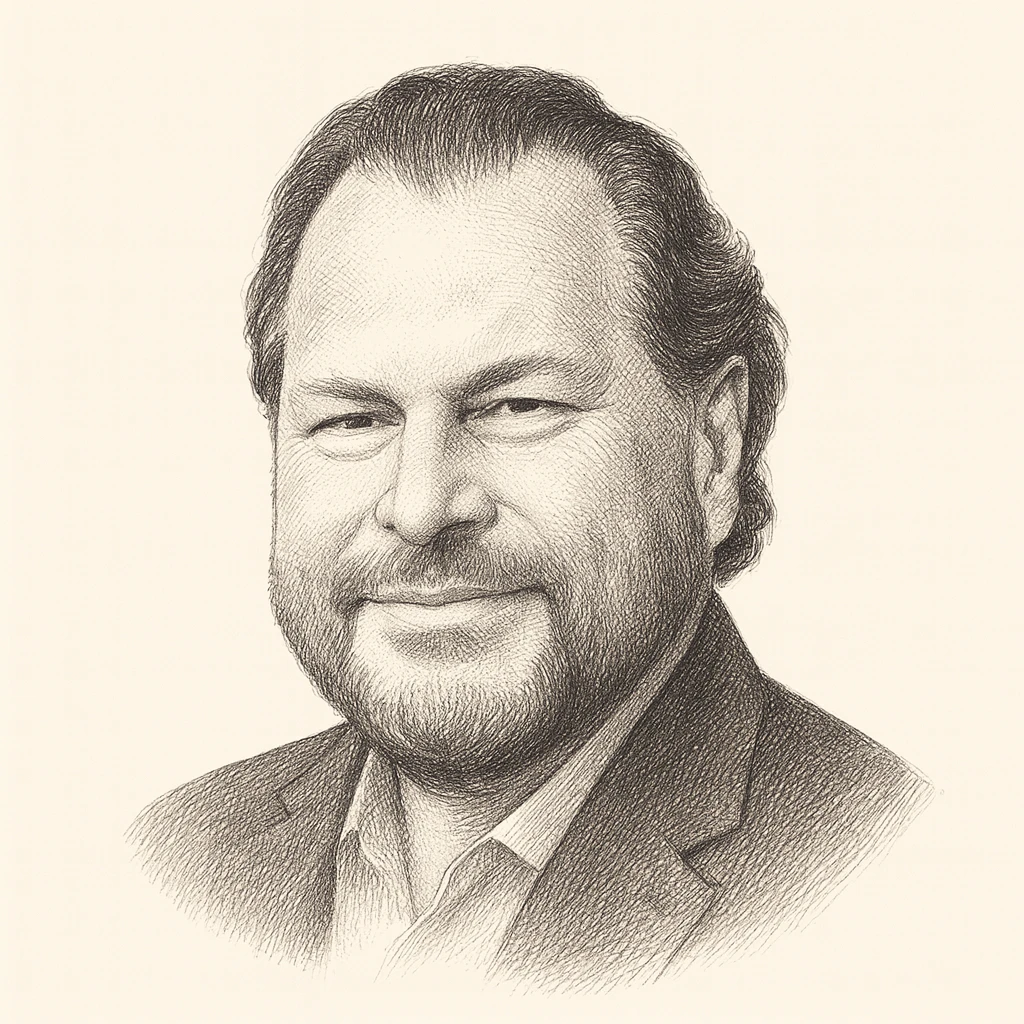
Marc Benioff, the founder and chief executive of the software company Salesforce, is best known politically as an advocate of "stakeholder capitalism" and what is often called corporate activism. His central argument is that businesses have obligations not only to shareholders but to employees, customers, communities, and society broadly. This positions him against the shareholder-primacy doctrine associated with Milton Friedman, and aligns him with a longer tradition of business thinkers who see corporations as social institutions with civic responsibilities. Benioff has popularized the idea that companies should be a "platform for change," contending that private enterprise can and should address problems—inequality, homelessness, environmental degradation—that governments have failed to solve.
Benioff's most visible political interventions have involved his home city of San Francisco and the state of California. He has funded initiatives addressing homelessness and public health, and publicly supported local ballot measures that would tax large businesses to fund homelessness services, a position that put him at odds with some fellow technology executives. He has also engaged in high-profile disputes over social legislation, threatening to reduce business activity in states that passed laws he characterized as discriminatory. Through practices such as pledging a portion of corporate equity, time, and product to philanthropic causes, he has promoted a model of integrated corporate giving that he encourages other firms to adopt.
Benioff's thought sits within contemporary debates about the proper role of corporations in democratic life. Supporters see him as demonstrating that profitability and social conscience can coexist, offering an alternative to purely market-driven capitalism. Critics from the left question whether billionaire philanthropy and voluntary corporate responsibility can substitute for democratic taxation and public provision, warning that it concentrates civic power in unaccountable private hands. Critics from the right argue that executives who steer companies toward political and social causes exceed their proper mandate and impose contested values. His ownership of a major news magazine has further linked him to discussions about the influence of wealthy business figures over media and public discourse.
As a political thinker Benioff is less a systematic theorist than an influential practitioner-advocate whose visibility has helped move stakeholder capitalism from a niche idea into mainstream corporate and political conversation.
Marc Benioff is associated with Establishment Progressive. See the archetype