
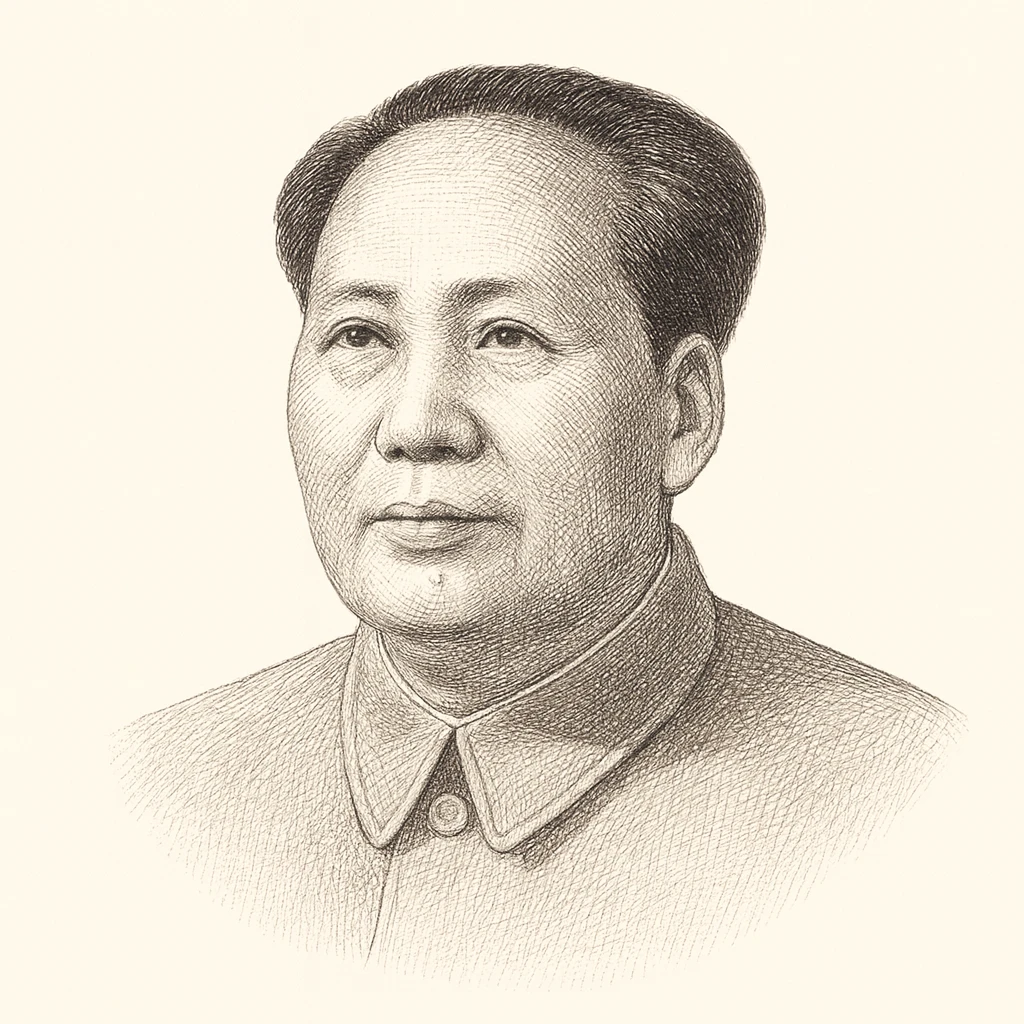
Mao Zedong was the communist revolutionary who founded the People's Republic of China, ruling as Chairman from 1949 until his death in 1976. Born to a peasant family in Hunan, Mao became a communist organizer and developed theories of peasant-based revolution that diverged from orthodox Marxism's focus on the urban proletariat. Where classical Marxism located revolutionary agency in an industrial working class, Mao argued that in a largely agrarian, semi-colonial society the peasantry could be the main force of the revolution under Communist leadership. This shift, worked out during the years of rural guerrilla struggle, produced his doctrine of protracted people's war, in which revolutionaries would build base areas in the countryside and eventually encircle the cities.
After the Long March and victory in the Chinese Civil War, Mao proclaimed the People's Republic in 1949. His rule brought land reform and industrialization, and also two mass campaigns: the Great Leap Forward (1958-62), which caused a famine killing 15-55 million people, and the Cultural Revolution (1966-76), which unleashed chaos, persecution, and destruction of cultural heritage. The Great Leap sought to accelerate collectivization and rural industrialization through mass mobilization; the Cultural Revolution, in which Mao publicly backed student Red Guards, turned his theory of continued revolution against party and government leaders denounced as 'capitalist-roaders.'
Mao's ideology, 'Mao Zedong Thought,' combined Marxism-Leninism with Chinese characteristics, emphasizing continuous revolution, peasant mobilization, and the primacy of will over material conditions. He stressed the role of ideological transformation, mass line politics, and voluntarism, the belief that human determination could overcome objective constraints. This diverged from Soviet orthodoxy, and after Stalin's death a polemic between the Chinese and Soviet parties grew into the Sino-Soviet split.
His writings and slogans circulated globally, and Maoism inspired insurgent and radical movements abroad, among them the Naxalite groups in India. In 1981 the Chinese Communist Party's resolution on its own history judged his contributions primary and his errors secondary while assigning him chief responsibility for the Cultural Revolution, a formula that preserved his standing as founder of the People's Republic.
Mao Zedong is associated with Vanguard Collectivist. See the archetype