
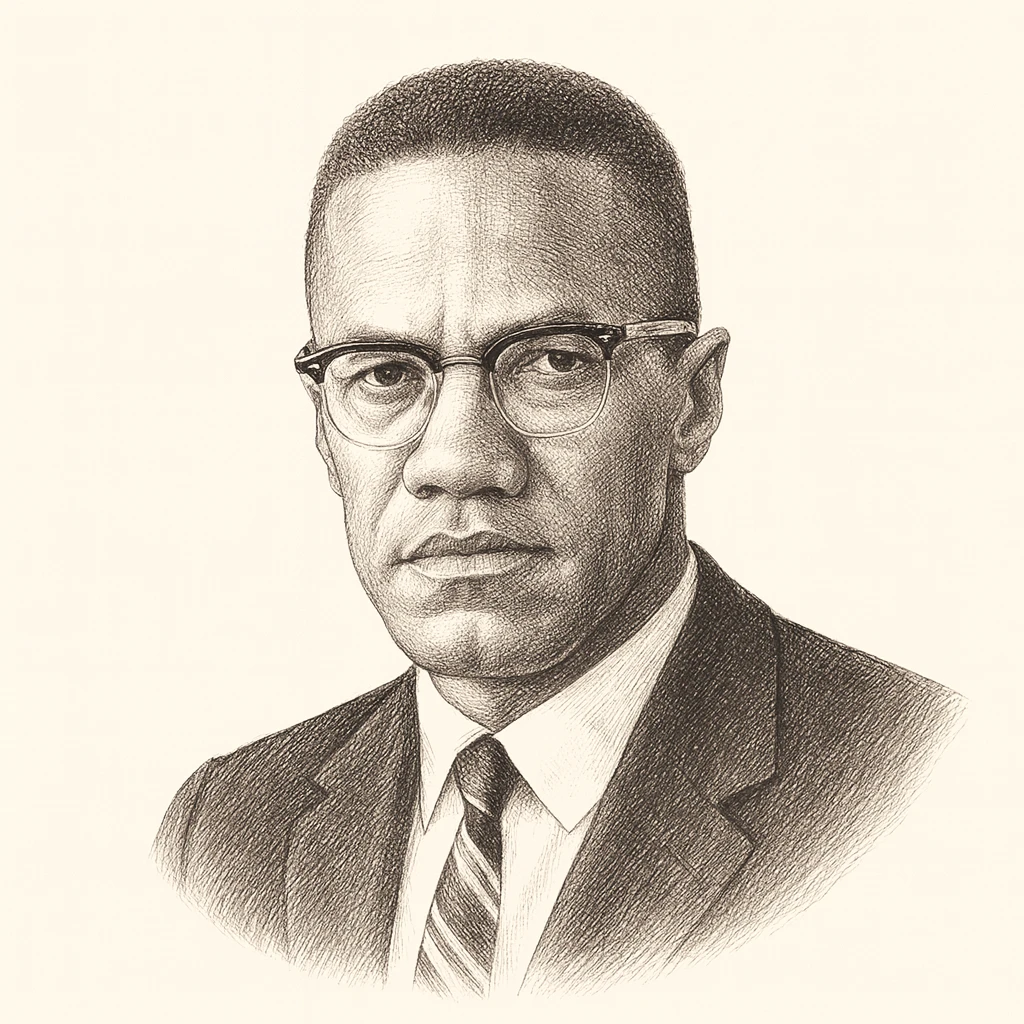
Malcolm X was among the most prominent voices of Black anger and pride in mid-century America, challenging the integrationist approach of Martin Luther King Jr. with a philosophy of Black nationalism and self-defense. Born Malcolm Little in Omaha, he was shaped by his father's violent death and his mother's institutionalization before a prison conversion to the Nation of Islam transformed him. His family believed his father had been murdered by white supremacists; the authorities ruled the death an accident.
As the Nation of Islam's chief spokesman, Malcolm rejected integration as begging for acceptance from white oppressors. He advocated Black self-reliance, separatism, and self-defense. His oratory and direct confrontation of white racism made him both feared and admired, and he publicly criticized King's nonviolent approach.
Malcolm broke with the Nation of Islam and its leader Elijah Muhammad in March 1964. In 'The Ballot or the Bullet' that April, he argued that Black Americans should control the politics and the economy of their own communities, and that they should be nonviolent only with those who were nonviolent with them, with a right to defend themselves where the government would not. He called for expanding the civil-rights struggle to the level of human rights, so that the case of Black Americans could be taken before the United Nations.
A pilgrimage to Mecca that spring transformed his worldview: he encountered white Muslims and embraced a more inclusive Islam. At the June 1964 founding rally of his Organization of Afro-American Unity, he gave its motto as freedom 'by any means necessary.' The organization connected Black American struggles to global human rights and to the anti-colonial movements of Africa, seeking to internationalize the cause. His emphasis on racial pride and on an African identity expressed a politics of Black self-determination. This evolution was cut short by his assassination in 1965.
His autobiography, completed with Alex Haley, became one of the most influential books of the 20th century. His ideas shaped the Black Power movement that followed, and the argument between integration and self-determination that he pressed against King's approach continued in Black political thought after his death.
Malcolm X is associated with Progressive Activist. See the archetype