
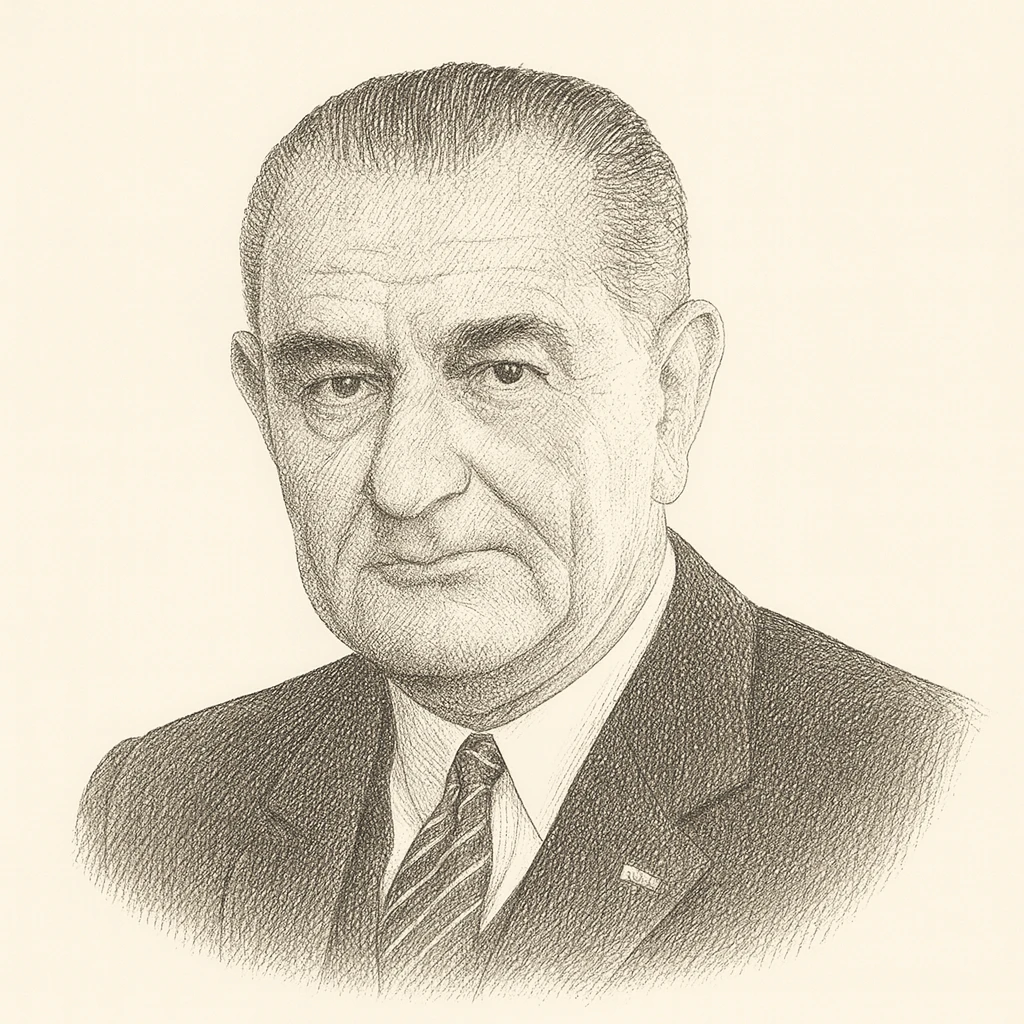
Lyndon Baines Johnson was the 36th President, a legislator who enacted more domestic reform than any president since FDR—and whose escalation of the Vietnam War brought mass protest, split his party, and ended his presidency. A poor Texan who rose through congressional politics, LBJ became Senate Majority Leader, steering the Civil Rights Act of 1957 through the chamber, before serving as Kennedy's vice president. His political formation drew directly on the New Deal: he ran the National Youth Administration in Texas and entered Congress in 1937 as a Roosevelt supporter, and he carried its faith in activist federal government into the presidency.
Johnson's Great Society remade federal social policy. The Civil Rights Act of 1964 and Voting Rights Act of 1965 ended legal segregation and guaranteed Black voting rights—'We shall overcome,' he told Congress. Medicare, Medicaid, federal education funding, Head Start, and environmental protection followed. Johnson's War on Poverty aimed to eliminate want in the world's richest nation. Underlying these programs was the conviction that prosperity and formal rights were not enough, and that government bore responsibility for extending opportunity to those left behind. At the University of Michigan in 1964 he said that material progress was only the foundation for 'a richer life of mind and spirit.'
Johnson pressed civil rights forward expecting, by his aide Bill Moyers's account, that it would cost his party the once-Democratic South—a realignment that reshaped both parties for decades. His method relied heavily on personal persuasion.
Vietnam came to dominate Johnson's presidency. Escalation from 16,000 advisors to over 500,000 troops brought no victory, while American casualties and domestic protest mounted; demonstrators chanted 'Hey, hey, LBJ, how many kids did you kill today?' War spending competed with his domestic programs, and opposition to the war split the Democratic coalition. In March 1968, facing antiwar challengers within his own party, Johnson announced that he would not seek reelection.
Lyndon B. Johnson is associated with Social Liberal. See the archetype