
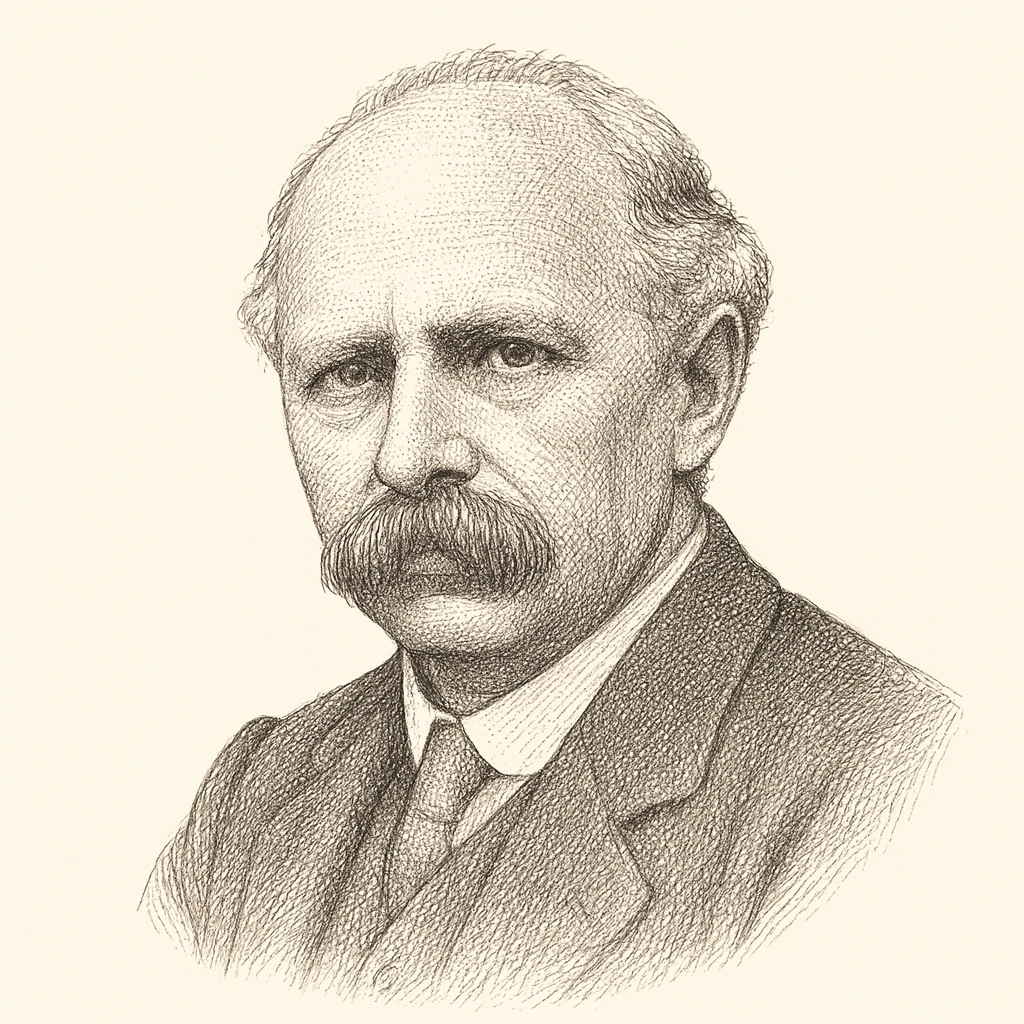
Leonard Trelawny Hobhouse turned the New Liberalism from a mood into a doctrine. By the turn of the twentieth century, British liberals could feel their creed shifting under them; the old certainties about free contract and the minimal state were failing the people the industrial economy actually produced. Plenty of politicians sensed the change. Hobhouse gave it an argument.
He came at politics from two working lives at once. As a leader-writer for the Manchester Guardian under C.P. Scott, he made the Liberal case in daily print and opposed the Boer War when that stance cost the paper readers. As a scholar, he took up the first British chair of sociology, at the London School of Economics, in 1907, and spent decades on comparative studies of morals and social development. The combination shows in everything he wrote: journalism kept the theory concrete, and sociology kept it evolutionary.
Liberalism (1911), a short book written for a popular series, became the classic statement of the position. Liberty and social welfare are complementary. A contract between a millowner and a starving worker is free only on paper; real freedom requires health, education, and a living wage, which individuals cannot always secure alone. Property is partly a social creation, since no fortune is made without the roads, laws, and inherited knowledge a whole society supplies, so society may claim a share back through taxation without committing theft. Every chapter was built to show that the democratic state can expand liberty as well as menace it.
Green's Oxford legacy shaped him, but Hobhouse refused the metaphysics that came with it. The Metaphysical Theory of the State (1918), written while German raids fell on London, is a sustained attack on the Hegelian idea that the state embodies a higher self than its citizens — he saw in the bombs overhead the practical outcome of the doctrine he was dismantling. The welfare liberalism of the twentieth century, from the New Liberal budgets to the postwar settlement, worked from premises Hobhouse had already set down.
L.T. Hobhouse is associated with Social Liberal. See the archetype