
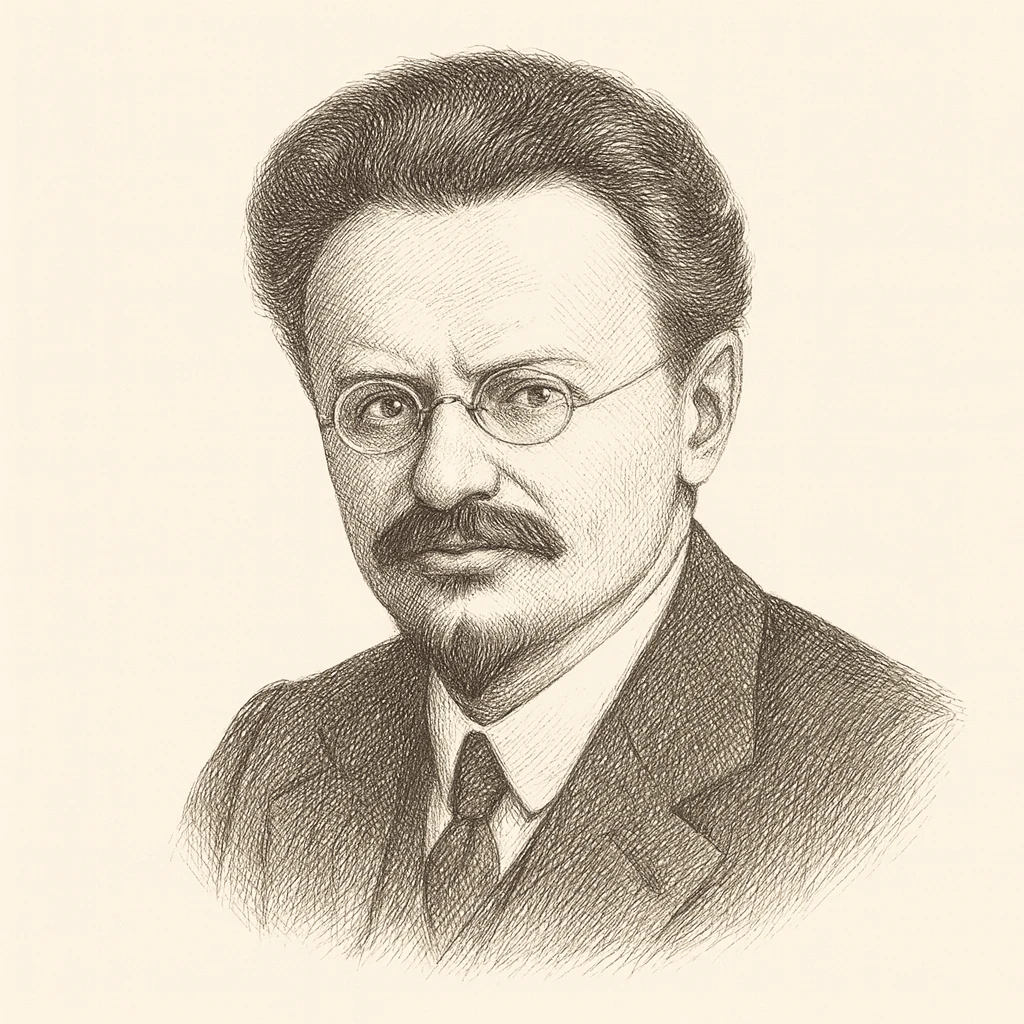
Leon Trotsky was a leading figure of the Russian Revolution and one of the most influential Marxist theorists of the twentieth century. A key organizer of the Bolshevik takeover in 1917 and the founder and commander of the Red Army during the civil war that followed, he combined a career of practical revolutionary leadership with a substantial body of political writing. His thought sits within the revolutionary Marxist tradition that insisted socialism must be achieved through the seizure of state power by an organized working-class movement, guided by a disciplined vanguard party.
His most distinctive contribution is the theory of 'permanent revolution,' which argued that in economically backward countries the bourgeoisie was too weak to complete a democratic revolution, so the working class would have to take the lead and press on toward socialist transformation. Crucially, he held that revolution could not survive in isolation within a single country: it had to spread internationally to succeed. This put him in direct conflict with Joseph Stalin's doctrine of 'socialism in one country.' After Lenin's death, Trotsky lost the ensuing power struggle, was removed from his posts, expelled from the party, and eventually deported from the Soviet Union.
In exile he became the foremost left-wing critic of Stalinism, analyzing the Soviet regime as a 'degenerated workers' state' ruled by a privileged bureaucratic caste that had betrayed the revolution. He founded the Fourth International as a rival to the Stalin-aligned Communist movement, and his critique became a founding reference point for Trotskyist currents on the anti-Stalinist revolutionary left. He was assassinated in Mexico in 1940 by an agent of the Soviet secret police.
Trotsky's legacy is genuinely contested. To admirers he represents a democratic, internationalist socialism betrayed by Stalinist despotism. Critics note that he was himself an architect of Bolshevik one-party rule, defended the suppression of political opposition, endorsed the militarization of labor, and helped crush revolts such as Kronstadt — a record that complicates his later image as a champion of freedom. His writings on revolution, bureaucracy, and the fate of the Soviet state remain widely studied across the Marxist tradition and beyond.
Leon Trotsky is associated with Vanguard Collectivist. See the archetype