
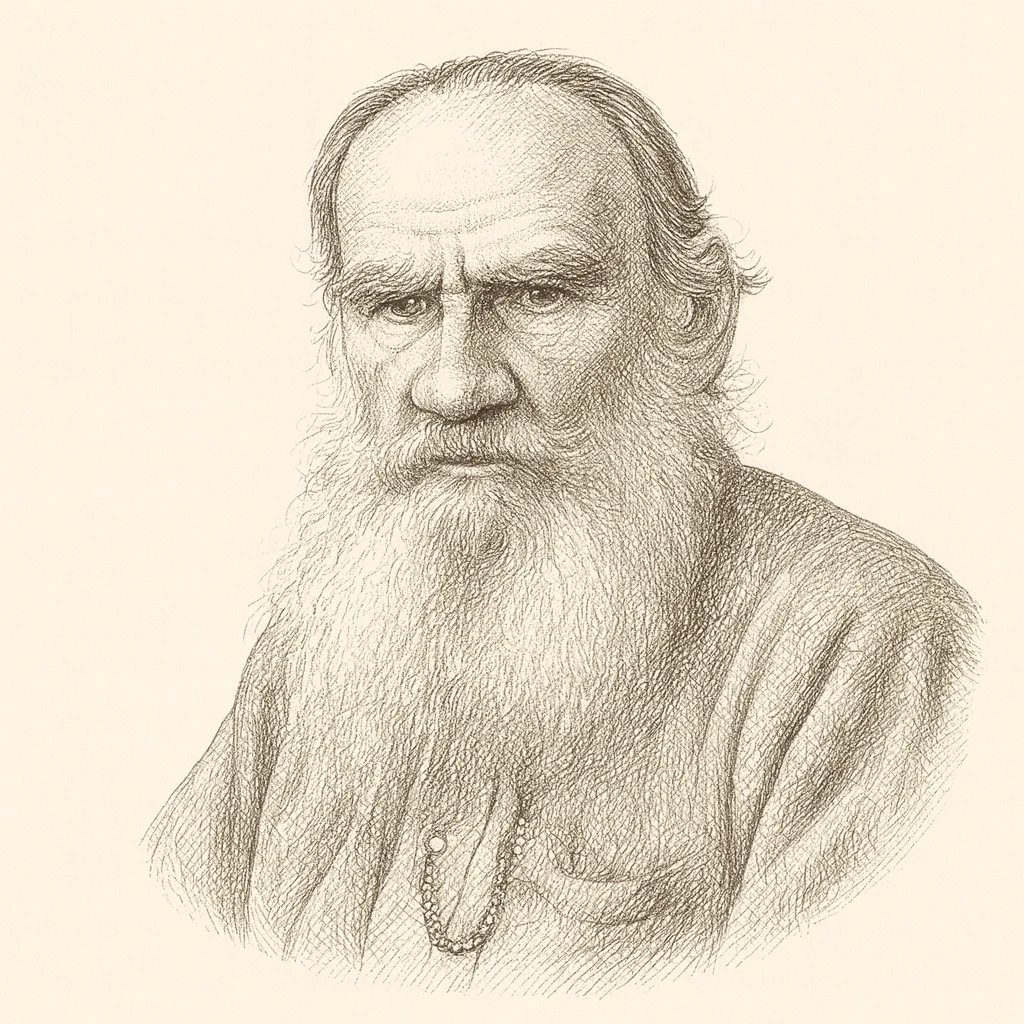
Leo Tolstoy was a Russian novelist, the author of War and Peace and Anna Karenina. But in his later decades, Tolstoy renounced art for radical Christianity, becoming a pacifist, anarchist, and moral reformer whose ideas influenced Gandhi, Martin Luther King Jr., and the anarchist movement.
Born to Russian aristocracy, Tolstoy served in the army, managed estates, and produced masterworks of psychological realism. Then, in his 50s, a spiritual crisis led him to reject wealth, status, and the Orthodox Church for a stripped-down Christianity focused on Jesus's Sermon on the Mount—nonviolence, simple living, and rejection of all coercive authority, including government. His conversion narrative, set out in his Confession, treated the meaning of life and the fear of death as questions his fame and property had failed to answer.
Tolstoy's Christian anarchism held that the state is organized violence and true Christians cannot participate in it—no military service, no courts, no coercion. Its cornerstone was the literal reading of the command to resist not evil by force. Governments, he insisted, rest ultimately on the willingness of individuals to kill and obey, so refusal, especially conscientious objection to military service, could dissolve their power without counter-violence. He therefore rejected revolution as merely violence in another form.
He tried to free his serfs, lived simply, and inspired communities worldwide, including agrarian colonies that tried to embody his ethic of manual labor and non-participation in the state. The Holy Synod of the Orthodox Church excommunicated him in 1901, and Russian authorities censored his religious and political writings. Lenin, in his 1908 essay "Leo Tolstoy as the Mirror of the Russian Revolution," praised his "exposure of government outrages" but dismissed his "crackpot preaching of submission."
His philosophy directly influenced Gandhi's nonviolent resistance (the two corresponded near the end of Tolstoy's life), which in turn shaped the American civil rights movement and Martin Luther King Jr. His fusion of pacifism, anti-statism, and voluntary poverty also fed later traditions of conscientious objection, war resistance, and religious anarchism.
Leo Tolstoy is associated with Christian Socialist. See the archetype