
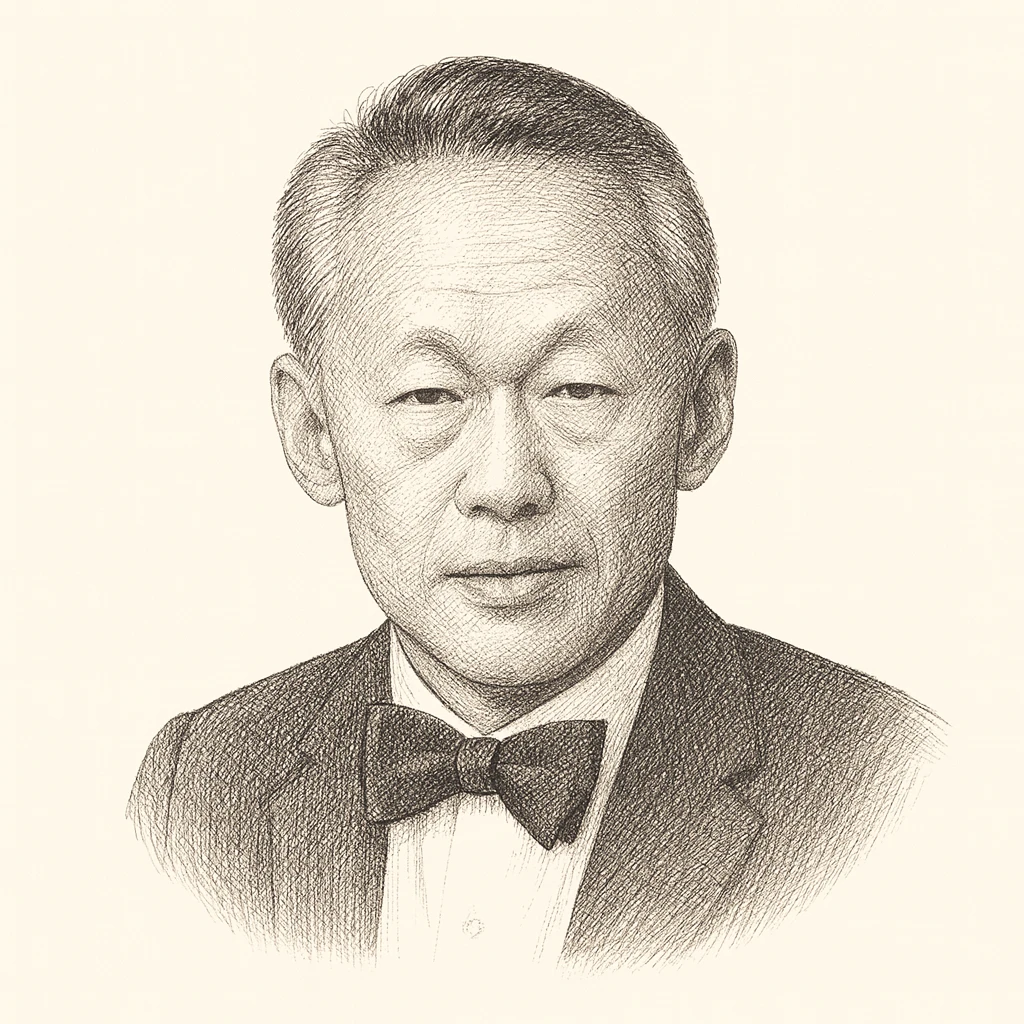
Lee Kuan Yew (1923–2015) was the founding prime minister of Singapore, holding office from the city-state's independence era until 1990, and remaining an influential presence in government for decades afterward. As leader of the People's Action Party, he presided over Singapore's transformation from a small, resource-poor port into one of the wealthiest and most orderly states in the world. His political thought is inseparable from this project: he treated governance less as a contest of competing ideologies than as a problem of engineering effective outcomes, prizing pragmatism, meritocracy, and administrative competence over doctrine.
At the core of Lee's thinking was the conviction that political order and economic development must precede, and in some measure take priority over, individual liberties and pluralist democracy. He argued that a small, vulnerable, ethnically diverse society required strong, disciplined leadership, a clean and capable bureaucracy, and social cohesion enforced from above. This underpinned policies emphasizing multiracial harmony, public housing, education, and a market-friendly economy tightly guided by the state. Critics pointed to constraints on press freedom, opposition politics, and civil liberties; Lee generally defended these as the necessary conditions of stability and prosperity rather than regrettable compromises.
Lee became closely associated with the notion of "Asian values," the argument that Confucian-influenced societies legitimately prioritize community, order, family, and deference to authority over Western-style individualism and adversarial democracy. He framed this as a critique of the assumption that liberal democracy is universally applicable, contending that governance models must fit a society's culture and circumstances. This stance made him a prominent interlocutor in global debates about modernization, development, and the relationship between freedom and growth.
Lee's enduring influence lies in the model he embodied: authoritarian yet competent, capitalist yet dirigiste, offering an alternative to the assumption that prosperity requires liberal democracy. The "Singapore model" has been studied and selectively admired by reformers and rulers across Asia and beyond, including in China, while liberal critics treat it as a cautionary example of how developmental success can be used to justify constraints on political rights. He remains a reference point in arguments about whether good governance can be decoupled from democratic accountability.
Lee Kuan Yew is associated with Techno-Authoritarian. See the archetype