
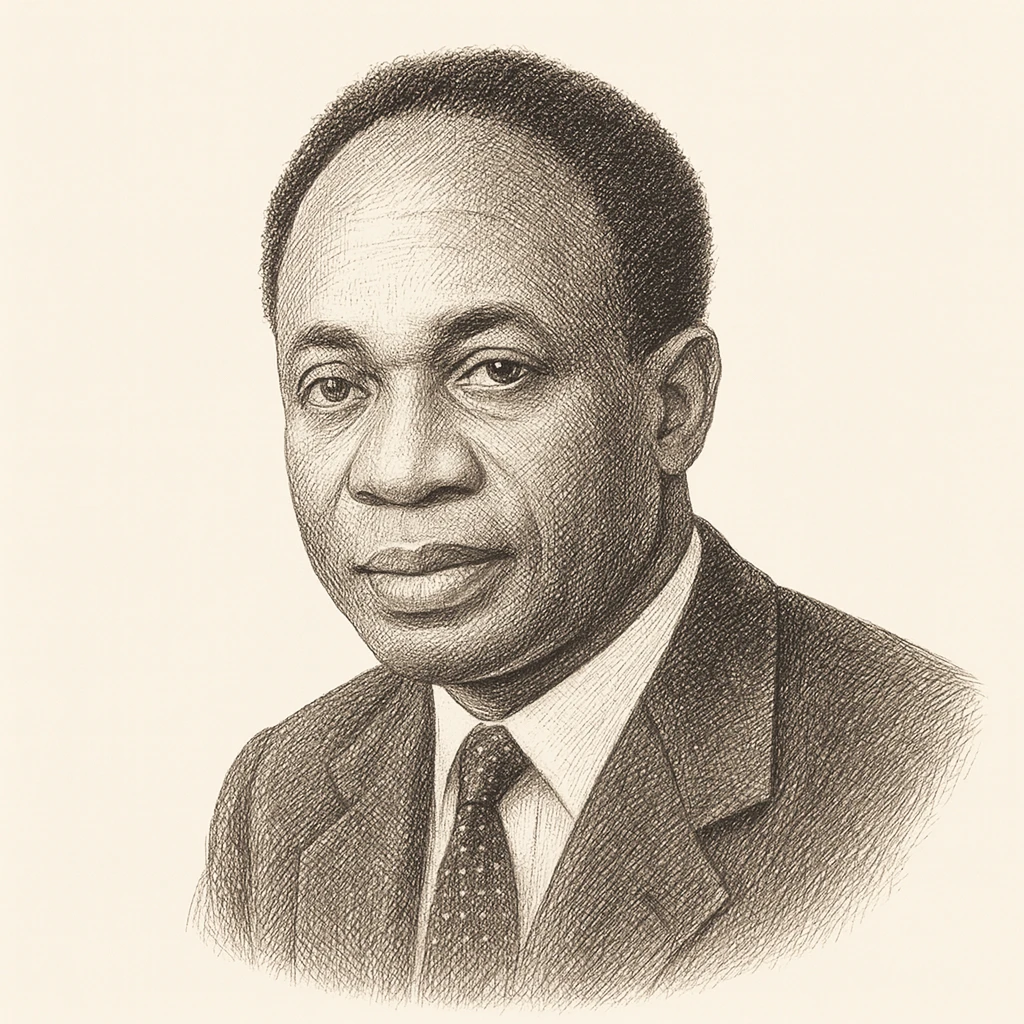
Kwame Nkrumah led the Gold Coast to independence in 1957 as Ghana, becoming the first head of a sub-Saharan African state to break from colonial rule. His political thought fused nationalism, socialism, and pan-Africanism into a program he presented as a coherent response to European domination. He argued that formal independence was hollow without economic sovereignty and continental solidarity, and that fragmented African states remained vulnerable to outside control. His slogan urging Africans to seek first the political kingdom captured his conviction that state power was the precondition for every other transformation.
Nkrumah's most enduring contribution to political theory is his account of neo-colonialism: the idea that former colonies could be nominally sovereign yet economically dominated through foreign capital, trade dependence, and multinational influence, leaving them subject to control without accountability. He also championed continental federation, arguing that only a politically united Africa could resist this domination, and he pushed the vision at the founding of the Organization of African Unity. He developed a doctrine he called Consciencism, an attempt to synthesize African communal traditions with socialist and other imported currents into a philosophy for decolonized societies.
In power, Nkrumah pursued rapid state-led industrialization and ambitious public projects, but his record is seriously contested. He moved Ghana toward a one-party state, imprisoned opponents under preventive-detention laws, and cultivated a personality cult, drawing lasting criticism that his socialism slid into authoritarianism and that his development schemes strained the economy. He was overthrown in a military coup in 1966 while abroad and spent his final years in exile.
Despite the collapse of his government, Nkrumah's ideas outlived his rule. His writings on neo-colonialism and African unity became foundational texts for later generations of anti-imperialist and left-nationalist thinkers, and his name is paired with figures like Patrice Lumumba and Thomas Sankara as an emblem of independence-era radicalism. He remains a defining reference point for debates about sovereignty, development, and what genuine liberation requires beyond the lowering of a colonial flag.
Kwame Nkrumah is associated with Left Nationalist. See the archetype