
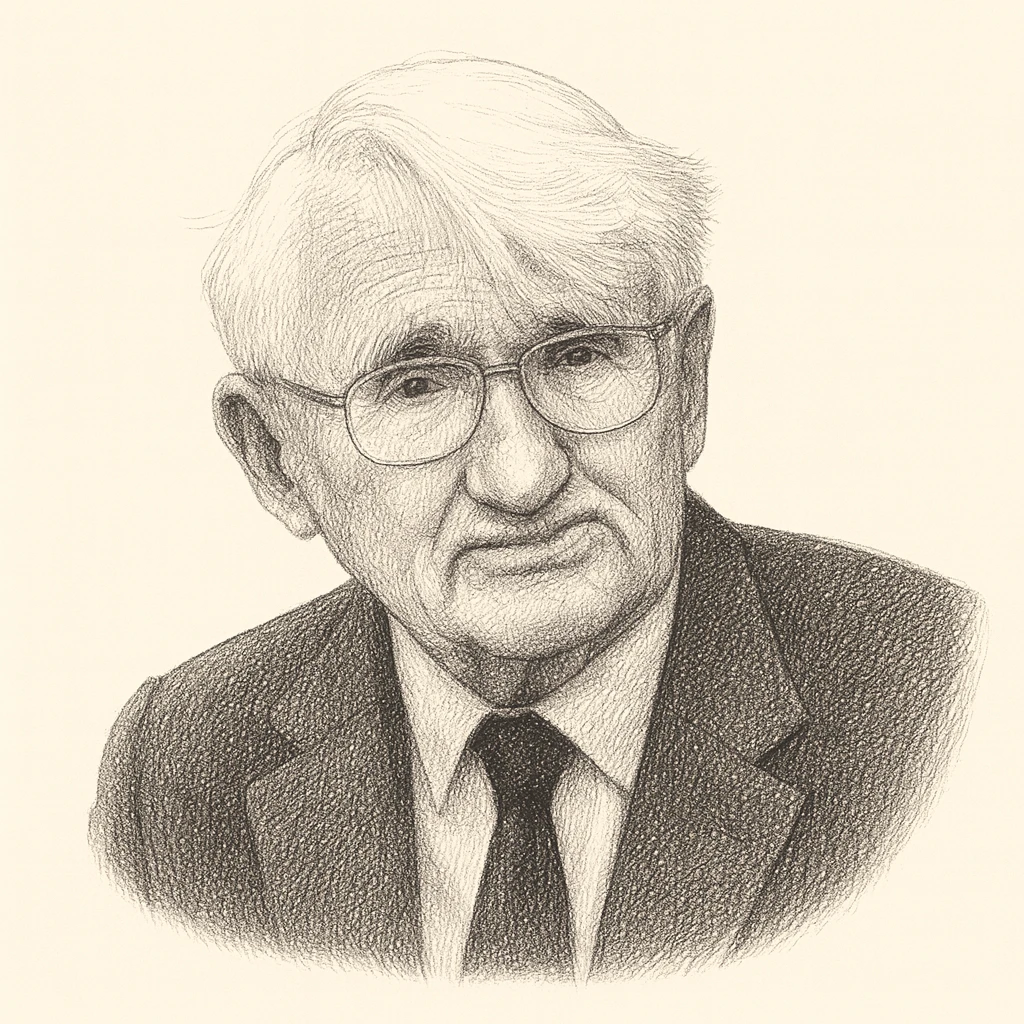
Jürgen Habermas is the most important living representative of the Frankfurt School tradition of critical theory and one of the most influential political philosophers of the late 20th and early 21st centuries. Across more than sixty years of prolific writing, he has developed a distinctive framework for thinking about the conditions under which democratic politics can function legitimately, the relationship between communication and social integration, the challenges facing liberal democracy in an era of moral and religious pluralism, and the possibilities for a European political community that transcends the nation-state. His work bridges the gap between continental critical theory and Anglo-American analytical philosophy in ways that few other contemporary philosophers have managed, and his influence on contemporary debates about deliberative democracy, public reason, and the moral foundations of political community is difficult to overstate.
Habermas was born in 1929 in Düsseldorf, and his earliest political memories were of the Nazi period and its aftermath. As a child he was enrolled in the Hitler Youth; as an adolescent he watched the collapse of the Nazi regime and the slow recognition among his fellow Germans of what the regime had actually done. These experiences shaped his entire subsequent political philosophy. He came to see the central question of postwar German intellectual life as how a political culture that had produced Auschwitz could develop the moral and institutional resources to become democratic in more than name, and he has returned to this question throughout his career in various forms. His commitment to democratic deliberation, to public reason, and to the possibility of rational consensus across deep disagreement has always been rooted in the recognition that the alternative is not mere political dysfunction but something like what Germany had experienced in his childhood.
Habermas studied philosophy at Göttingen, Zurich, and Bonn, and in the 1950s became an assistant to Theodor Adorno at the Institute for Social Research in Frankfurt, which had been the institutional home of the Frankfurt School since the 1920s. He absorbed the Frankfurt School's tradition of critical theory — the combination of Marxist social analysis, Weberian sociology, psychoanalysis, and philosophical critique of Enlightenment rationality — but he eventually broke with some of its central pessimistic commitments. Where Horkheimer and Adorno had concluded in Dialectic of Enlightenment (1944) that Enlightenment rationality itself was inextricably linked to domination and that critical theory's task was to resist this trajectory without being able to offer any positive alternative, Habermas argued that Enlightenment rationality had genuine emancipatory dimensions that could be recovered and defended. His entire mature project can be read as an attempt to rescue the Enlightenment's rational and democratic commitments from both the pessimism of the early Frankfurt School and the postmodern skepticism that was beginning to gain ground in the 1960s and 1970s.
Habermas's most important theoretical work was The Theory of Communicative Action (1981), a two-volume work that developed his distinctive philosophical framework. The core idea was that human beings engage in two fundamentally different kinds of action — strategic action, in which they treat other people as means to their own ends, and communicative action, in which they engage with others as equals seeking mutual understanding through argument. Communicative action, Habermas argued, has its own internal rationality grounded in what he called "the ideal speech situation" — conditions under which participants have equal opportunity to speak, where the only force recognized is the force of the better argument, and where the goal is genuine mutual understanding rather than strategic manipulation. Real human communication rarely achieves these ideal conditions, but the ideal is implicit in the very structure of communicative action itself, and it provides a standard against which actual discourse can be evaluated and criticized.
This framework had important political implications. Democratic politics, Habermas argued, was best understood not as a procedure for aggregating pre-existing preferences (as in much liberal democratic theory) but as a process of genuine deliberation in which citizens engaged with each other as communicative partners trying to reach rational consensus on collective questions. Legitimate political decisions were those that could be justified through public reasoning that all affected parties could in principle accept, and the task of democratic political institutions was to create conditions under which such deliberation could actually take place. This vision of deliberative democracy has been one of the most influential frameworks in contemporary political philosophy, shaping debates about democratic theory, public reason, the role of religion in political life, and the institutional design of democratic governance.
Habermas's other major political contribution was his work on the public sphere. His early book The Structural Transformation of the Public Sphere (1962) argued that the emergence of bourgeois democracy in the 18th century had depended on the development of a new kind of social space — coffee houses, salons, journals, newspapers — in which private citizens could engage in public debate about matters of common concern without being constrained by state or market logics. This "public sphere" had been the crucial institutional precondition for democratic politics, but it had been increasingly eroded by the commercialization of media, the rise of mass politics, and the expansion of both state administration and corporate power into what had once been autonomous public space. The book became enormously influential in media studies, political theory, and the analysis of contemporary democracy, and Habermas has returned to these themes throughout his career, including in his recent writing about the challenges posed to democratic deliberation by digital media and social platforms.
In the later decades of his career, Habermas has written extensively on European political integration, on the challenges posed to liberal democracy by religious pluralism, on the philosophical foundations of human rights, and on the need for a "postnational constellation" in which democratic politics extends beyond the nation-state to encompass transnational institutions and cosmopolitan frameworks. His debates with Joseph Ratzinger (later Pope Benedict XVI) about the relationship between religion and reason in democratic politics became particularly influential in shaping contemporary discussions about the role of religious traditions in liberal democratic public life. His advocacy for the European Union has made him one of the most visible public intellectuals in contemporary Europe.
Habermas continues to write and publish into his nineties, remaining one of the most productive and influential philosophers of his generation. His framework continues to shape contemporary political philosophy, and his distinctive combination of rigorous theoretical work with sustained engagement in public political debate has made him a model of what serious public intellectual life can look like in contemporary democratic societies.
Jürgen Habermas is associated with Social Liberal. See the archetype