
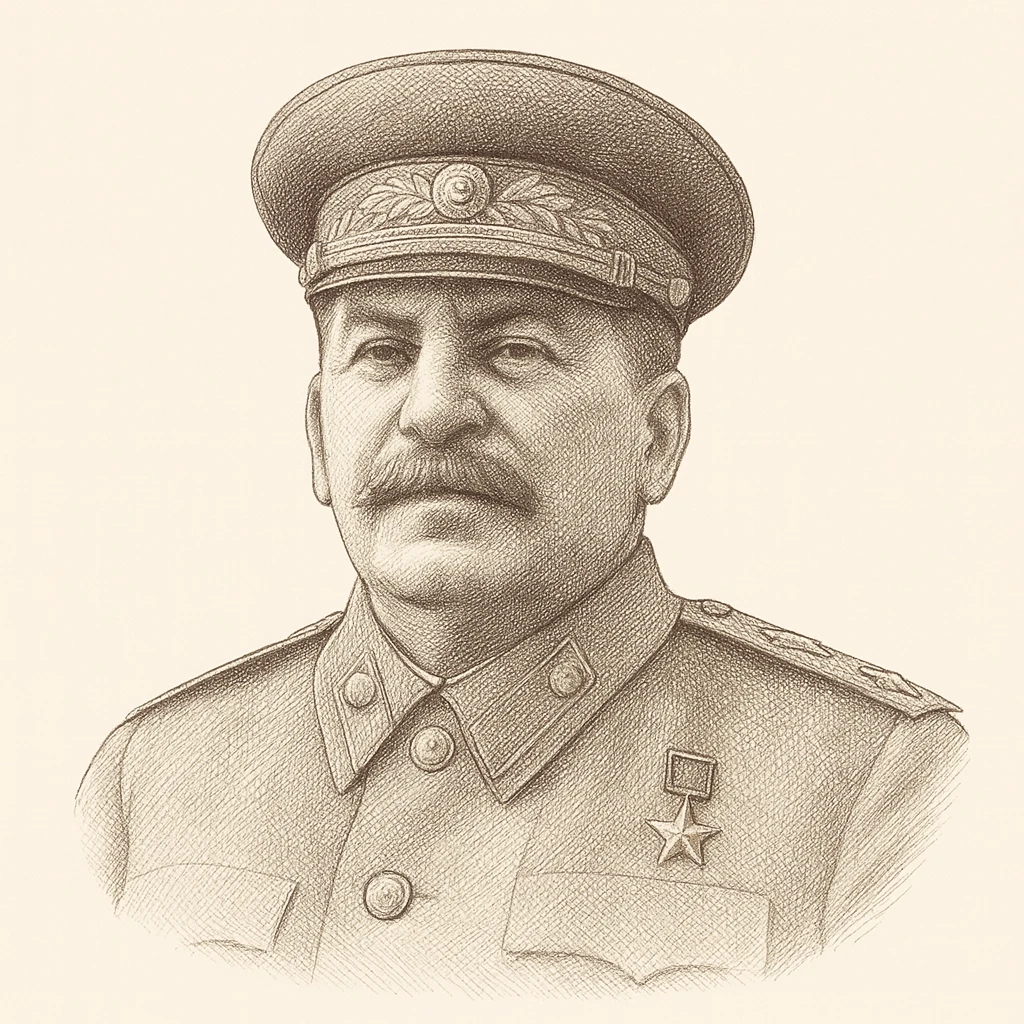
Joseph Stalin ruled the Soviet Union from the late 1920s until his death, and under him it was transformed from a largely agrarian country into an industrial superpower through forced collectivization, mass executions, and forced labor. Born Ioseb Jughashvili in Georgia, he became a Bolshevik revolutionary, organizing bank robberies to fund the party. After Lenin's death in 1924, Stalin outmaneuvered rivals to seize absolute power.
Stalin's ascent was as much doctrinal as tactical. Against Trotsky's insistence on "permanent revolution," the claim that socialism could not survive in one country without revolution abroad, Stalin advanced "socialism in one country," arguing that the USSR could build a socialist society within its own borders. He codified Lenin's thought as "Marxism-Leninism," presenting himself as its faithful interpreter while using his control of the party apparatus as General Secretary to crush dissent.
Stalin's forced collectivization of agriculture caused the Ukrainian Holodomor famine, killing millions. His Five-Year Plans achieved rapid industrialization, drawing in part on Gulag labor. The Great Purge of 1936-38 eliminated perceived enemies through show trials, executions (at least 680,000 in 1937-38 alone), and the Gulag system, a vast network of forced labor camps that processed millions. The terror was justified by his doctrine that class struggle intensifies as socialism advances, an argument that presented widening repression as ideologically necessary. Around him grew a pervasive cult of personality.
Despite the Nazi-Soviet Pact, Hitler invaded in 1941. The Soviet Union lost an estimated 27 million soldiers and civilians, and the Red Army ultimately broke the Wehrmacht on the Eastern Front. Victory in World War II made Stalin master of Eastern Europe and established the Soviet Union as a superpower, exporting his model of one-party rule, central planning, and state terror across the Soviet bloc.
His death in 1953 ended a dictatorship estimated to be responsible for 6-20 million deaths. In 1956 his successor Nikita Khrushchev denounced the cult of personality and the purges, launching "de-Stalinization." "Stalinism" came to name the system he built: one-party rule, a command economy, a leader cult, and mass repression.
Joseph Stalin is associated with Vanguard Collectivist. See the archetype