
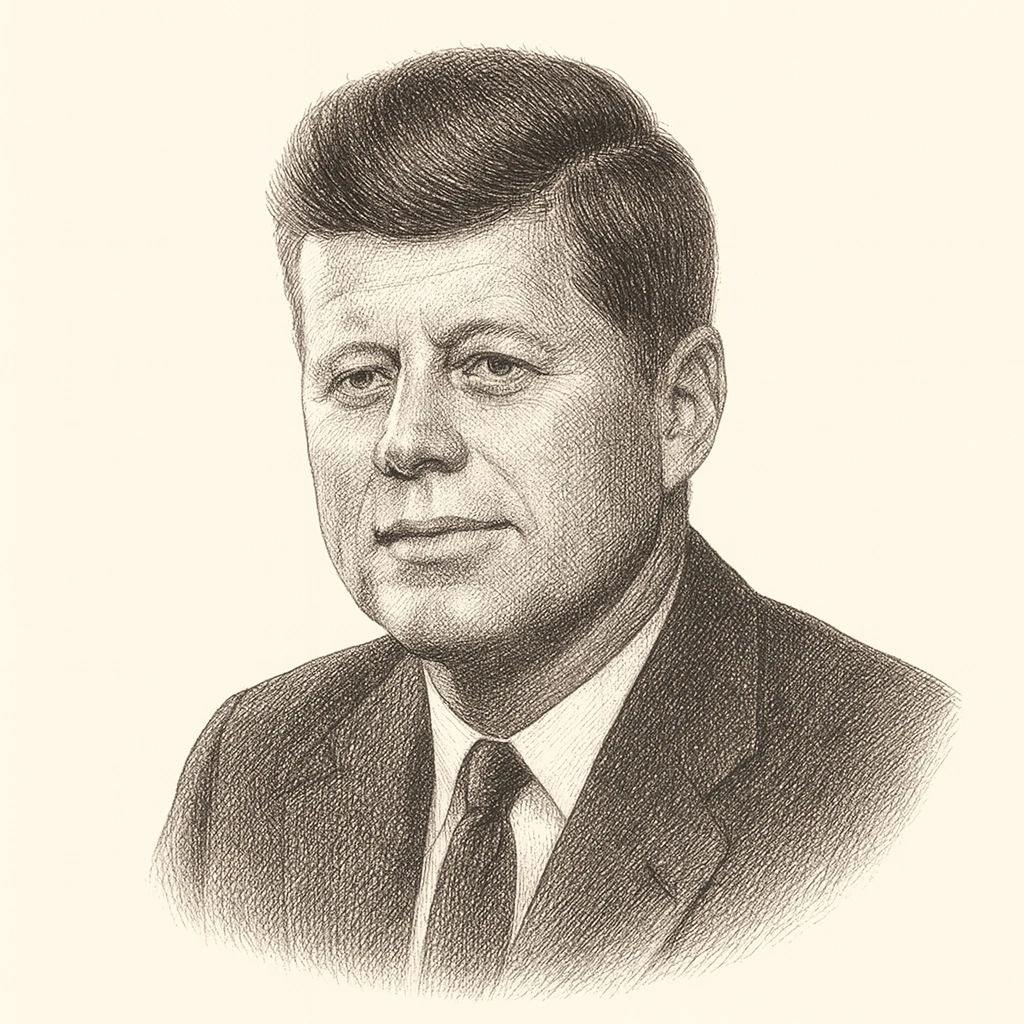
John Fitzgerald Kennedy was the 35th President of the United States, whose assassination after less than three years in office made him a lasting symbol of idealism and unfulfilled promise in American public memory. Born to wealth and political ambition, JFK served in the Navy in World War II, where he was decorated for his conduct after his patrol boat, PT-109, was sunk, then represented Massachusetts in Congress before winning the presidency in 1960 as the youngest elected president and first Catholic. His narrow victory over Richard Nixon followed a series of televised debates.
Kennedy paired expansive rhetoric with pragmatic politics. His inaugural call to 'ask not what your country can do for you—ask what you can do for your country' framed public service as a civic obligation, while his pledge to 'pay any price, bear any burden' cast the contest with communism as a worldwide commitment to defend liberty. He called his program the 'New Frontier,' establishing the Peace Corps and committing America to reaching the moon. In the Cuban Missile Crisis of October 1962, perhaps the closest the world came to nuclear war, he imposed a naval quarantine of Cuba, and the Soviet Union removed its missiles in exchange for a US pledge not to invade the island.
Kennedy's domestic record was more cautious than his oratory. He was slow to embrace civil rights, wary of alienating Southern Democrats, and proposed comprehensive civil rights legislation only in June 1963, after the Birmingham campaign and the confrontation over desegregating the University of Alabama. To stimulate the economy he sought lower taxes, expecting a lasting boom; his proposed tax cuts, paired with a substantial military buildup, anticipated policies later associated with conservative economics.
His assassination in Dallas on November 22, 1963, cut short a presidency whose ultimate direction was never settled: more than 16,000 American military advisers were then in South Vietnam, and his civil rights and tax bills had not passed Congress. His successor, Lyndon Johnson, pressed Congress to pass Kennedy's tax cut and civil rights bill, which became the Civil Rights Act of 1964, and escalated the war in Vietnam. His image of youth, vigor, and public service has held a lasting place in the American imagination.
John F. Kennedy is associated with Moderate Liberal. See the archetype